TEKS ELAR 7.8.D
The Standard
analyze characteristics and structural elements of informational text, including: the controlling idea or thesis with supporting evidence, features such as references or acknowledgements, and organizational patterns that support multiple topics, categories, and subcategories
Texas Essential Knowledge and Skills for English Language Arts and Reading · Multiple genres: listening, speaking, reading, writing, and thinking using multiple texts
Teacher's field guide
What This Standard Means
What Students Need to Do
- Students identify an informational text’s controlling idea or thesis and connect it to relevant evidence. They trace how headings, sections, categories, and subcategories organize several related topics. They explain how references and acknowledgments help readers identify sources and contributors.
What Mastery Looks Like
- A student states the controlling idea or thesis in their own words and selects evidence that directly supports it. The student maps headings and subheadings to show how topics, categories, and subcategories fit together. The student explains what references and acknowledgments reveal about sources and contributors.
Common Misconceptions
- Students often name the broad topic instead of stating the author’s main point. They may list interesting facts as evidence without showing what each fact supports. They may overlook references and acknowledgments or miss how headings show categories and subcategories.
How to Assess It
- Give students a one-page article with headings, two subheadings, and a short reference list. Ask them to state the main point, cite two supporting details, sketch the section hierarchy, and explain one reference’s purpose.
Lesson moves
Ways to Teach It
Cut up an article into thesis, evidence, headings, and reference sections, then have groups rebuild its topic and subtopic structure.
Discuss: Which section best supports the author’s main point, and how do its evidence and placement make that support clear?
Play Evidence Match: teams pair evidence cards with claims, then place each pair under the correct category and subcategory headings.
Compare a news site’s sections and source links to see how readers locate topics, verify evidence, and judge credibility.
Free download
Printable 7.8.D Worksheet
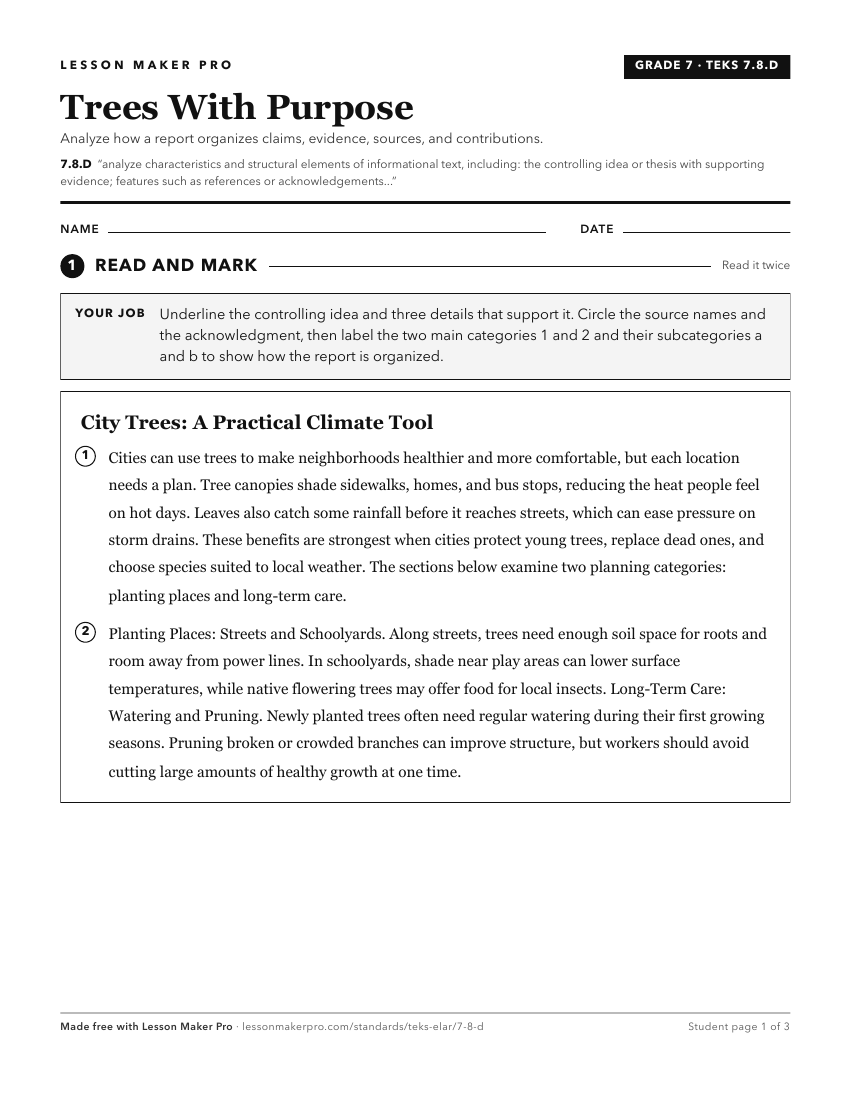
A ready-to-print activity worksheet aligned to 7.8.D, with an answer key for the teacher on its own page. No account needed.
PDF, US Letter, prints cleanly in black and white.
Download the worksheetKeep exploring
Related Standards
- 6.11.B
compose informational texts, including multi-paragraph essays that convey information about a topic, using a clear controlling idea or thesis statement and genr...
- 8.11.B
compose informational texts, including multi-paragraph essays that convey information about a topic, using a clear controlling idea or thesis statement and genr...
- 7.11.B
compose informational texts, including multi-paragraph essays that convey information about a topic, using a clear controlling idea or thesis statement and genr...
- 7.8.E
analyze characteristics and structures of argumentative text by: identifying the claim, explaining how the author uses various types of evidence and considerati...
Turn this exact standard into a lesson
Grade, subject, topic, and the complete standard are prefilled. Create one free, no account needed.
Also for this standard:Make a WorksheetMake a QuizMake a Sub Lesson