TEKS ELAR 4.11.D.v
The Standard
adverbs that convey frequency and adverbs that convey degree
Texas Essential Knowledge and Skills for English Language Arts and Reading · The student uses the writing process recursively to compose multiple texts that are legible and uses appropriate conventions.
Teacher's field guide
What This Standard Means
What Students Need to Do
- Students find adverbs of frequency, such as always, often, and rarely, and adverbs of degree, such as very, almost, and too. They edit drafts so each adverb clearly changes the meaning of a verb, adjective, or another adverb.
What Mastery Looks Like
- A student can revise “I visit the library” to show how often the visit happens. The student can adjust “The soup is hot” with words such as slightly, very, or too, then explain the change in meaning.
Common Misconceptions
- Students may call every describing word an adjective, even when it modifies a verb or adjective. They may confuse frequency with degree, or assume words such as very can modify any verb. They may place an adverb where its meaning is unclear.
How to Assess It
- Give students: “Maya reads before bed. The puzzle was difficult.” Ask them to add one frequency adverb and one degree adverb, then label each and explain its effect.
Lesson moves
Ways to Teach It
Give pairs sentence strips and adverb cards. Students place each card where it fits, then sort it under frequency or degree.
Ask students to compare “I sometimes practice” and “I always practice,” then write how the adverb changes the reader’s understanding.
Play Adverb Swap. Teams replace a highlighted adverb in a draft sentence and earn a point for preserving clear grammar.
Have students edit a school announcement by adding adverbs that show how often events happen and how strongly conditions apply.
Free download
Printable 4.11.D.v Worksheet
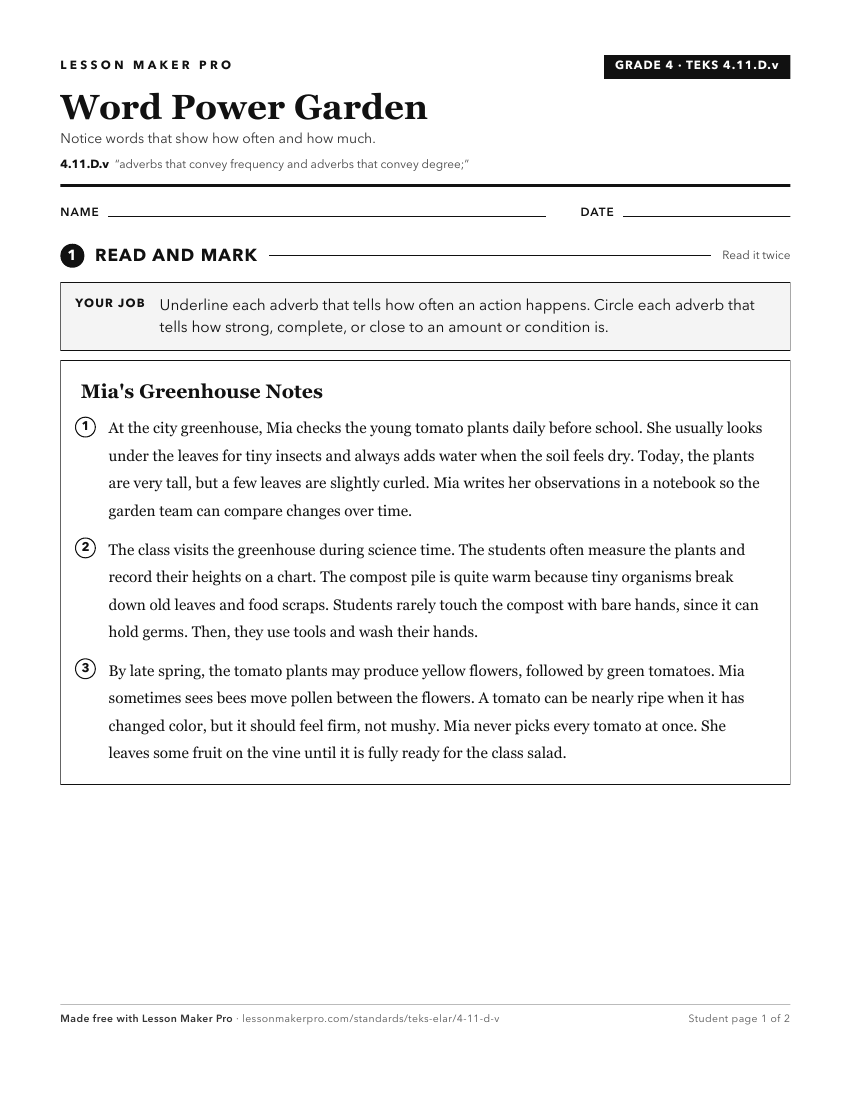
A ready-to-print activity worksheet aligned to 4.11.D.v, with an answer key for the teacher on its own page. No account needed.
PDF, US Letter, prints cleanly in black and white.
Download the worksheetKeep exploring
Related Standards
Turn this exact standard into a lesson
Grade, subject, topic, and the complete standard are prefilled. Create one free, no account needed.
Also for this standard:Make a WorksheetMake a QuizMake a Sub Lesson