TEKS ELAR 2.8.C
The Standard
describe and understand plot elements, including the main events, the conflict, and the resolution, for texts read aloud and independently
Texas Essential Knowledge and Skills for English Language Arts and Reading
Teacher's field guide
What This Standard Means
What Students Need to Do
- Students retell a story by choosing the events that move it forward. They explain what problem the characters face and how that problem is settled.
What Mastery Looks Like
- A student can put key events in order and leave out minor details. The student can clearly name the story's problem and connect its solution to what happened earlier.
Common Misconceptions
- Students may retell every detail instead of selecting events that move the story forward. They may name a character's feeling as the problem or assume the final event always solves it.
How to Assess It
- After reading "The Lion and the Mouse," ask students to write three important events, the characters' problem, and how the problem is settled.
Lesson moves
Ways to Teach It
Give pairs five event cards from a familiar story to sequence, then label the problem and how it gets solved.
Ask, "Which event changes the story most, and how does it lead to the ending?"
Play Plot Sort: students place details under important event, character problem, or solution, then defend one choice.
Have students describe a playground problem, list what happened, and explain how the people involved resolved it.
Free download
Printable 2.8.C Worksheet
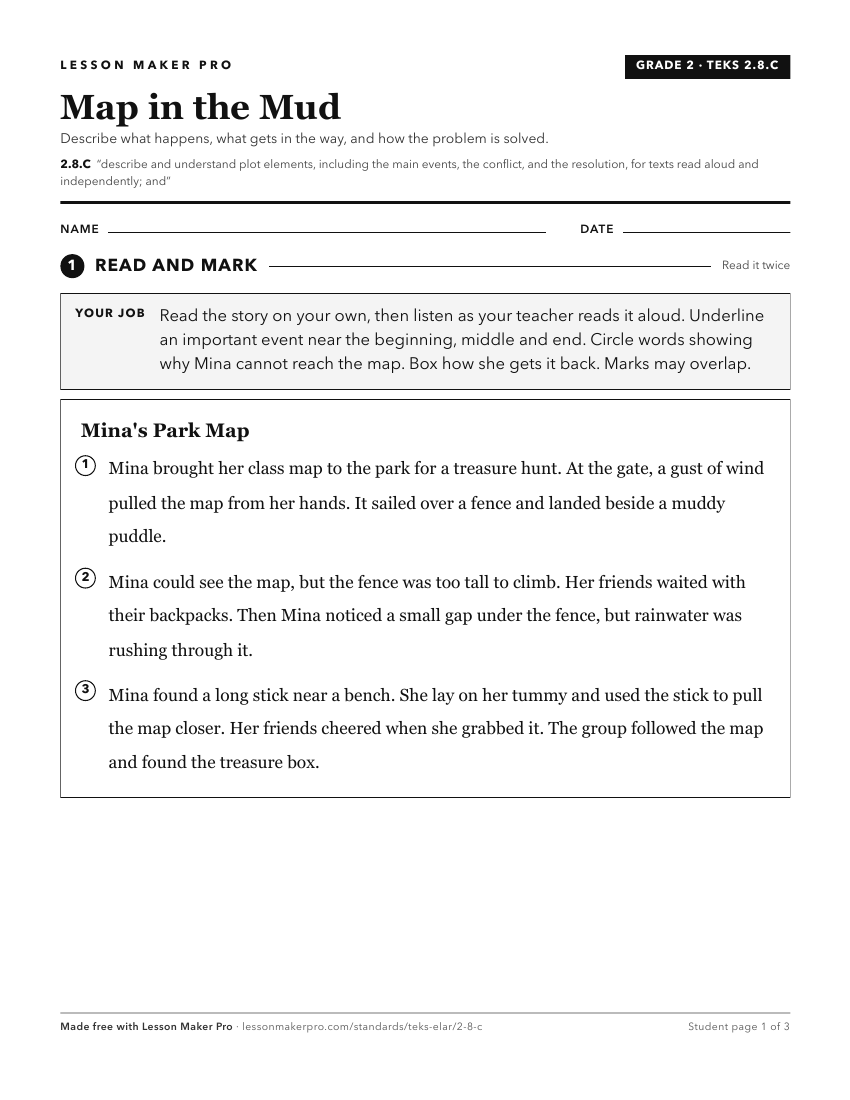
A ready-to-print activity worksheet aligned to 2.8.C, with an answer key for the teacher on its own page. No account needed.
PDF, US Letter, prints cleanly in black and white.
Download the worksheetKeep exploring
Related Standards
- 5.8.C
analyze plot elements, including rising action, climax, falling action, and resolution; and
- 1.8.C
describe plot elements, including the main events, the problem, and the resolution, for texts read aloud and independently; and
- K.7.C
describe the elements of plot development, including the main events, the problem, and the resolution for texts read aloud with adult assistance; and
- 3.8.C
analyze plot elements, including the sequence of events, the conflict, and the resolution; and
Turn this exact standard into a lesson
Grade, subject, topic, and the complete standard are prefilled. Create one free, no account needed.
Also for this standard:Make a WorksheetMake a QuizMake a Sub Lesson