TEKS ELAR 5.8.C
The Standard
analyze plot elements, including rising action, climax, falling action, and resolution
Texas Essential Knowledge and Skills for English Language Arts and Reading
Teacher's field guide
What This Standard Means
What Students Need to Do
- Students track how a story's main events build tension, change the conflict, and lead to an ending. They explain each event's role using details from the text.
What Mastery Looks Like
- Students place key events correctly on a plot diagram and explain how one event leads to another. They identify the turning point and show how later events address the main conflict.
Common Misconceptions
- Students may label the most exciting event as the turning point even when it does not change the conflict. They may also treat the ending and the conflict's solution as the same event.
How to Assess It
- Give students a short story and ask them to label four key stages on a plot diagram. For each label, require one sentence explaining its role.
Lesson moves
Ways to Teach It
Give groups event cards from a familiar story to arrange on a floor-sized plot mountain, then justify each card's placement.
Ask students to write: Which event changes the conflict most, and what happens because of it?
Play Plot Sort by having teams place short event summaries under build-up, turning point, aftermath, or ending headings.
Map the events of a school competition or sports game, showing the build-up, decisive moment, immediate results, and final outcome.
Free download
Printable 5.8.C Worksheet
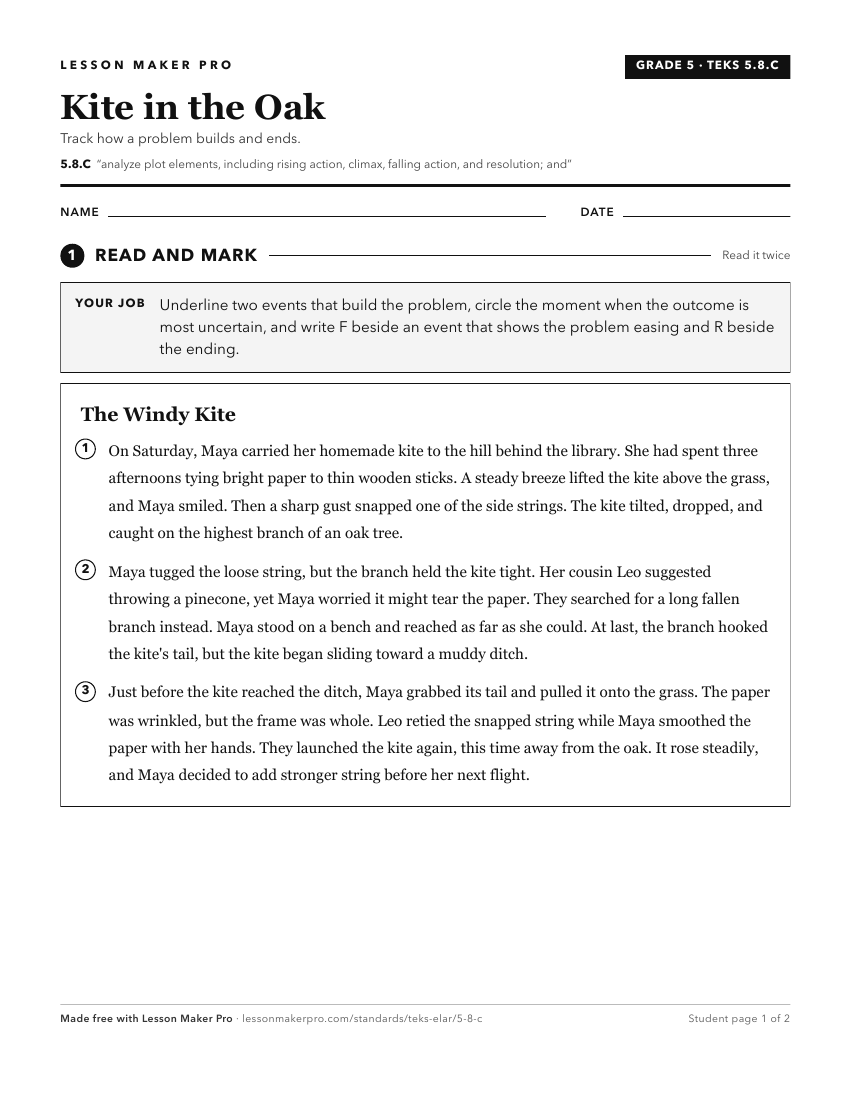
A ready-to-print activity worksheet aligned to 5.8.C, with an answer key for the teacher on its own page. No account needed.
PDF, US Letter, prints cleanly in black and white.
Download the worksheetKeep exploring
Related Standards
- 6.7.C
analyze plot elements, including rising action, climax, falling action, resolution, and non-linear elements such as flashback; and
- 1.8.C
describe plot elements, including the main events, the problem, and the resolution, for texts read aloud and independently; and
- 4.8.C
analyze plot elements, including the rising action, climax, falling action, and resolution; and
- 3.8.C
analyze plot elements, including the sequence of events, the conflict, and the resolution; and
Turn this exact standard into a lesson
Grade, subject, topic, and the complete standard are prefilled. Create one free, no account needed.
Also for this standard:Make a WorksheetMake a QuizMake a Sub Lesson