TEKS ELAR 6.7.C
The Standard
analyze plot elements, including rising action, climax, falling action, resolution, and non-linear elements such as flashback
Texas Essential Knowledge and Skills for English Language Arts and Reading
Teacher's field guide
What This Standard Means
What Students Need to Do
- Students trace how events build a conflict, reach a turning point, and move toward an outcome. They explain how flashbacks interrupt time order and shape the reader’s understanding.
What Mastery Looks Like
- Students can label each major part of a story’s plot and support each choice with text evidence. They can explain why the climax is the turning point and how a flashback affects the conflict, character, or suspense.
Common Misconceptions
- Students may choose the most exciting scene as the climax, even when the conflict does not change there. They may confuse falling action with resolution or treat a flashback as ordinary background information.
How to Assess It
- Give students a short passage with a flashback. Ask them to identify the climax and flashback, cite evidence, and explain how the flashback changes their understanding.
Lesson moves
Ways to Teach It
Print story events on cards; pairs arrange them by time, then by story order, and mark where the conflict changes.
After reading a short story, ask, "Which event changes the conflict, and what evidence rules out another scene as the climax?"
Teams place event cards on a blank plot mountain, earning a point only when they justify each placement with text evidence.
Students map a television episode’s conflict and flashback on two timelines, then explain why information appears out of order.
Free download
Printable 6.7.C Worksheet
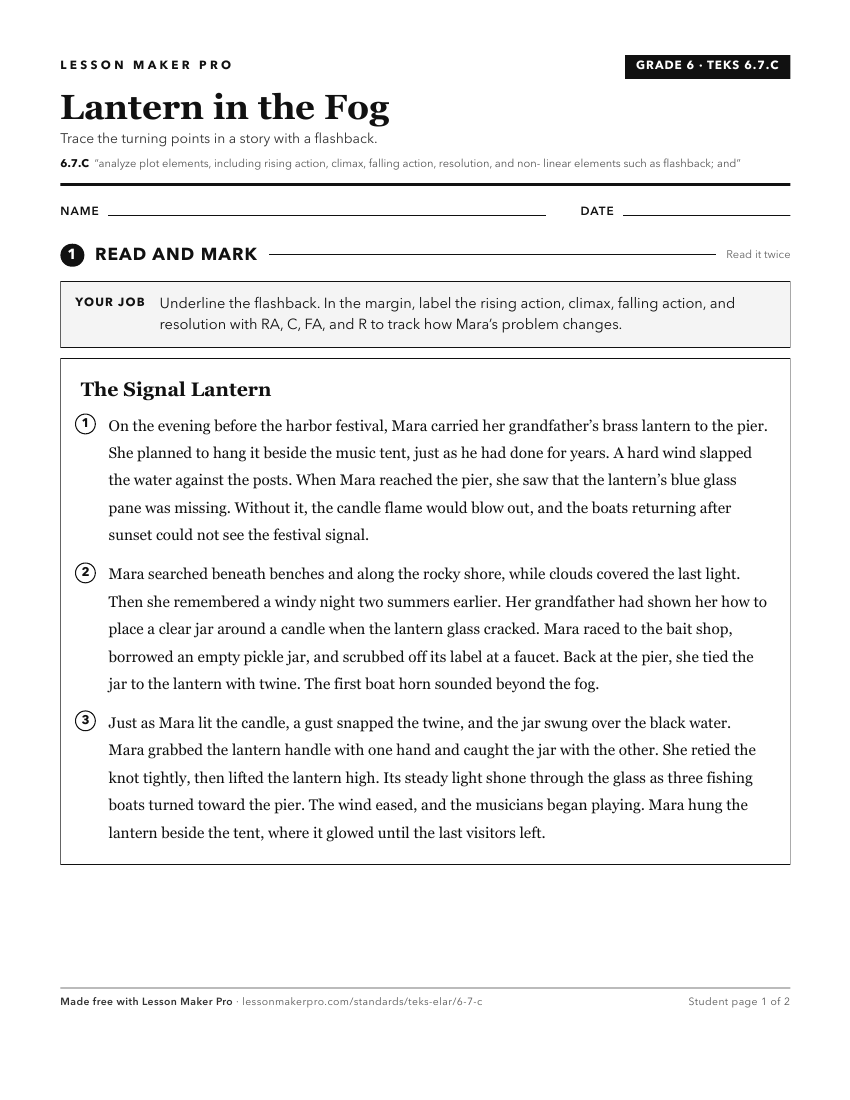
A ready-to-print activity worksheet aligned to 6.7.C, with an answer key for the teacher on its own page. No account needed.
PDF, US Letter, prints cleanly in black and white.
Download the worksheetKeep exploring
Related Standards
- 5.8.C
analyze plot elements, including rising action, climax, falling action, and resolution; and
- 8.7.C
analyze non-linear plot development such as flashbacks, foreshadowing, subplots, and parallel plot structures and compare it to linear plot development; and
- 4.8.C
analyze plot elements, including the rising action, climax, falling action, and resolution; and
- 3.8.C
analyze plot elements, including the sequence of events, the conflict, and the resolution; and
Turn this exact standard into a lesson
Grade, subject, topic, and the complete standard are prefilled. Create one free, no account needed.
Also for this standard:Make a WorksheetMake a QuizMake a Sub Lesson