TEKS ELAR 1.3.D
The Standard
identify and use words that name actions, directions, positions, sequences, categories, and locations.
Texas Essential Knowledge and Skills for English Language Arts and Reading
Teacher's field guide
What This Standard Means
What Students Need to Do
- Students learn words that tell what someone does, where something is, which way to move, and what comes next. They also use words for groups and places in speech and writing.
What Mastery Looks Like
- A student can select a word that fits a picture, command, or sentence. They correctly use words such as skip, right, behind, next, clothing, and library when speaking or writing.
Common Misconceptions
- Students may mix up left and right, above and below, or before and after. They may name an example, such as apple, when asked for a group word, such as fruit. They may recognize a word in a picture but not use it in their own sentence.
How to Assess It
- Use each word once: run, left, under, first, animal, park. Complete: I can __; Turn __; The cat is __ the table; __, wash your hands; A dog is an __; We play at the __.
Lesson moves
Ways to Teach It
Set up a toy figure and blocks, then have students give commands using words such as jump, left, over, behind, and beside.
Show three picture cards and ask, “What happens first, next, and last?” Students say or write the sequence.
Play Vocabulary Sort with word cards and labeled mats for actions, directions, positions, order, groups, and places.
Have partners explain the route from the classroom door to their seats using turn, straight, past, beside, and under.
Free download
Printable 1.3.D Worksheet
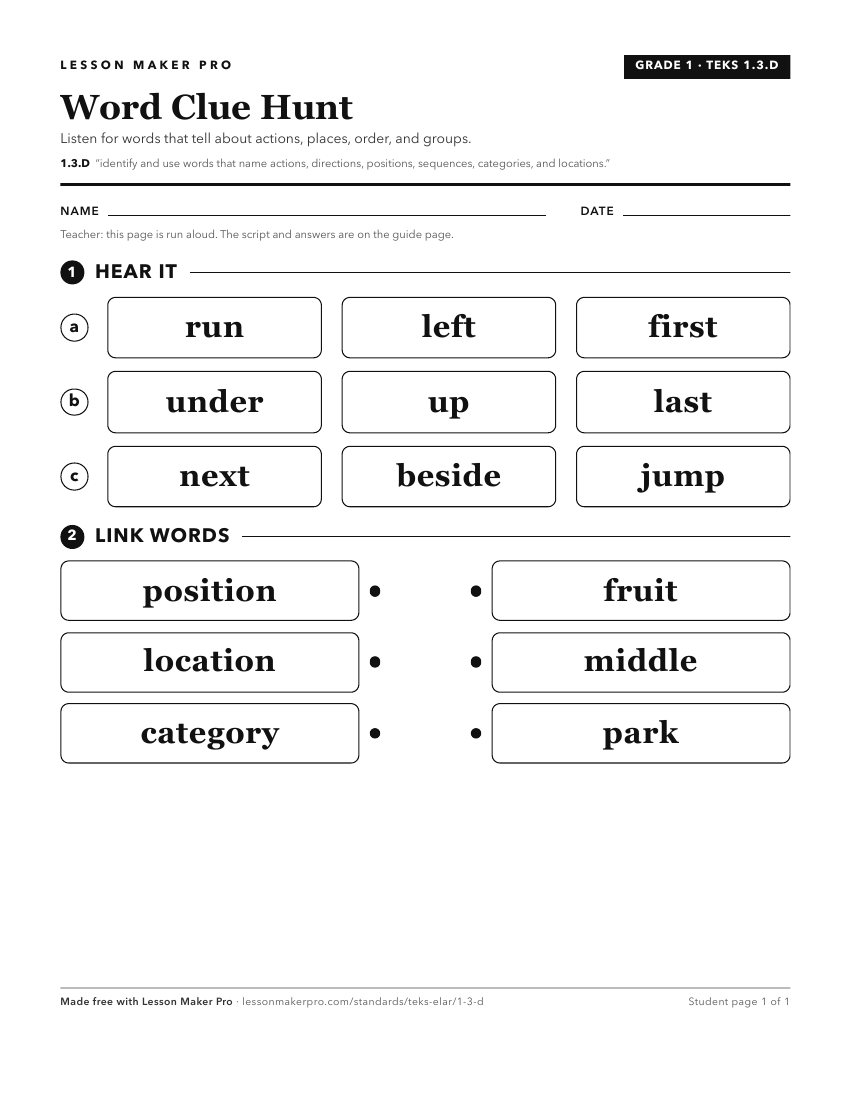
A ready-to-print activity worksheet aligned to 1.3.D, with an answer key for the teacher on its own page. No account needed.
PDF, US Letter, prints cleanly in black and white.
Download the worksheetKeep exploring
Related Standards
- K.3.C
identify and use words that name actions; directions; positions; sequences; categories such as colors, shapes, and textures; and locations.
- 3.3.C
identify the meaning of and use words with affixes such as im- into, non-, dis-, in- not, non, pre-, -ness, -y, and -ful; and
- 5.3.C
identify the meaning of and use words with affixes such as trans-, super-, -ive, and -logy and roots such as geo and photo; and
- 2.3.D
identify, use, and explain the meaning of antonyms, synonyms, idioms, and homographs in context.
Turn this exact standard into a lesson
Grade, subject, topic, and the complete standard are prefilled. Create one free, no account needed.
Also for this standard:Make a WorksheetMake a QuizMake a Sub Lesson