TEKS ELAR K.3.C
The Standard
identify and use words that name actions; directions; positions; sequences; categories such as colors, shapes, and textures; and locations.
Texas Essential Knowledge and Skills for English Language Arts and Reading
Teacher's field guide
What This Standard Means
What Students Need to Do
- Students learn precise words for movement, place, order, features, groups, and where things are found. They use those words to follow directions and explain actions or locations.
What Mastery Looks Like
- A student can follow a direction such as, “Put the smooth circle behind the box, then clap.” The student can explain what happened using accurate words such as behind, smooth, first, and clap.
Common Misconceptions
- Students may mix up pairs such as above and below, before and after, or push and pull. They may name an object instead of its action or use general words like there and stuff. Some treat color, shape, and texture as the same kind of description.
How to Assess It
- Give each child a toy animal, a box, and a rough red square, then say, “First make the animal hop behind the box, then place the square inside.” Ask the child to explain what happened using action, position, sequence, color, shape, and texture words.
Lesson moves
Ways to Teach It
Give pairs toy animals, blocks, and textured shapes, then have one child build a scene and describe each move to a partner.
Show a playground picture and ask, “What happened first, where is each child, and which words describe the equipment?”
Play Simon Says with commands such as turn left, crawl under, touch the blue circle, and clap after you jump.
Take a classroom scavenger walk, then have children name an object’s color, shape, or texture and tell where it belongs.
Free download
Printable K.3.C Worksheet
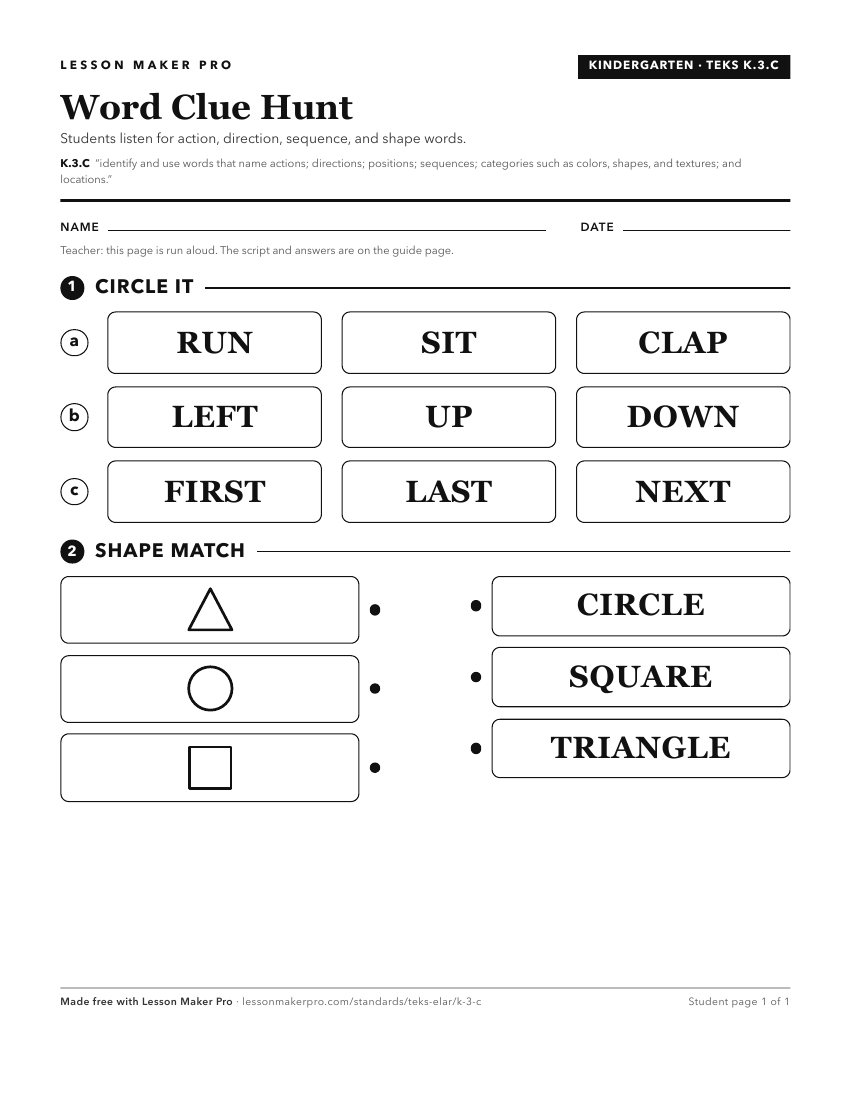
A ready-to-print activity worksheet aligned to K.3.C, with an answer key for the teacher on its own page. No account needed.
PDF, US Letter, prints cleanly in black and white.
Download the worksheetKeep exploring
Related Standards
- 1.3.D
identify and use words that name actions, directions, positions, sequences, categories, and locations.
- K.3.A
use a resource such as a picture dictionary or digital resource to find words;
- 1.3.A
use a resource such as a picture dictionary or digital resource to find words;
- K.9.D
discuss with adult assistance how the author uses words that help the reader visualize; and
Turn this exact standard into a lesson
Grade, subject, topic, and the complete standard are prefilled. Create one free, no account needed.
Also for this standard:Make a WorksheetMake a QuizMake a Sub Lesson