TEKS ELAR 1.3.A
The Standard
use a resource such as a picture dictionary or digital resource to find words
Texas Essential Knowledge and Skills for English Language Arts and Reading
Teacher's field guide
What This Standard Means
What Students Need to Do
- Students locate a needed word in a picture dictionary or approved digital tool. They use pictures, first letters, and simple search features to confirm the word and its meaning.
What Mastery Looks Like
- A student can choose a suitable resource and locate a requested word with little help. The student checks the picture or meaning, then uses the word correctly when speaking or writing.
Common Misconceptions
- Students may choose a word based only on its picture without checking the entry. They may search by the wrong first letter or select the first digital result without confirming its meaning.
How to Assess It
- Give students a picture dictionary or approved word tool. Ask them to find “enormous,” explain it, and use it in a sentence.
Lesson moves
Ways to Teach It
Place object cards around the room, then have students find and label each object using a picture dictionary.
Ask students to find a stronger word for “big,” then explain which word best describes an elephant and why.
Play a word-finding relay where pairs draw a word card and locate the word in a book or approved digital tool.
Have students make a picture glossary for a new student, checking words for places such as cafeteria, library, and office.
Free download
Printable 1.3.A Worksheet
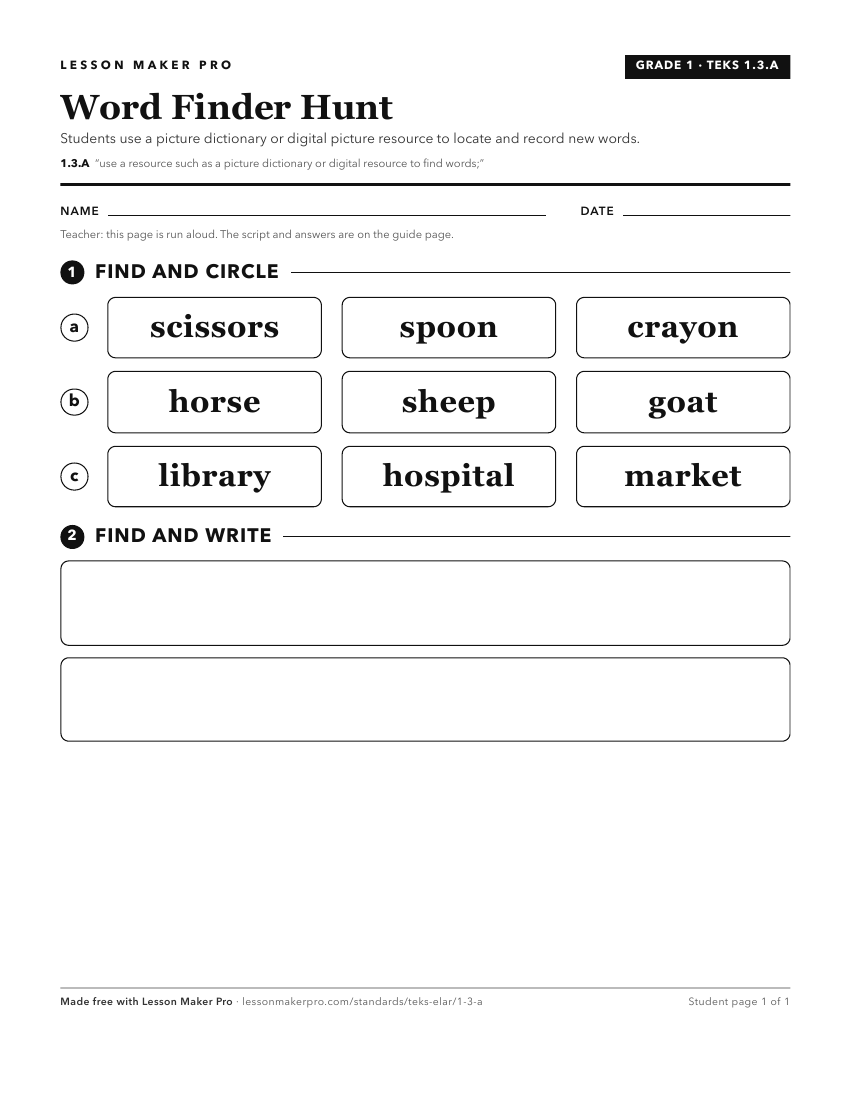
A ready-to-print activity worksheet aligned to 1.3.A, with an answer key for the teacher on its own page. No account needed.
PDF, US Letter, prints cleanly in black and white.
Download the worksheetKeep exploring
Related Standards
- 2.3.A
use print or digital resources to determine meaning and pronunciation of unknown words;
- K.3.A
The Kindergarten version of this standard.
- 5.3.A
use print or digital resources to determine meaning, syllabication, pronunciation, and word origin;
- 6.2.A
use print or digital resources to determine the meaning, syllabication, pronunciation, word origin, and part of speech;
Turn this exact standard into a lesson
Grade, subject, topic, and the complete standard are prefilled. Create one free, no account needed.
Also for this standard:Make a WorksheetMake a QuizMake a Sub Lesson