Oklahoma Social Studies USG.P.2.4
Standard Cluster
- USG.P.2
- Use interdisciplinary tools to acquire, apply, and evaluate content understanding of the four strands of social studies.
Identify the principles of economic systems and develop an understanding of the benefits of a market system in local, national, and global settings. Evaluate economic data from charts and graphs, noting trends and making predictions. Construct arguments using a combination of evidence regarding solutions used by nations to address historical or contemporary economic issues. Evaluate the impact, both intended and unintended, of government policies on market outcomes at national and global levels, past and present.
Oklahoma Academic Standards for Social Studies (2026) · USG.P.2
Cluster contents
Standards in This Cluster
USG.P.2.4 is a cluster heading. These are the individual standards under it.
- USG.P.2.4.A
Evaluate economic data from charts and graphs, noting trends and making predictions.
- USG.P.2.4.B
Construct arguments using a combination of evidence regarding solutions used by nations to address historical or contemporary economic issues.
- USG.P.2.4.C
Evaluate the impact, both intended and unintended, of government policies on market outcomes at national and global levels, past and present.
Teacher's field guide
What This Cluster Means
What Students Need to Do
- Students compare who decides what gets made in market, command, mixed, and traditional economies. They explain how prices and competition can benefit buyers and sellers. They read graphs, predict trends, and use evidence to argue how government policies affect people at home and abroad.
What Mastery Looks Like
- A student can explain how competition affects prices at a local store and how a government-set price changes sellers' choices. They cite graph values to predict a trend. They can argue how a tariff may help domestic producers while raising prices for buyers or changing trade abroad.
Common Misconceptions
- Students may assume market economies have no government rules or that a tariff benefits everyone in the country using it. They may treat one high point on a graph as a lasting upward trend.
How to Assess It
- Exit ticket: Show a line graph of imported-shoe prices at $8, $8, $11, and $12 across four months, with a tariff introduced before month three. Ask for a month-five prediction supported by two prices, one intended benefit, and one possible unintended cost of the tariff.
Lesson moves
Ways to Teach It
Give each pair a paper apple, a $2 seller cost, and a $3 buyer budget; compare trades before and after a $1 price cap.
Ask: Who gains and loses, here and abroad, from a shoe tariff? Use a chart of prices, imports, and factory jobs.
Sort cards showing a vendor setting prices, state quotas, family crop barter, and a regulated bank into market, command, traditional, and mixed economies.
Give students six months of national gas prices from EIA; graph them, predict month seven, and explain how a fuel tax might affect drivers.
Free download
Printable USG.P.2.4 Worksheet
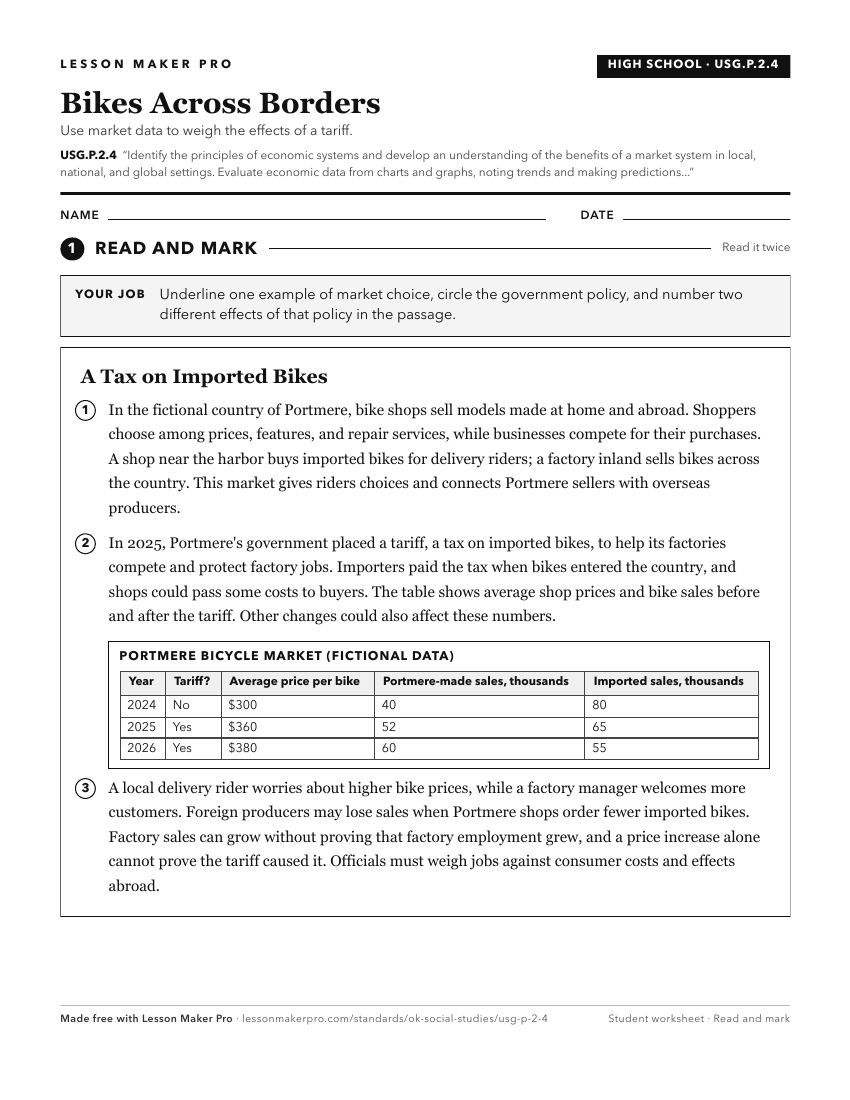
A ready-to-print activity worksheet aligned to USG.P.2.4, with an answer key for the teacher on its own page. No account needed.
PDF, US Letter, prints cleanly in black and white.
Download the worksheetKeep exploring
Related Standards
- WG.P.2.4
Identify the principles of economic systems and develop an understanding of the benefits of a market system in local, national, and global settings.
- 1.P.2.4
Identify the principles of economic systems and develop an understanding of the benefits of a market system in local, national, and global settings.
- AWH.P.2.4
Identify the principles of economic systems and develop an understanding of the benefits of a market system in local, national, and global settings.
- 3.P.2.4
Identify the principles of economic systems and develop an understanding of the benefits of a market system in local, national, and global settings.
Turn this cluster into a lesson
Grade, subject, topic, and the complete cluster are prefilled. Create one free, no account needed.
Also for this cluster:Make a WorksheetMake a QuizMake a Sub Lesson