Oklahoma Social Studies 3.P.2.4
Standard Cluster
- 3.P.2
- Use interdisciplinary tools to acquire, apply, and evaluate content understanding of the four strands of social studies.
Identify the principles of economic systems and develop an understanding of the benefits of a market system in local, national, and global settings. Gather basic economic data from various types of graphs and charts. Describe freedom of choice when determining needs and wants in a free market, including costs and benefits resulting from economic decisions. Describe examples of the goods and services that local and state governments provide, explaining why people trade.
Oklahoma Academic Standards for Social Studies (2026) · 3.P.2
Cluster contents
Standards in This Cluster
3.P.2.4 is a cluster heading. These are the individual standards under it.
- 3.P.2.4.A
Gather basic economic data from various types of graphs and charts.
- 3.P.2.4.B
Describe freedom of choice when determining needs and wants in a free market, including costs and benefits resulting from economic decisions.
- 3.P.2.4.C
Describe examples of the goods and services that local and state governments provide, explaining why people trade.
Teacher's field guide
What This Cluster Means
What Students Need to Do
- Students sort needs from wants and choose what to buy with limited money. They read prices and sales from charts and graphs, then name the cost and benefit of a purchase. They explain why people trade nearby, across the country, and abroad, and name services local and state governments provide.
What Mastery Looks Like
- A student uses a price chart to choose a snack within a budget and says what they gain and give up. They read a sales graph and explain how a store can offer more choices by buying fruit from other places. They name local fire protection and state road repair as government services.
Common Misconceptions
- Students may call every item they want a need or think a cheap choice has no cost. They may mistake a sales graph for a price chart. Some think trade only means swapping objects without money, or that the government runs every store.
How to Assess It
- Show a bar graph with 8 apples and 5 bananas sold, plus a price chart listing apples at $2 and bananas at $3. Ask students which sold more, what they would buy with $3, what they would give up, and why the store might buy fruit from another place.
Lesson moves
Ways to Teach It
Give pairs $5 in play money and price tags for bread, fruit, and stickers, then have them buy a need and explain what they skipped.
Ask: Why might a grocery store buy bananas from another country, and how could that give shoppers more choices?
Play graph match: Teams match a bar graph of lunch sales to its data table, then name the item sold most.
Map a grocery trip using a store flyer, marking a local library and state highway, then discuss how taxes support each.
Free download
Printable 3.P.2.4 Worksheet
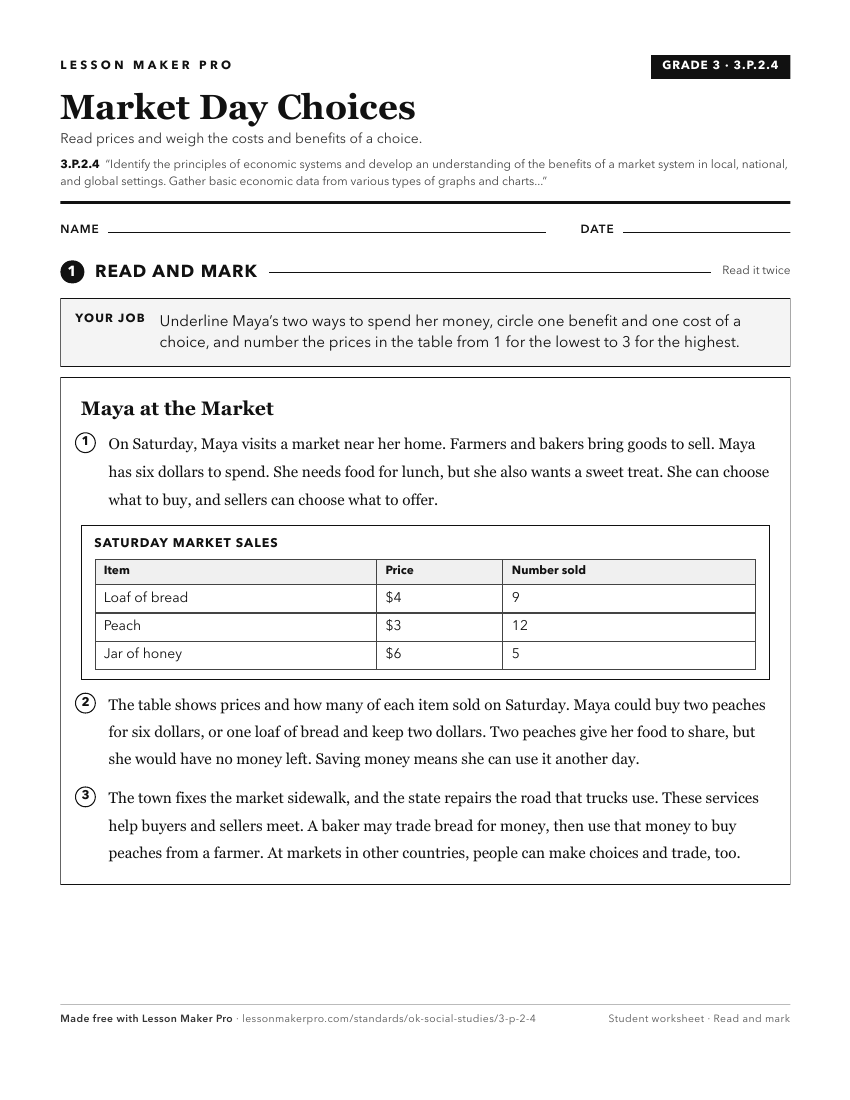
A ready-to-print activity worksheet aligned to 3.P.2.4, with an answer key for the teacher on its own page. No account needed.
PDF, US Letter, prints cleanly in black and white.
Download the worksheetKeep exploring
Related Standards
- E.P.2.4
Identify the principles of economic systems and develop an understanding of the benefits of a market system in local, national, and global settings.
- USH.P.2.4
Identify the principles of economic systems and develop an understanding of the benefits of a market system in local, national, and global settings.
- AWH.P.2.4
Identify the principles of economic systems and develop an understanding of the benefits of a market system in local, national, and global settings.
- 8.P.2.4
The 8th Grade version of this standard.
Turn this cluster into a lesson
Grade, subject, topic, and the complete cluster are prefilled. Create one free, no account needed.
Also for this cluster:Make a WorksheetMake a QuizMake a Sub Lesson