Oklahoma Social Studies E.P.2.4
Standard Cluster
- E.P.2
- Use interdisciplinary tools to acquire, apply, and evaluate content understanding of the four strands of social studies.
Identify the principles of economic systems and develop an understanding of the benefits of a market system in local, national, and global settings. Evaluate economic data from charts and graphs, noting trends and making predictions. Construct arguments using a combination of evidence regarding solutions used by nations to address historical or contemporary economic issues. Evaluate the impact, both intended and unintended, of government policies on market outcomes at national and global levels, past and present.
Oklahoma Academic Standards for Social Studies (2026) · E.P.2
Cluster contents
Standards in This Cluster
E.P.2.4 is a cluster heading. These are the individual standards under it.
- E.P.2.4.A
Evaluate economic data from charts and graphs, noting trends and making predictions.
- E.P.2.4.B
Construct arguments using a combination of evidence regarding solutions used by nations to address historical or contemporary economic issues.
- E.P.2.4.C
Evaluate the impact, both intended and unintended, of government policies on market outcomes at national and global levels, past and present.
Teacher's field guide
What This Cluster Means
What Students Need to Do
- Students explain how prices, competition, and choice shape a market, compared with government-set production. They read graphs to spot trends and make predictions. They use evidence to argue how a policy addresses a problem and affects people at home and abroad.
What Mastery Looks Like
- A student explains how competition can affect prices at a local store. They use a graph and another source to defend a policy choice. They name who gains or loses nationally and globally, including an unintended effect.
Common Misconceptions
- Students may think markets have no government rules or that price controls help everyone. They may assume a rising national average means every household gains. They may treat a graph's trend as a sure forecast or assume a policy caused any nearby change.
How to Assess It
- Sketch a line graph showing imported steel prices at $600, $700, and $800 per ton in the three months after a tariff. Ask: “What price might come next? Use the trend and one market principle to argue who might benefit and who might face an unintended cost, at home or abroad.”
Lesson moves
Ways to Teach It
Give pairs paper apples, play money, and price cards; run free-price and price-cap rounds, then tally unsold apples and unmet demand.
Show a 1970s U.S. gas price chart and a photo of pump lines; ask who gained, who waited, and why.
Project a three-year unemployment graph; teams race to label the trend, predict the next year, and explain why predictions can fail.
Bring a grocery receipt with imported bananas; have students trace how a new import tariff could affect prices, shoppers, and growers.
Free download
Printable E.P.2.4 Worksheet
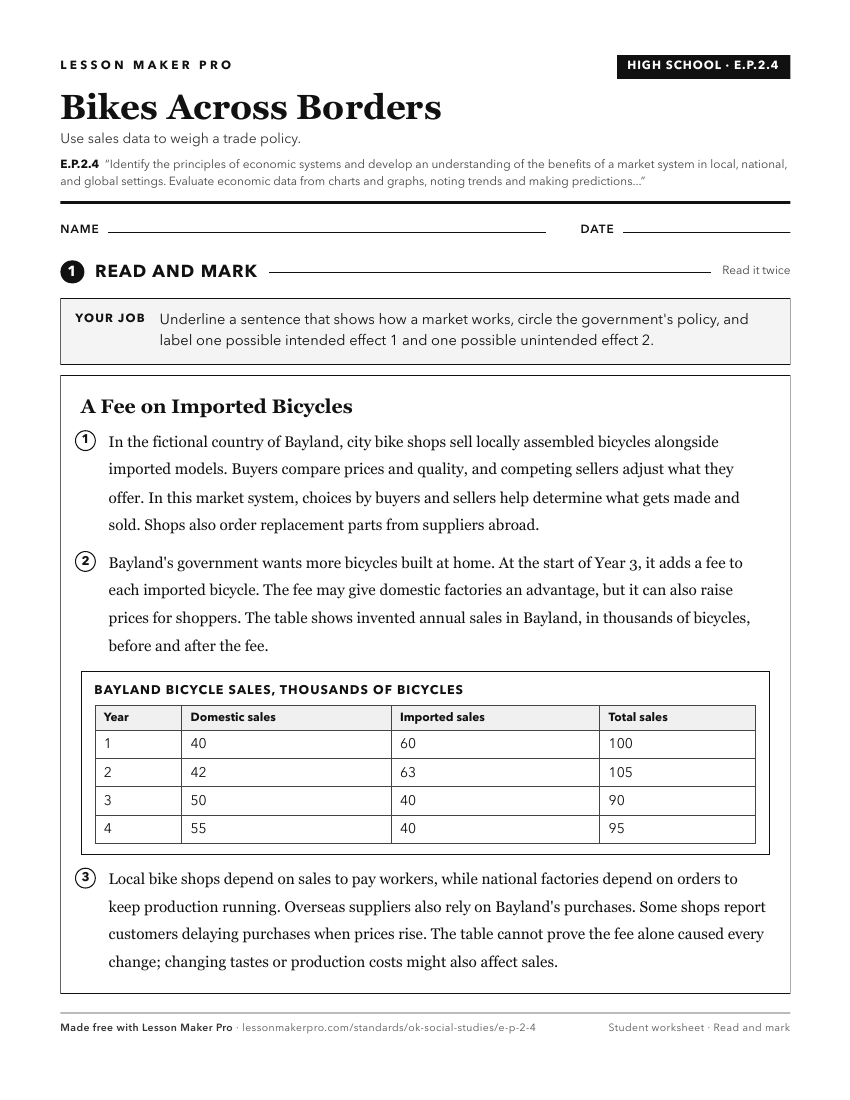
A ready-to-print activity worksheet aligned to E.P.2.4, with an answer key for the teacher on its own page. No account needed.
PDF, US Letter, prints cleanly in black and white.
Download the worksheetKeep exploring
Related Standards
- USH.P.2.4
Identify the principles of economic systems and develop an understanding of the benefits of a market system in local, national, and global settings.
- AWH.P.2.4
Identify the principles of economic systems and develop an understanding of the benefits of a market system in local, national, and global settings.
- 3.P.2.4
Identify the principles of economic systems and develop an understanding of the benefits of a market system in local, national, and global settings.
- 4.P.2.4
Identify the principles of economic systems and develop an understanding of the benefits of a market system in local, national, and global settings.
Turn this cluster into a lesson
Grade, subject, topic, and the complete cluster are prefilled. Create one free, no account needed.
Also for this cluster:Make a WorksheetMake a QuizMake a Sub Lesson