Oklahoma Social Studies USG.C.5
Standard Cluster
Analyze factors affecting the political process at the local, state, and national levels of government. Analyze how citizens participate in our constitutional republic by voting in public elections and running for public office; describe factors that affect voter turnout, trends in voter turnout, and attempts to increase voter participation. Compare political platforms of major contemporary political parties and describe how political parties influence both policymaking and the election of like-minded candidates to public office. Trace the steps of the electoral process, including the roles of state caucuses and primaries, national conventions, and campaigns. Describe the function and impact of political action committees on state and national elections, analyzing issues and decisions of significant court cases, such as Citizens United v. Federal Election Commission. Explain the function of the Electoral College, identifying different methods in which presidential electors are determined (e.g., split electoral vote versus winner-take-all). Examine ongoing challenges to the election process, including redistricting and the practice of gerrymandering. Describe the impact of the media, public opinion polls, and digital communications on the political process, including issues related to the influence of social media and the potential of artificial intelligence.
Oklahoma Academic Standards for Social Studies (2026)
Cluster contents
Standards in This Cluster
USG.C.5 is a cluster heading. These are the individual standards under it.
- USG.C.5.1
Analyze how citizens participate in our constitutional republic by voting in public elections and running for public office; describe factors that affect voter ...
- USG.C.5.2
Compare political platforms of major contemporary political parties and describe how political parties influence both policymaking and the election of like-mind...
- USG.C.5.3
Trace the steps of the electoral process, including the roles of state caucuses and primaries, national conventions, and campaigns.
- USG.C.5.4
Describe the function and impact of political action committees on state and national elections, analyzing issues and decisions of significant court cases, such...
- USG.C.5.5
Explain the function of the Electoral College, identifying different methods in which presidential electors are determined (e.g., split electoral vote versus wi...
- USG.C.5.6
Examine ongoing challenges to the election process, including redistricting and the practice of gerrymandering.
- USG.C.5.7
Describe the impact of the media, public opinion polls, and digital communications on the political process, including issues related to the influence of social...
Teacher's field guide
What This Cluster Means
What Students Need to Do
- Students explain how people vote or run for office and why turnout varies in local, state, and national races. They trace caucuses or primaries, conventions, campaigns, and electoral votes. They compare party platforms and examine how parties, campaign spending, district maps, polls, news, and social media shape elections and laws.
What Mastery Looks Like
- Given turnout data, a student spots that presidential races usually draw more voters than midterms and gives a likely reason. They use party platforms to predict how party-backed lawmakers might vote and trace a presidential candidate from primary to electoral votes. They distinguish PAC donations from independent spending protected by Citizens United and explain how maps, polls, or AI-made posts could affect voters.
Common Misconceptions
- Students may think the nationwide popular vote picks the president or that every state awards electoral votes the same way. They may think Citizens United lets donors give unlimited money directly to candidates. They may treat a poll as a final result or miss how district lines can change representation without changing anyone's vote.
How to Assess It
- Exit ticket: Lee wins 52% in State A, which has five electors; Lee wins statewide and two of three districts in State B. Ask how many electors Lee gets if A uses winner-take-all and B awards two statewide electors plus one per district (five and four).
Lesson moves
Ways to Teach It
Give groups a map of 12 colored precincts; have them draw three equal-size districts, then compare how many seats each party wins.
Print 2024 Democratic and Republican platform excerpts on immigration; ask pairs to name one policy difference and predict one vote in Congress.
Give groups cards for caucus or primary, convention, fall campaign, election day, and elector vote; have them order and explain each.
Show a local campaign post beside a county election notice; have students check its voting-date claim and note what the post leaves out.
Free download
Printable USG.C.5 Worksheet
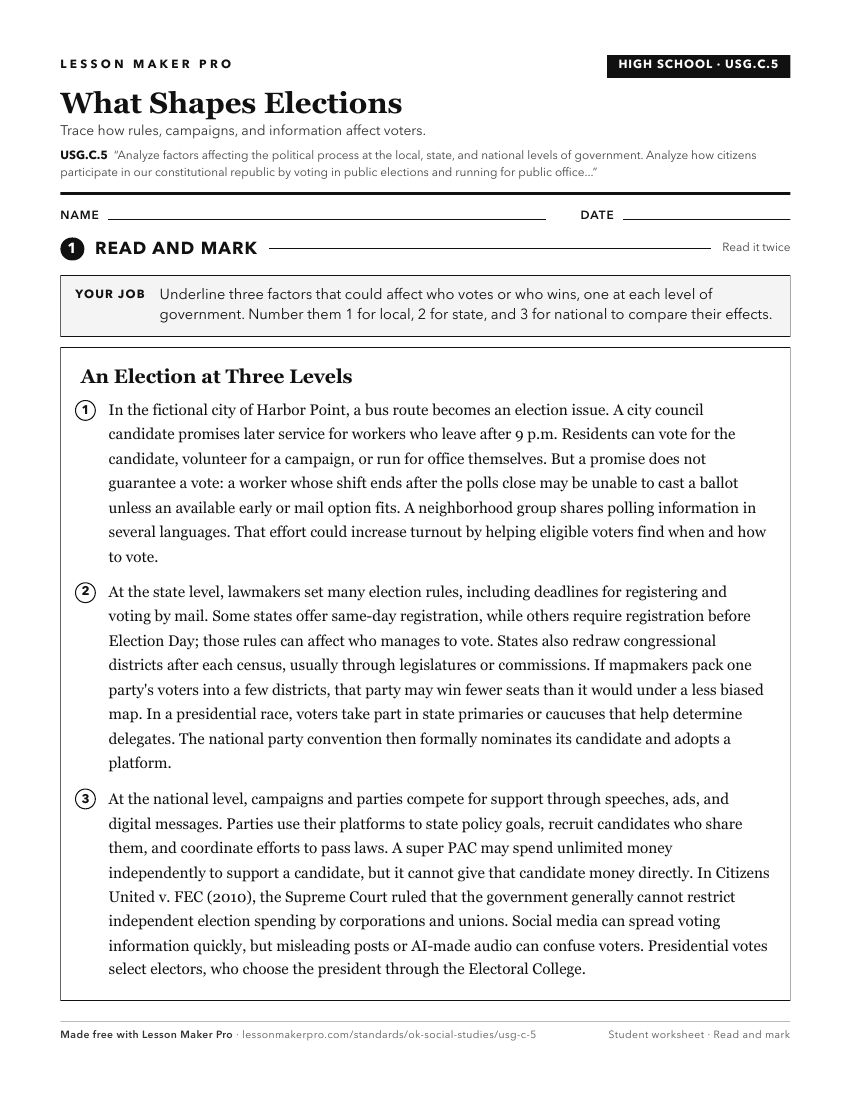
A ready-to-print activity worksheet aligned to USG.C.5, with an answer key for the teacher on its own page. No account needed.
PDF, US Letter, prints cleanly in black and white.
Download the worksheetKeep exploring
Related Standards
- USH.C.7.3
Analyze the ongoing social and political transformations within the United States of America , affecting domestic and foreign policy.
- 7.C.6
Analyze systems of government by examining their source of authority, principles, structures, and processes.
- USG.C.7
Analyze the processes and implementation of public policy in the United States of America.
- USG.C.3.5.A
Explain how local, state, and national governments are involved in cooperatively shaping public policy and responding to public policy issues.
Turn this cluster into a lesson
Grade, subject, topic, and the complete cluster are prefilled. Create one free, no account needed.
Also for this cluster:Make a WorksheetMake a QuizMake a Sub Lesson