Oklahoma Social Studies TOT.C.9.6
The Standard
Examine how Marxism evolved after the West’s intellectual disillusionment with Soviet Communism and evaluate the role of Soviet dissidents, such as Boris Pasternak, Aleksandr Solzhenitsyn, and Vladimir Bukovsky.
Oklahoma Academic Standards for Social Studies (2026)
Teacher's field guide
What This Standard Means
What Students Need to Do
- Students explain how evidence of Soviet repression caused some Western thinkers to question Soviet Communism. They show how some Marxists rejected one-party rule while keeping their ideas about economic inequality, and describe what three Soviet dissidents revealed.
What Mastery Looks Like
- A student connects Pasternak's banned novel to censorship, Solzhenitsyn's writing to prison camps, and Bukovsky's evidence to psychiatric abuse. They can explain why a Western Marxist might support multiparty elections and still favor socialist economic policies.
Common Misconceptions
- Students may assume that rejecting Soviet rule meant rejecting every Marxist idea. They may also mistake the dissidents for Marxist theorists or mix up Solzhenitsyn's camp writing with Bukovsky's evidence of psychiatric abuse.
How to Assess It
- Exit ticket: Match Pasternak, Solzhenitsyn, and Bukovsky with a banned novel, prison camps, and psychiatric abuse, then explain how a Marxist could reject Soviet rule without rejecting Marxism.
Lesson moves
Ways to Teach It
Give pairs five cards showing Khrushchev's 1956 speech, three dissidents' works, and Eurocommunism; have them order the cards and draw links.
Ask students to write: Can someone oppose Soviet censorship and prison camps while still supporting Marxist ideas about inequality? Use one dissident's evidence.
Run a matching relay with name cards, source cards, and Soviet practice cards for Pasternak, Solzhenitsyn, and Bukovsky.
Print a recent news report on political imprisonment; have students compare how testimony reaches readers abroad with Solzhenitsyn's camp account.
Free download
Printable TOT.C.9.6 Worksheet
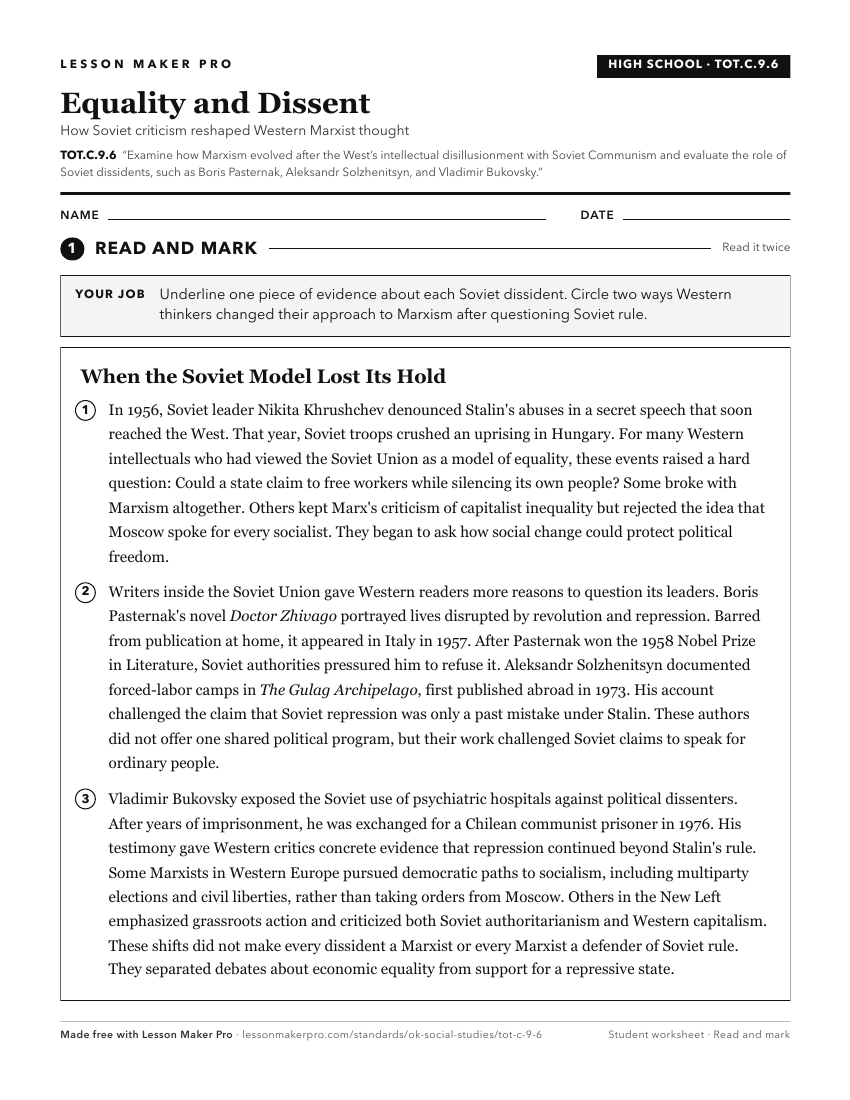
A ready-to-print activity worksheet aligned to TOT.C.9.6, with an answer key for the teacher on its own page. No account needed.
PDF, US Letter, prints cleanly in black and white.
Download the worksheetKeep exploring
Related Standards
- MWH.C.7.6.F
Assess the role of Western leadership, diplomacy, and dissident movements in weakening Soviet power and encouraging democratic transitions, including figures su...
- MWH.C.7.6.D
Analyze the effect of the collapse of the Soviet Union on global power dynamics, including the emergence of new democracies in Eastern Europe.
- TOT.C.9.8
Examine Gorbachev’s attempt to reform the Soviet Union, including the effects of perestroika and glasnost.
- TOT.C.9.1
Examine the USSR’s occupation of Eastern Europe after World War II, including Soviet Communization of Eastern Europe, the coup d’etat in Czechoslovakia, chronic...
Turn this exact standard into a lesson
Grade, subject, topic, and the complete standard are prefilled. Create one free, no account needed.
Also for this standard:Make a WorksheetMake a QuizMake a Sub Lesson