Oklahoma Social Studies TOT.C.8.3
Standard Cluster
Describe interwar Soviet foreign policy and the effect of World War II, including the support for foreign Communist parties and popular fronts opposition to reform socialists that catalyzed the rise of fascist governments support for Chinese Communists cooperation with Nazi Germany (e.g., Nazi-Soviet pact, Soviet annexations and population deportations, the Winter War,the Katyn massacre) war policy (e.g., terror, ethnic cleansing, looting operations in conquered countries, occupation of Eastern Europe).
Oklahoma Academic Standards for Social Studies (2026)
Cluster contents
Standards in This Cluster
TOT.C.8.3 is a cluster heading. These are the individual standards under it.
- TOT.C.8.3.A
support for foreign communist parties and popular fronts
- TOT.C.8.3.B
opposition to reform socialists that catalyzed the rise of fascist governments
- TOT.C.8.3.C
support for Chinese Communists
- TOT.C.8.3.D
cooperation with Nazi Germany (e.g., Nazi-Soviet pact, Soviet annexations and population deportations, the Winter War,the Katyn massacre)
- TOT.C.8.3.E
war policy (e.g., terror, ethnic cleansing, looting operations in conquered countries, occupation of Eastern Europe).
Teacher's field guide
What This Cluster Means
What Students Need to Do
- Students trace Soviet support for Communist parties abroad, including in China, and its shift from attacking reform socialists to backing popular fronts. They explain how the 1939 pact, the war, and Soviet occupation reshaped Eastern Europe.
What Mastery Looks Like
- A student can put the Nazi-Soviet Pact, Winter War, Katyn massacre, and occupation of Eastern Europe in order. They explain how annexations, deportations, and wartime violence affected people in neighboring countries.
Common Misconceptions
- Students may think the Soviet Union opposed Nazi Germany from the start of World War II, missing the 1939 pact and Germany's 1941 invasion. They may confuse early attacks on reform socialists with later popular fronts, or describe Soviet occupation as liberation without addressing deportations and violence.
How to Assess It
- Exit ticket: Put popular fronts, the Nazi-Soviet Pact, and Soviet occupation of Eastern Europe in order. Write one effect each had outside the Soviet Union.
Lesson moves
Ways to Teach It
Pairs place six event cards on a string timeline: 1935 popular fronts, 1939 pact, 1939 Winter War, 1940 Katyn, 1941 invasion, 1945 occupation.
Ask, "How did Communist attacks on German reform socialists differ from the later popular front approach, and how might that split have helped fascists?"
Play a card match: students pair the Nazi-Soviet Pact with the annexation of eastern Poland, and the Winter War with the invasion of Finland.
Compare a 1938 map with today's borders of Poland and the Baltic states; circle changes and write one question about national sovereignty.
Free download
Printable TOT.C.8.3 Worksheet
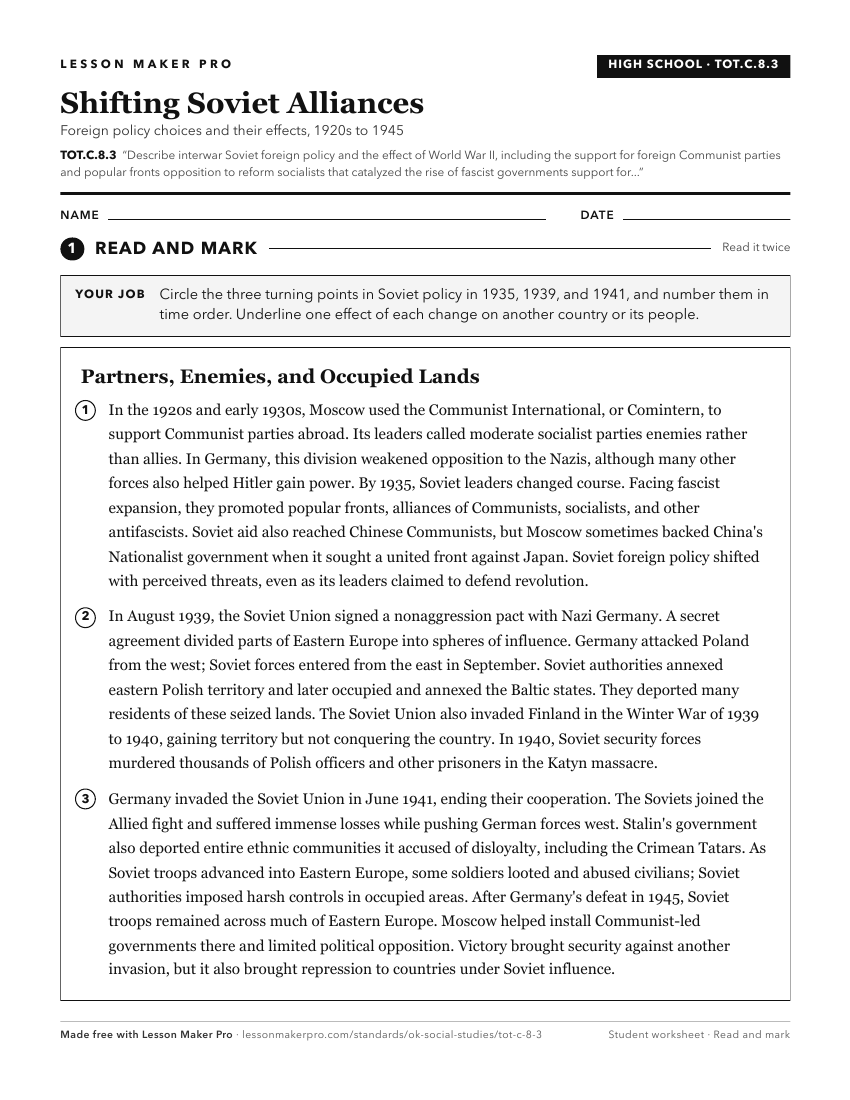
A ready-to-print activity worksheet aligned to TOT.C.8.3, with an answer key for the teacher on its own page. No account needed.
PDF, US Letter, prints cleanly in black and white.
Download the worksheetKeep exploring
Related Standards
- TOT.C.8.2
Describe the domestic policies of interwar Soviet Russia, including the
- USH.C.5.2
Analyze the series of events affecting the outcome of World War II.
- MWH.C.7.1
Evaluate the effects of World War II including the origins and escalation of the Cold War.
- TOT.C.8.1
Examine the political history of interwar Soviet Russia:
Turn this cluster into a lesson
Grade, subject, topic, and the complete cluster are prefilled. Create one free, no account needed.
Also for this cluster:Make a WorksheetMake a QuizMake a Sub Lesson