Oklahoma Social Studies S.5.4
The Standard
- S.5
- Analyze social problems that affect large numbers of people within a social system.
Describe social problems and distinguish between characteristics of a social problem versus an individual problem.
Oklahoma Academic Standards for Social Studies (2026) · S.5
Teacher's field guide
What This Standard Means
What Students Need to Do
- Students describe a problem and decide whether it affects one person or shows a wider pattern. They look for evidence about who is affected, what causes the problem, and who could help address it.
What Mastery Looks Like
- A student can explain why one missed bus is an individual problem, while a canceled route affecting many riders is a social problem. They can also explain how a social problem affects individuals.
Common Misconceptions
- Students may think any problem shared by two people is a social problem. They may also blame individuals for problems shaped by rules, costs, or access to services.
How to Assess It
- Exit ticket: One student misses school after oversleeping. Fifty students miss school after the city cuts a bus route. Classify each case and give one reason for each choice.
Lesson moves
Ways to Teach It
Give pairs case cards about missed buses, rent increases, and lost jobs; have them sort the cards and write a reason beside each.
Ask students to write: When might one family's rent trouble point to a wider housing problem? What evidence would you need?
Play a quick classification game: read a case aloud, have students hold up individual or social, then defend one answer.
Give students a local news article about housing costs; have them mark numbers, affected groups, and possible responses.
Free download
Printable S.5.4 Worksheet
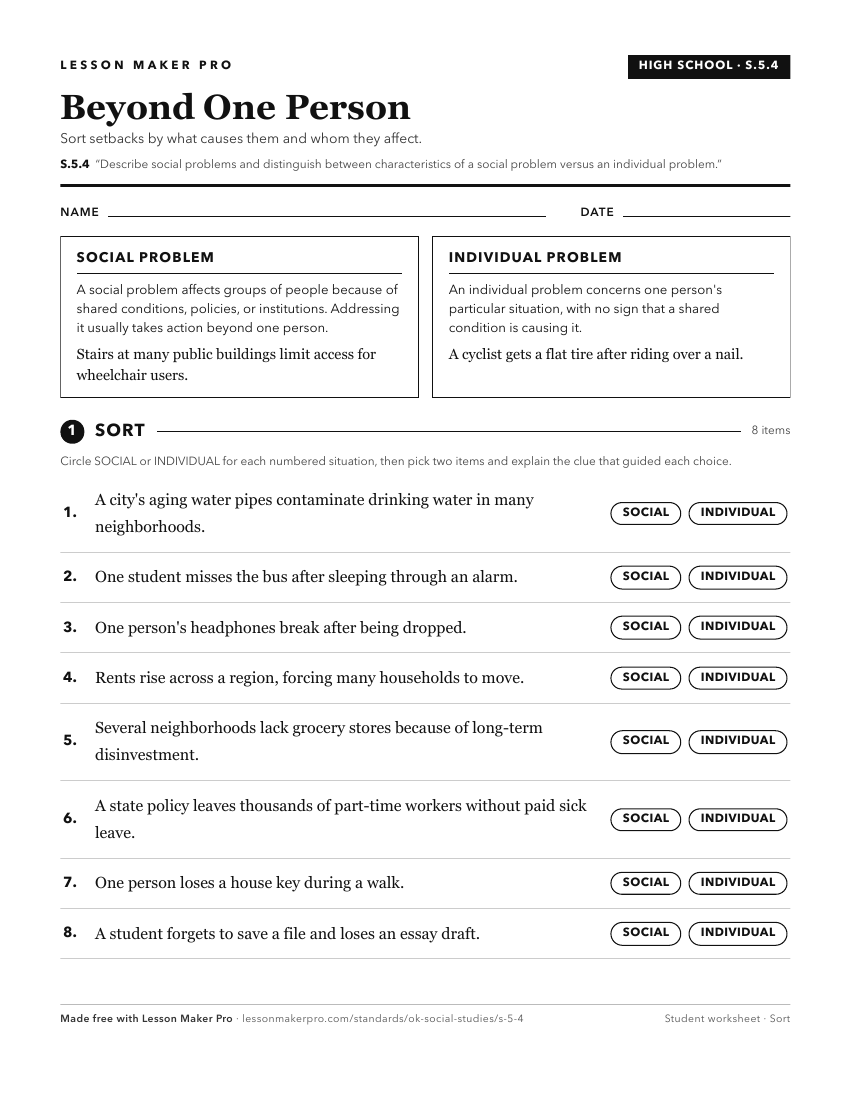
A ready-to-print activity worksheet aligned to S.5.4, with an answer key for the teacher on its own page. No account needed.
PDF, US Letter, prints cleanly in black and white.
Download the worksheetKeep exploring
Related Standards
- S.5.6
Examine the extent to which individual and group responses influence potential resolutions to social problems.
- S.1.2
Identify, differentiate among, and apply the major sociological paradigms (e.g., functional analysis, conflict theory, symbolic interactionism).
- S.5
Analyze social problems that affect large numbers of people within a social system.
- S.5.5
Analyze patterns of behavior found within social problems and their implications for society (e.g., juvenile crime, long-term unemployment).
Turn this exact standard into a lesson
Grade, subject, topic, and the complete standard are prefilled. Create one free, no account needed.
Also for this standard:Make a WorksheetMake a QuizMake a Sub Lesson