Oklahoma Social Studies S.5
Standard Cluster
Analyze social problems that affect large numbers of people within a social system. Analyze patterns of social stratification and their effects on individuals and groups. Describe how social movements can influence and change society. Analyze effects of stratification and social inequality on individuals and groups, including life outcomes, social problems, and group conflict. Describe social problems and distinguish between characteristics of a social problem versus an individual problem. Analyze patterns of behavior found within social problems and their implications for society (e.g., juvenile crime, long-term unemployment). Examine the extent to which individual and group responses influence potential resolutions to social problems.
Oklahoma Academic Standards for Social Studies (2026)
Cluster contents
Standards in This Cluster
S.5 is a cluster heading. These are the individual standards under it.
- S.5.1
Analyze patterns of social stratification and their effects on individuals and groups.
- S.5.2
Describe how social movements can influence and change society.
- S.5.3
Analyze effects of stratification and social inequality on individuals and groups, including life outcomes, social problems, and group conflict.
- S.5.4
Describe social problems and distinguish between characteristics of a social problem versus an individual problem.
- S.5.5
Analyze patterns of behavior found within social problems and their implications for society (e.g., juvenile crime, long-term unemployment).
- S.5.6
Examine the extent to which individual and group responses influence potential resolutions to social problems.
Teacher's field guide
What This Cluster Means
What Students Need to Do
- Students tell the difference between one person's hardship and a problem that affects many people. They use data to find gaps between groups and explain how those gaps can affect people's lives. They describe how organized groups can push for change.
What Mastery Looks Like
- Given unemployment rates for two groups, a student identifies the gap without claiming the numbers prove its cause. They explain a possible effect on families and describe how a worker group could press for a policy change.
Common Misconceptions
- Students may call any personal setback a social problem without looking for a wider pattern. They may assume a gap between groups proves that one group made worse choices. They may think a march fixes a problem by itself.
How to Assess It
- Show unemployment rates of 12% and 4% for two neighborhoods. Ask: “What makes this a possible social problem, who might be affected, and what could an organized group do?”
Lesson moves
Ways to Teach It
Give pairs printed unemployment data cards for four neighborhoods; have them sort the rates, mark gaps, and list one question the numbers cannot answer.
Ask students to write whether one missed rent payment or a citywide rise in evictions is a social problem, and explain why.
Play a card sort with short scenarios; students label each individual problem, social problem, or both, then defend one choice.
Read a local housing meeting agenda and ask students to name one proposed change and one group that could speak for it.
Free download
Printable S.5 Worksheet
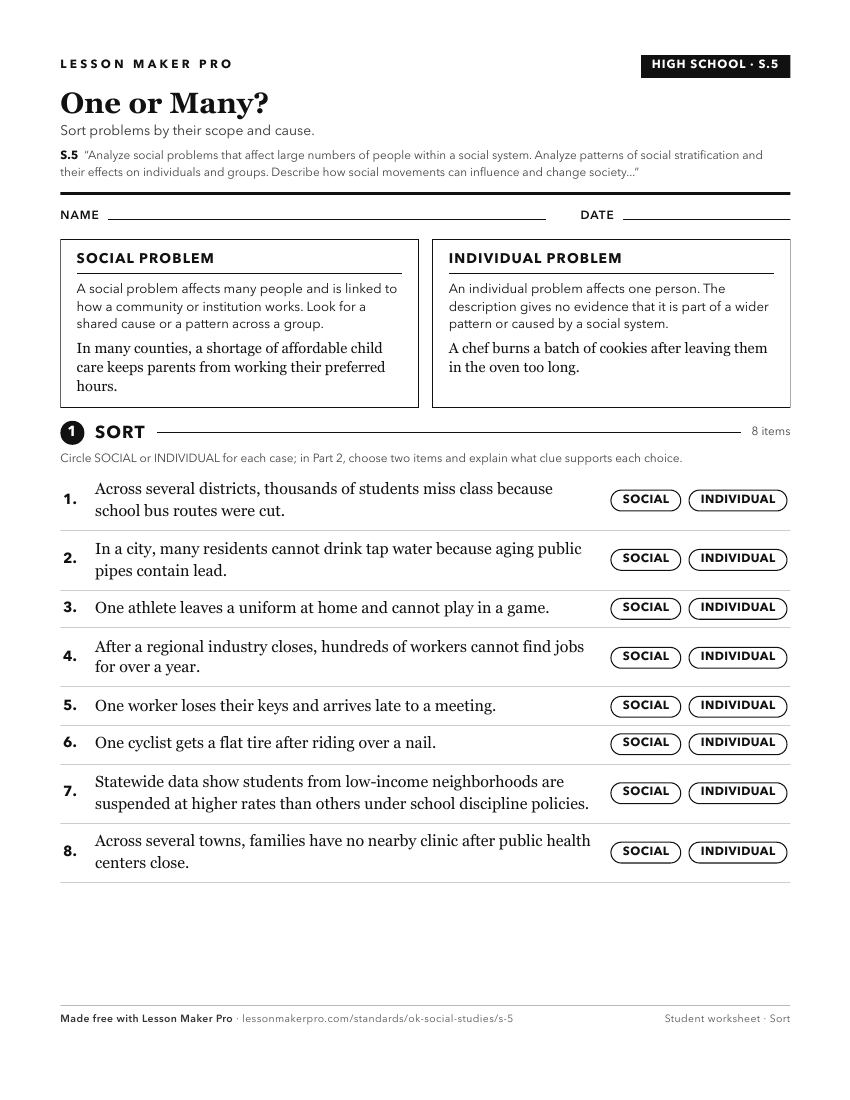
A ready-to-print activity worksheet aligned to S.5, with an answer key for the teacher on its own page. No account needed.
PDF, US Letter, prints cleanly in black and white.
Download the worksheetTurn this cluster into a lesson
Grade, subject, topic, and the complete cluster are prefilled. Create one free, no account needed.
Also for this cluster:Make a WorksheetMake a QuizMake a Sub Lesson