Oklahoma Social Studies PS.1
Standard Cluster
Examine the foundations of psychology and its origins as an empirical science. Analyze the context and origins of psychology including the major approaches to psychology (e.g., cognitive-behavioral, psychoanalytic, cognitive) and major historical figures. Describe the classifications and various subfields in psychology, including vocational applications such as counseling, industrial, clinical, experimental, and educational psychology. Compare the appropriate application of experimental and non-experimental research methodologies (e.g., case study, correlation, meta-analysis, and naturalistic observation). Identify and evaluate psychological concepts in representations of data, including tables, graphs, charts, figures, and diagrams. Compare quantitative and qualitative research strategies including experiments, surveys, focus groups, and narratives as the foundation of research in psychology.
Oklahoma Academic Standards for Social Studies (2026)
Cluster contents
Standards in This Cluster
PS.1 is a cluster heading. These are the individual standards under it.
- PS.1.1
Analyze the context and origins of psychology including the major approaches to psychology (e.g., cognitive-behavioral, psychoanalytic, cognitive) and major his...
- PS.1.2
Describe the classifications and various subfields in psychology, including vocational applications such as counseling, industrial, clinical, experimental, and ...
- PS.1.3
Compare the appropriate application of experimental and non-experimental research methodologies (e.g., case study, correlation, meta-analysis, and naturalistic ...
- PS.1.4
Identify and evaluate psychological concepts in representations of data, including tables, graphs, charts, figures, and diagrams.
- PS.1.5
Compare quantitative and qualitative research strategies including experiments, surveys, focus groups, and narratives as the foundation of research in psycholog...
Teacher's field guide
What This Cluster Means
What Students Need to Do
- Students explain how psychology moved from philosophical questions to testing ideas with observations and data. They compare early psychologists and major approaches, then choose research methods for different questions. They identify psychology careers and read charts to judge what research findings show.
What Mastery Looks Like
- A student can explain why an experiment can test cause, while a survey or observation can show patterns. They can read a graph, spot a claim it does not support, and explain what an interview might add. They can match a problem to a clinical, educational, or workplace psychologist.
Common Misconceptions
- Students may think Freud represents all of psychology or that every psychologist provides therapy. They may assume a correlation proves cause or call an interview an experiment. They may also overlook the scale or sample size when reading a graph.
How to Assess It
- Exit ticket: A survey chart shows that students who study with music report higher quiz scores. Ask students why the chart cannot prove that music raised scores and how they would test that claim.
Lesson moves
Ways to Teach It
Give groups dated cards about Wundt, Freud, Watson, and cognitive psychology; have them sort the cards by time and label each approach's evidence.
Ask: Would Freud and a cognitive psychologist explain a forgotten name the same way? Have pairs write both explanations and name evidence each would seek.
Play method match: give teams question cards and experiment, survey, focus group, case study, observation, and meta-analysis cards; require a reason for each match.
Draw bars showing 8 of 10 night-shift and 4 of 10 day-shift workers reporting stress; ask what an industrial psychologist can and cannot conclude.
Free download
Printable PS.1 Worksheet
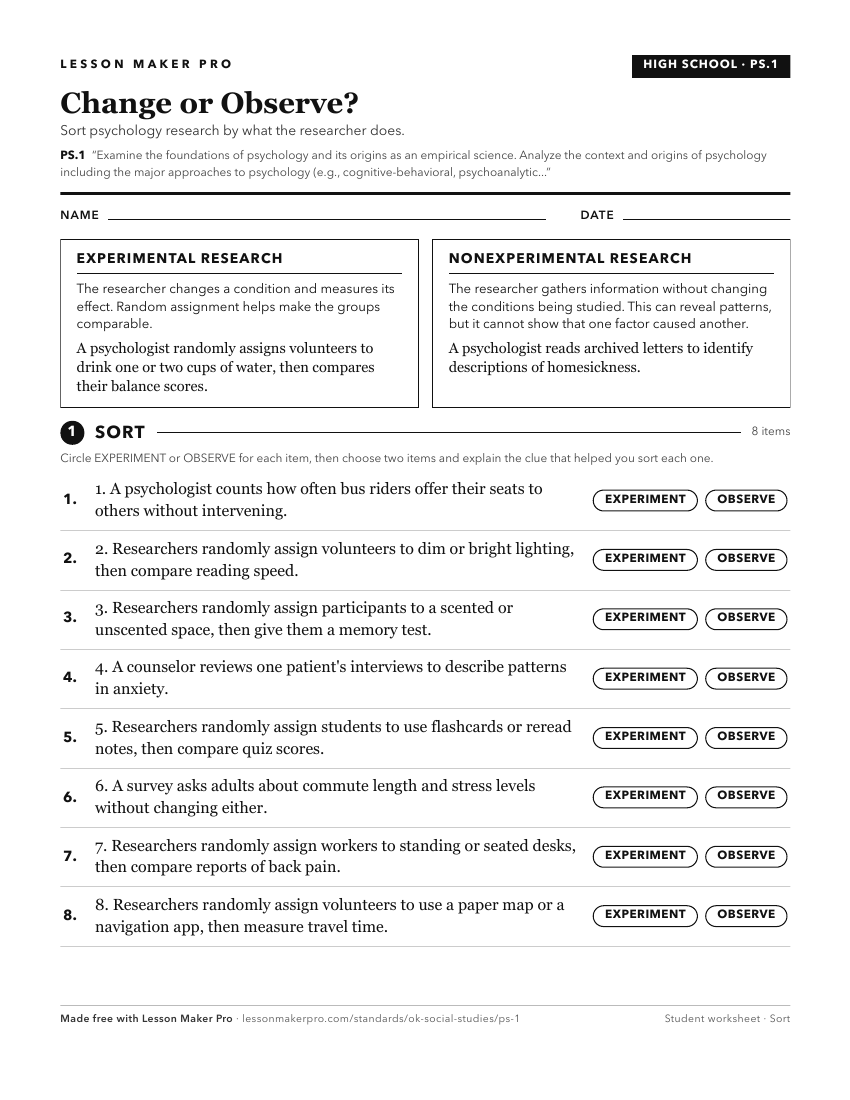
A ready-to-print activity worksheet aligned to PS.1, with an answer key for the teacher on its own page. No account needed.
PDF, US Letter, prints cleanly in black and white.
Download the worksheetKeep exploring
Related Standards
Turn this cluster into a lesson
Grade, subject, topic, and the complete cluster are prefilled. Create one free, no account needed.
Also for this cluster:Make a WorksheetMake a QuizMake a Sub Lesson