Oklahoma Social Studies OKH.P.2
Standard Cluster
Use interdisciplinary tools to acquire, apply, and evaluate content understanding of the four strands of social studies. Demonstrate an understanding of the principles of government, the benefits of democratic systems, and their responsibilities as citizens. Evaluate various significant documents from the United States of America and other nations to compare civic virtues and principles of political systems. Evaluate the impact of the structure and powers exercised by governmental systems on public policy, using historical and contemporary examples. Analyze the impact of constitutions, laws, treaties, and international agreements, by comparing how various governmental powers and responsibilities have changed over time. Develop skills which demonstrate an understanding of historical events and the people who shaped our history. Gather and evaluate the usefulness of various formats of evidence for specific inquiry, analyzing the broader historical context, and assessing potential bias and credibility of sources. Analyze complex and interacting factors that influence multiple perspectives during different historical eras and contemporary events. Evaluate how multiple, complex events are shaped by unique circumstances of time and place; construct and interpret parallel timelines. Demonstrate a mastery of geographic concepts and the use of geographic tools to understand the impact of geography on the past and present. Actively engage in asking and answering geographic questions by acquiring, organizing, and analyzing multiple sources of data and information about the world’s past and present. Compare and analyze complex maps and mapping technologies to analyze spatial patterns of human and physical environments, explaining relationships between the environment and events, past and present. Evaluate the extent to which political and economic decisions have had significant impact on human and physical environments of various places and regions. Identify the principles of economic systems and develop an understanding of the benefits of a market system in local, national, and global settings. Evaluate economic data from charts and graphs, noting trends and making predictions. Construct arguments using a combination of evidence regarding solutions used by nations to address historical or contemporary economic issues. Evaluate the impact, both intended and unintended, of government policies on market outcomes at national and global levels, past and present.
Oklahoma Academic Standards for Social Studies (2026)
Cluster contents
Standards in This Cluster
OKH.P.2 is a cluster heading. These are the individual standards under it.
- OKH.P.2.1
Demonstrate an understanding of the principles of government, the benefits of democratic systems, and their responsibilities as citizens.
- OKH.P.2.1.A
Evaluate various significant documents from the United States of America and other nations to compare civic virtues and principles of political systems.
- OKH.P.2.1.B
Evaluate the impact of the structure and powers exercised by governmental systems on public policy, using historical and contemporary examples.
- OKH.P.2.1.C
Analyze the impact of constitutions, laws, treaties, and international agreements, by comparing how various governmental powers and responsibilities have change...
- OKH.P.2.2
Develop skills which demonstrate an understanding of historical events and the people who shaped our history.
- OKH.P.2.2.A
Gather and evaluate the usefulness of various formats of evidence for specific inquiry, analyzing the broader historical context, and assessing potential bias a...
- OKH.P.2.2.B
Analyze complex and interacting factors that influence multiple perspectives during different historical eras and contemporary events.
- OKH.P.2.2.C
Evaluate how multiple, complex events are shaped by unique circumstances of time and place; construct and interpret parallel timelines.
- OKH.P.2.3
Demonstrate a mastery of geographic concepts and the use of geographic tools to understand the impact of geography on the past and present.
- OKH.P.2.3.A
Actively engage in asking and answering geographic questions by acquiring, organizing, and analyzing multiple sources of data and information about the world’s ...
- OKH.P.2.3.B
Compare and analyze complex maps and mapping technologies to analyze spatial patterns of human and physical environments, explaining relationships between the e...
- OKH.P.2.3.C
Evaluate the extent to which political and economic decisions have had significant impact on human and physical environments of various places and regions.
- OKH.P.2.4
Identify the principles of economic systems and develop an understanding of the benefits of a market system in local, national, and global settings.
- OKH.P.2.4.A
Evaluate economic data from charts and graphs, noting trends and making predictions.
- OKH.P.2.4.B
Construct arguments using a combination of evidence regarding solutions used by nations to address historical or contemporary economic issues.
- OKH.P.2.4.C
Evaluate the impact, both intended and unintended, of government policies on market outcomes at national and global levels, past and present.
Teacher's field guide
What This Cluster Means
What Students Need to Do
- Students compare government powers, rights, and citizen duties across countries and time. They check sources for bias, build timelines, and read maps and economic graphs. They use evidence to explain how policy, geography, and markets shape people's choices.
What Mastery Looks Like
- A student can use a map, a price graph, and a dated account to explain a policy's intended and unintended effects. They can compare two constitutional passages and explain how government powers differ. They can also say what their evidence cannot show.
Common Misconceptions
- Students may assume a constitution proves what a government actually does. They may mistake events that happened close together for cause and effect, or read higher prices as higher output. They may treat a government poster as neutral evidence.
How to Assess It
- Give students a 1930s drought map and a farm price graph. Ask: “Why did families leave the Plains? Use both sources, propose one federal response, and name one possible downside.”
Lesson moves
Ways to Teach It
Give groups printed 1930s drought maps, farm price graphs, and sticky notes to build parallel timelines of weather, migration, and federal action.
Compare the U.S. Constitution's commerce clause with Mexico's Article 27; ask which powers each government has and how citizens could challenge a policy.
Run a source-check relay with a 1936 government poster, a dated migrant photo, and a farm price graph; students flag claims each cannot prove.
Show a current Oklahoma drought map and local wheat prices; ask students to propose a water rule and predict who benefits and who pays.
Free download
Printable OKH.P.2 Worksheet
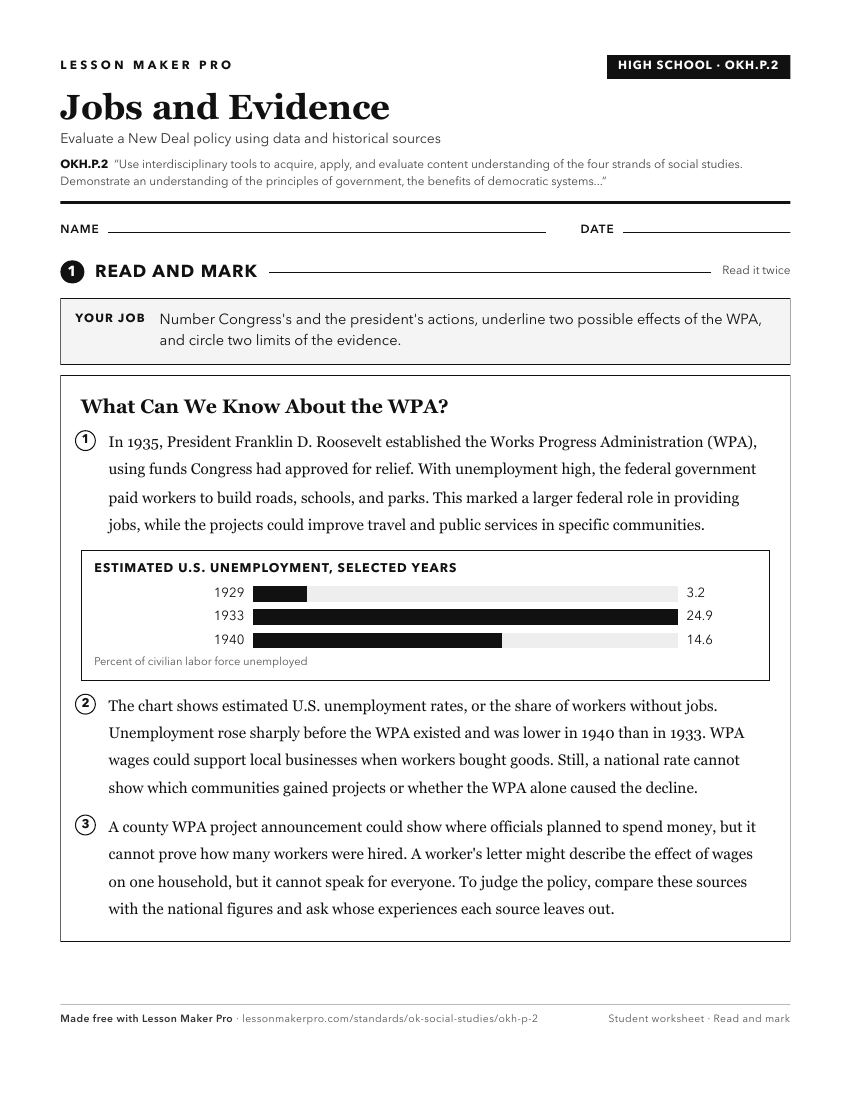
A ready-to-print activity worksheet aligned to OKH.P.2, with an answer key for the teacher on its own page. No account needed.
PDF, US Letter, prints cleanly in black and white.
Download the worksheetKeep exploring
Related Standards
- 4.P.2
Use interdisciplinary tools to acquire, apply, and evaluate content understanding of the four strands of social studies.
- 3.P.2
Use interdisciplinary tools to acquire, apply, and evaluate content understanding of the four strands of social studies.
- 2.P.2
Use interdisciplinary tools to acquire, apply, and evaluate content understanding of the four strands of social studies.
- 1.P.2
Use interdisciplinary tools to acquire, apply, and evaluate content understanding of the four strands of social studies.
Turn this cluster into a lesson
Grade, subject, topic, and the complete cluster are prefilled. Create one free, no account needed.
Also for this cluster:Make a WorksheetMake a QuizMake a Sub Lesson