Oklahoma Social Studies AWH.C.9.2
The Standard
Explain the growth and influence of Christianity and the Catholic Church in medieval society, including the significance of Europe’s network of medieval pilgrimage routes, the role of monasteries in preserving the culture of antiquity, and the spread of Christianity to Northern and Eastern Europe.
Oklahoma Academic Standards for Social Studies (2026)
Teacher's field guide
What This Standard Means
What Students Need to Do
- Students trace how Christianity spread into Scandinavia and Kievan Rus through missionaries, rulers, and Byzantine ties. They explain why pilgrims traveled to holy sites and how those routes affected towns. They show how monks preserved ancient writing by copying texts.
What Mastery Looks Like
- A student can trace a route to Santiago de Compostela and explain how pilgrims supported inns and markets. They can name the Aeneid as a text monks copied. They can explain how missionaries and rulers spread Christianity in Scandinavia, while Byzantine ties shaped Christianity in Kievan Rus.
Common Misconceptions
- Students may think monks wrote the ancient works they copied, or that pilgrims traveled only to trade. They may assume Eastern Europe became Catholic, overlooking Orthodox Christianity and Byzantine influence.
How to Assess It
- Give students a blank map with Santiago, Scandinavia, and Kievan Rus marked. Ask them to draw a pilgrimage route, then write what monks copied and one way Christianity spread north or east.
Lesson moves
Ways to Teach It
Give pairs a Europe map and cards for Santiago, Rome, Byzantium, Scandinavia, and Kievan Rus; have them trace pilgrimage and missionary routes.
Show a copied Aeneid page and ask students to write who might lose access to the text without monastic copying.
Play route sort: students match Santiago, a monastery scriptorium, Scandinavia, and Kievan Rus to pilgrimage, manuscript copying, western missions, and Byzantine influence.
Compare a modern Camino de Santiago trail map with a medieval pilgrimage map; circle towns on both and discuss why travelers need stops.
Free download
Printable AWH.C.9.2 Worksheet
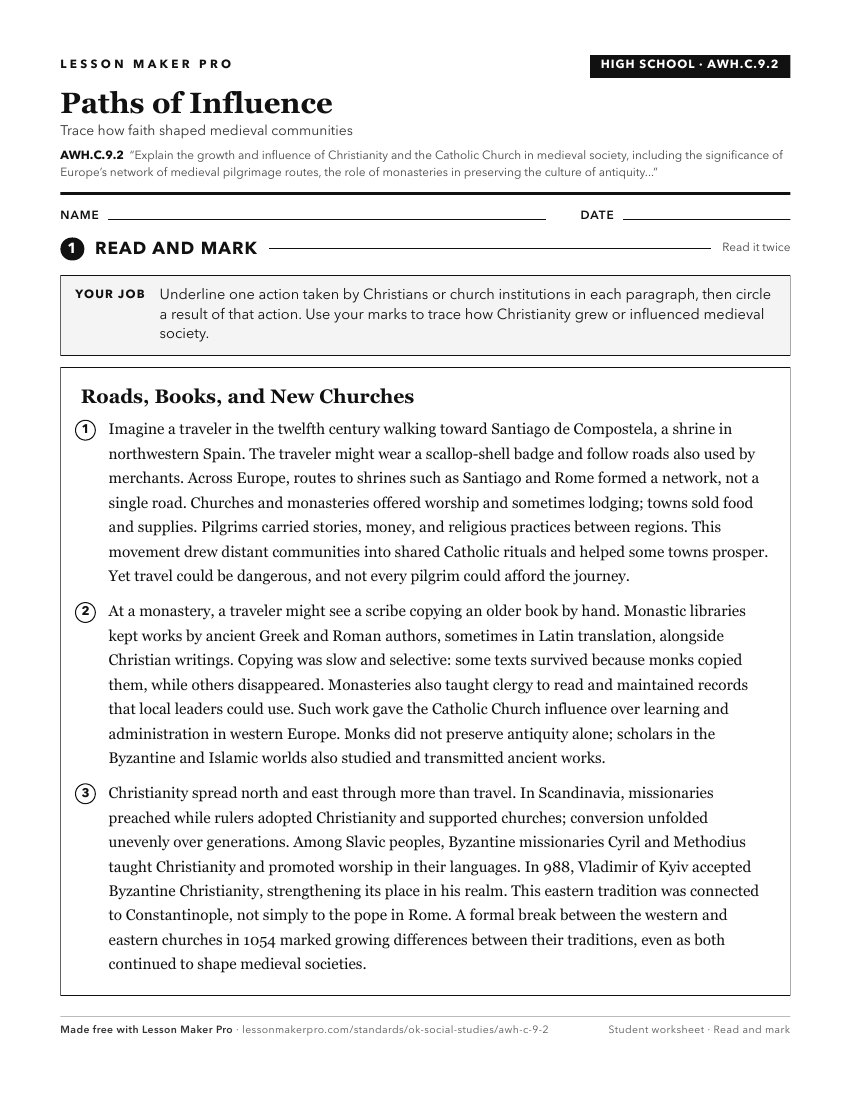
A ready-to-print activity worksheet aligned to AWH.C.9.2, with an answer key for the teacher on its own page. No account needed.
PDF, US Letter, prints cleanly in black and white.
Download the worksheetKeep exploring
Related Standards
- AWH.C.10.5.C
Describe significant aspects of medieval culture, including architecture. music, art, and literature.
- MWH.C.2.3.D
Trace the spread of Protestantism across Europe, including Lutherans, Reformed (Calvinist) Church of England, Anabaptists, and the effects on European society (...
- MWH.C.2
Analyze patterns of social, economic, political, and cultural changes during the Late Middle Ages to the Age of Exploration.
- AWH.C.10.5
Examine religious, intellectual, cultural, technological, and economic developments in medieval Europe from the Norman Conquest to 1300.
Turn this exact standard into a lesson
Grade, subject, topic, and the complete standard are prefilled. Create one free, no account needed.
Also for this standard:Make a WorksheetMake a QuizMake a Sub Lesson