Oklahoma Social Studies AWH.C.6.5
The Standard
Analyze the causes, course, and consequences of the Persian and Peloponnesian Wars including the significance of Pericles’ Funeral Oration.
Oklahoma Academic Standards for Social Studies (2026)
Teacher's field guide
What This Standard Means
What Students Need to Do
- Students explain how Persian expansion and Athens’ growing power led to two different wars. They trace key events and results, then explain what Pericles’ funeral speech says about Athens and sacrifice.
What Mastery Looks Like
- Students can connect Persia’s defeat to Athens’ rise, then Athens’ defeat to weaker Greek cities. They can place Salamis and the Sicilian Expedition in the right wars and explain why Pericles praised democracy.
Common Misconceptions
- Students often mix up the wars and think Persia was Athens’ main enemy in both. They may treat Pericles’ praise of democracy as a neutral account, overlooking who could not vote.
How to Assess It
- Ask students to name one cause and one result of each war, then explain why Pericles praised Athens in his funeral speech. Require one named event from each war.
Lesson moves
Ways to Teach It
Give pairs a blank Greece map and event cards; have them mark Marathon, Salamis, Athens, and Sparta, then trace each war.
Read an excerpt from Pericles’ Funeral Oration and write two sentences comparing his praise of democracy with Athens’ treatment of its allies.
Sort event cards by war and label each cause, turning point, or consequence; have partners defend one choice.
Show a photo of a local war memorial; students write a caption comparing its message about sacrifice with Pericles’ speech.
Free download
Printable AWH.C.6.5 Worksheet
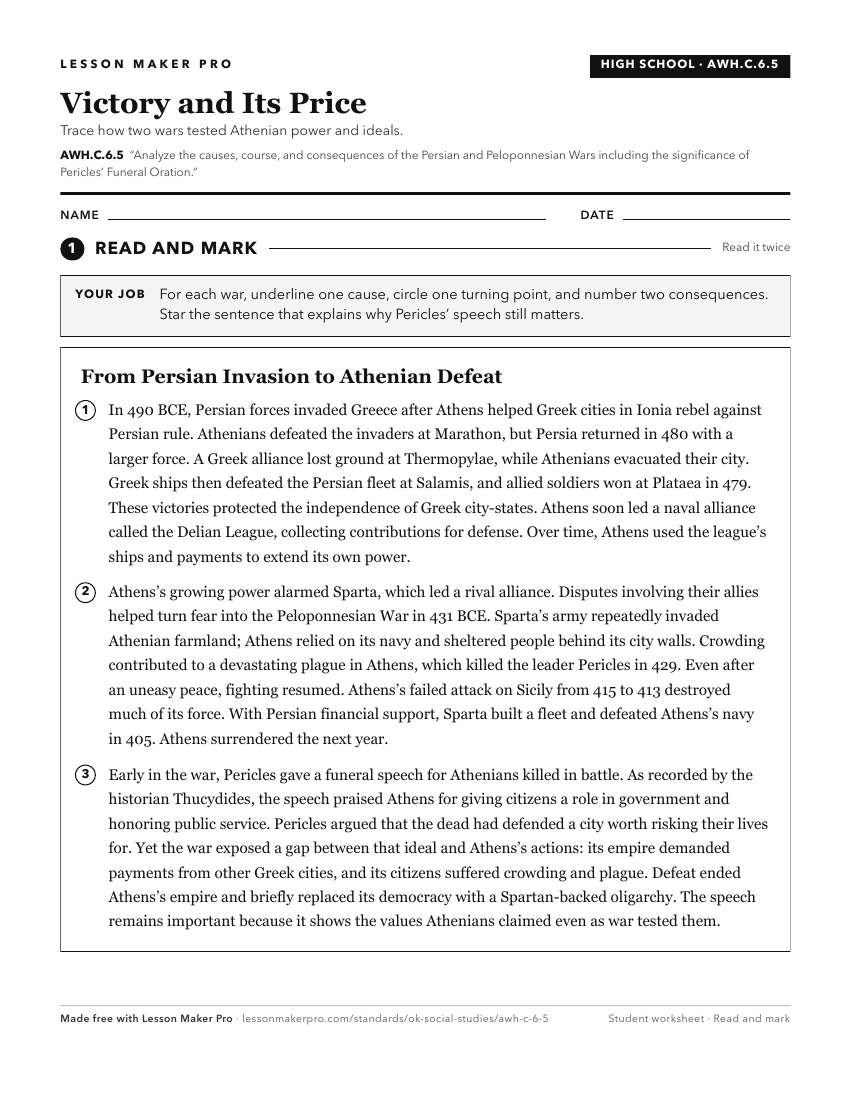
A ready-to-print activity worksheet aligned to AWH.C.6.5, with an answer key for the teacher on its own page. No account needed.
PDF, US Letter, prints cleanly in black and white.
Download the worksheetKeep exploring
Related Standards
- AWH.C.6.3
Analyze why the government of ancient Athens is considered the beginning of democratic government, by explaining the political concepts developed in ancient Gre...
- MWH.C.1.1.E
Compare the impact of Greek and Roman philosophers (e.g., Plato, Aristotle and Cicero) including their lasting influence on principles of government.
- 8.C.12
Analyze the course and consequences of the Civil War.
- AWH.C.7.4
Analyze the influence of Greek civilization on Roman art, literature, society, and government.
Turn this exact standard into a lesson
Grade, subject, topic, and the complete standard are prefilled. Create one free, no account needed.
Also for this standard:Make a WorksheetMake a QuizMake a Sub Lesson