Oklahoma Social Studies AWH.C.3.2
The Standard
Identify the social and economic characteristics of ancient Nubia (Kingdom of Kush) including its lucrative trade in iron and gold, military rivalry with Egypt, and assimilation of Egyptian culture.
Oklahoma Academic Standards for Social Studies (2026)
Teacher's field guide
What This Standard Means
What Students Need to Do
- Students describe the work of Kushite farmers, miners, metalworkers, and traders. They explain how gold and iron trade supported Kush, how it rivaled Egypt in war, and how its rulers adopted some Egyptian customs.
What Mastery Looks Like
- A student can place Kush and Egypt on a Nile map and trace gold and iron moving north. They can connect workers to that trade, describe the military rivalry, and identify Egyptian influence in Kushite buildings or royal customs.
Common Misconceptions
- Students may assume Kush was always part of Egypt, rather than a kingdom with its own rulers. They may think Kush imported gold and iron from Egypt, or that adopting Egyptian customs meant giving up its own culture.
How to Assess It
- Give students a blank Nile map and ask them to mark Kush and Egypt, draw a trade arrow, and label gold and iron. Below the map, ask them to name one Kushite worker, one way Kush and Egypt were rivals, and one Egyptian custom Kush adopted.
Lesson moves
Ways to Teach It
Give pairs a Nile map and gold and iron tokens; have them place miners and smiths in Kush, then move goods toward Egypt.
Show photos of pyramids at Meroe and Giza; ask, “What did Kushite builders borrow, and what did they change?”
Sort cards labeled gold mine, iron furnace, farmer, Egyptian-style temple, and border battle into economy, society, culture, and military.
Use a present-day Nile map to trace how river travel could link Kush's gold and iron producers to buyers in Egypt.
Free download
Printable AWH.C.3.2 Worksheet
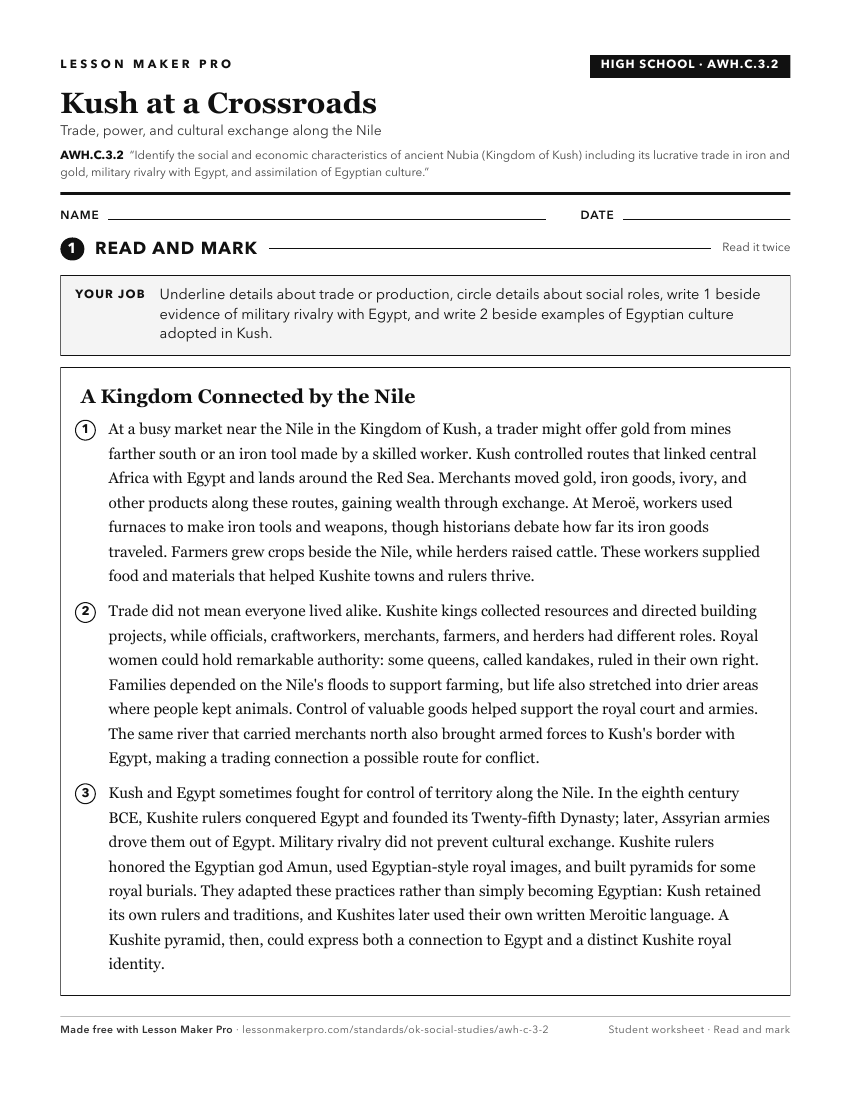
A ready-to-print activity worksheet aligned to AWH.C.3.2, with an answer key for the teacher on its own page. No account needed.
PDF, US Letter, prints cleanly in black and white.
Download the worksheetKeep exploring
Related Standards
- AWH.C.3.1
Locate on a historical map of the Mediterranean region ancient Nubia and Egypt, including Upper and Lower Egypt.
- MWH.C.1
Analyze the impact of the patterns of ancient political, economic, and cultural development.
- AWH.C.1.6
Identify the major characteristics of civilizations (e.g., geographic boundaries and political institutions, economies that produce food surpluses, the formatio...
- 7.C.5.2.A
Examine how and why major cultural hearths developed along major river valleys and crossroads of trade (e.g., Mesopotamia's Fertile Crescent; the Nile, Indus, H...
Turn this exact standard into a lesson
Grade, subject, topic, and the complete standard are prefilled. Create one free, no account needed.
Also for this standard:Make a WorksheetMake a QuizMake a Sub Lesson