Oklahoma Social Studies AWH.C.1.2
The Standard
Analyze the geographical and environmental factors that encouraged human communities to organize into complex states.
Oklahoma Academic Standards for Social Studies (2026)
Teacher's field guide
What This Standard Means
What Students Need to Do
- Students use maps and descriptions of land and climate to explain why people settled in some places. They connect farming, stored food, and shared projects to the growth of governments.
What Mastery Looks Like
- A student can use a Nile map to explain how seasonal floods supported farming and how canal work required cooperation. They can explain why a river did not automatically create a state.
Common Misconceptions
- Students may say a river alone created a government, skipping the roles of stored food and shared work. Some assume every flood helped farmers, even when floods damaged crops and homes.
How to Assess It
- Exit ticket: A village has fertile soil beside a river that floods each year. Explain two steps from that setting to a government that manages several villages.
Lesson moves
Ways to Teach It
Give groups a blank Nile map and colored pencils; have them mark water, farmland, and desert, then sketch a canal and nearby towns.
Ask: Why might Nile villages agree on canal rules, and who would settle disputes when two villages need water at once?
Give pairs four settlement cards listing water, soil, rainfall, and trade access; have them rank locations for a growing state and explain their picks.
Show a local floodplain map; ask students to place farms and homes, then name one rule people would need to manage flooding.
Free download
Printable AWH.C.1.2 Worksheet
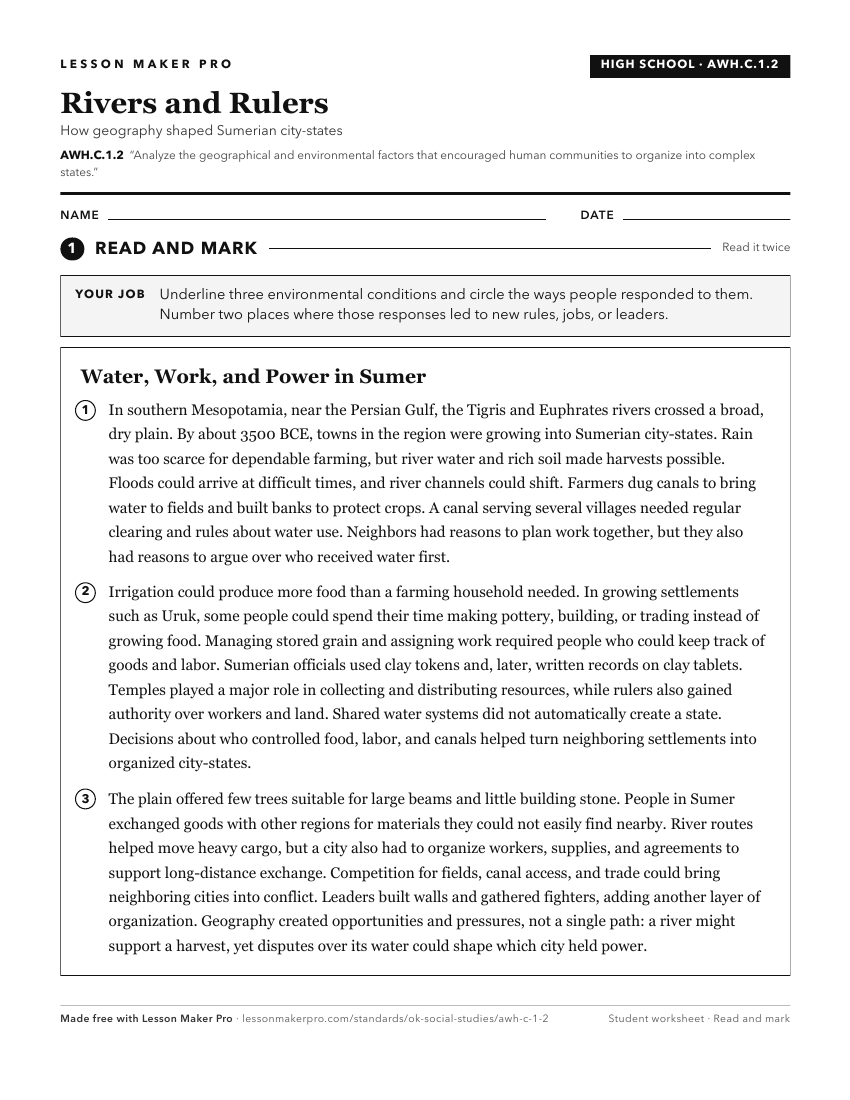
A ready-to-print activity worksheet aligned to AWH.C.1.2, with an answer key for the teacher on its own page. No account needed.
PDF, US Letter, prints cleanly in black and white.
Download the worksheetKeep exploring
Related Standards
- 4.C.3
Analyze how geography has impacted cultures and interactions during the early history of our nation.
- 7.C.5.2.B
Explain that complex societies and civilizations in different regions share common characteristics (e.g., agricultural innovations, written language, and early ...
- WG.C.2
Analyze how the human population is organized geographically in order to understand how change affects human systems.
- MWH.C.1
Analyze the impact of the patterns of ancient political, economic, and cultural development.
Turn this exact standard into a lesson
Grade, subject, topic, and the complete standard are prefilled. Create one free, no account needed.
Also for this standard:Make a WorksheetMake a QuizMake a Sub Lesson