Oklahoma Social Studies AWH.C.1.1
The Standard
Identify sites in Africa where archaeologists have found evidence of the origins of modern human beings and summarize their theories and conclusions.
Oklahoma Academic Standards for Social Studies (2026)
Teacher's field guide
What This Standard Means
What Students Need to Do
- Students locate African sites with early Homo sapiens fossils, such as Jebel Irhoud in Morocco and Omo Kibish in Ethiopia. They use the fossils and their estimated ages to explain what researchers know and why they debate where modern humans first emerged.
What Mastery Looks Like
- A student can place both sites on a map and describe the evidence found at each. They can explain that the oldest known fossil does not prove one site was the birthplace of all modern humans.
Common Misconceptions
- Students may assume the oldest fossil marks the exact place modern humans first appeared. They may also treat fossil ages as exact dates or think all early human fossils were found in one part of Africa.
How to Assess It
- On a blank map of Africa, label Jebel Irhoud and Omo Kibish. Then write two sentences explaining what their fossils suggest, and what they cannot prove, about human origins.
Lesson moves
Ways to Teach It
Give pairs a blank Africa map and dated fossil cards; have them pin each site and order the cards by age.
Ask students to write: Does finding the oldest known fossil at Jebel Irhoud prove modern humans began there? Explain.
Play a site-match game using cards with locations, fossil finds, and estimated ages for Jebel Irhoud, Omo Kibish, and Herto.
Have students write two museum exhibit labels, one for Jebel Irhoud and one for Omo Kibish, separating evidence from conclusions.
Free download
Printable AWH.C.1.1 Worksheet
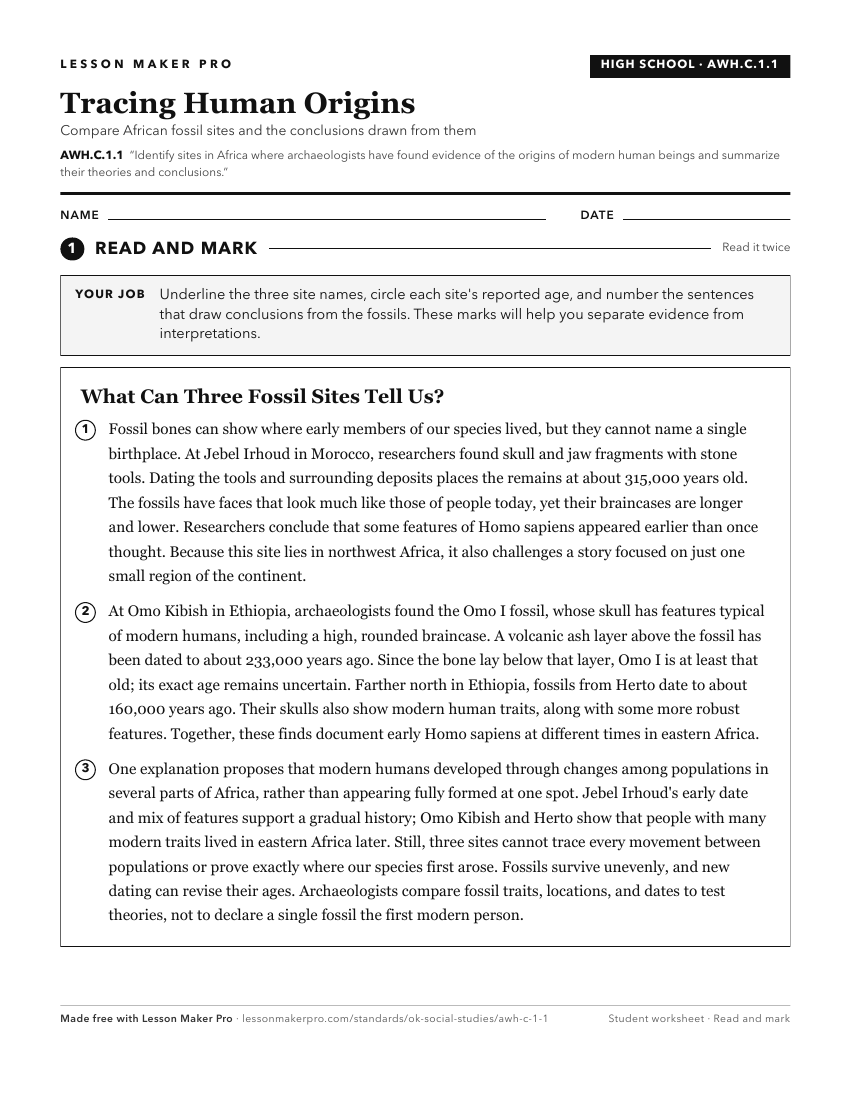
A ready-to-print activity worksheet aligned to AWH.C.1.1, with an answer key for the teacher on its own page. No account needed.
PDF, US Letter, prints cleanly in black and white.
Download the worksheetKeep exploring
Related Standards
- 7.C.8.2
Explain and summarize how common physical or human characteristics can link as well as divide regions (e.g., manmade canals linking European trading centers, th...
- MWH.C.5.3.C
Describe the outcomes of the Berlin Conference and the impact of superimposed boundaries on Africa’s Indigenous populations.
- 7.C.5.2.A
Examine how and why major cultural hearths developed along major river valleys and crossroads of trade (e.g., Mesopotamia's Fertile Crescent; the Nile, Indus, H...
- 3.C.3.1
Examine the state’s earliest peoples and the significance of their interactions.
Turn this exact standard into a lesson
Grade, subject, topic, and the complete standard are prefilled. Create one free, no account needed.
Also for this standard:Make a WorksheetMake a QuizMake a Sub Lesson