Oklahoma Social Studies 7.C.4
Standard Cluster
Analyze the interactions of humans and their environment. Analyze how humans adapt to their environment, including the impact of climate and weather patterns and natural disasters on human populations, resulting in displacement, scarcity of consumer goods, and loss of life. Describe how humans adapt to and modify their environment for the purpose of food production. Describe the differences among subsistence, cash crop, and commercial agriculture, including their impact on the economic development of a region. Explain how agricultural innovations, such as the Green Revolution and modern irrigation systems, increase food production in developing countries. Examine how agricultural practices in a region imprint the physical environment (e.g., desertification of the Aral Sea, terraced construction for rice farming, modern irrigation methods utilized in the Arabian Peninsula). Evaluate the effects of human modification of the natural environment through processes related to industrialization. Explain why places become major hubs of industrial activity by analyzing the relationship between the location of natural resources to various manufacturing industries. Describe the importance of transportation infrastructure and its direct impact on people's access to resources and consumer goods. Examine how the development of technology meets energy demands, as well as modifies the environment (e.g., extraction of raw materials, offshore drilling, nuclear power plants, water diversion, hydroelectric power plants).
Oklahoma Academic Standards for Social Studies (2026)
Cluster contents
Standards in This Cluster
7.C.4 is a cluster heading. These are the individual standards under it.
- 7.C.4.1
Analyze how humans adapt to their environment, including the impact of climate and weather patterns and natural disasters on human populations, resulting in dis...
- 7.C.4.2
Describe how humans adapt to and modify their environment for the purpose of food production.
- 7.C.4.2.A
Describe the differences among subsistence, cash crop, and commercial agriculture, including their impact on the economic development of a region.
- 7.C.4.2.B
Explain how agricultural innovations, such as the Green Revolution and modern irrigation systems, increase food production in developing countries.
- 7.C.4.2.C
Examine how agricultural practices in a region imprint the physical environment (e.g., desertification of the Aral Sea, terraced construction for rice farming, ...
- 7.C.4.3
Evaluate the effects of human modification of the natural environment through processes related to industrialization.
- 7.C.4.3.A
Explain why places become major hubs of industrial activity by analyzing the relationship between the location of natural resources to various manufacturing ind...
- 7.C.4.3.B
Describe the importance of transportation infrastructure and its direct impact on people's access to resources and consumer goods.
- 7.C.4.3.C
Examine how the development of technology meets energy demands, as well as modifies the environment (e.g., extraction of raw materials, offshore drilling, nucle...
Teacher's field guide
What This Cluster Means
What Students Need to Do
- Students explain how weather and disasters can force people to move, cause shortages, and cost lives. They compare farming methods and their effects on food supply, income, land, and water. They explain how resources and transport shape factory locations and access to goods, then weigh the effects of energy projects.
What Mastery Looks Like
- Given a drought map, students predict where families might move and which goods could become scarce. They distinguish subsistence farms, cash crops, and commercial farms, and explain how high-yield seeds and modern irrigation can raise harvests. They trace how river diversion can shrink a lake and how raw materials and rail lines affect factory sites.
Common Misconceptions
- Students may treat cash crops and commercial farming as the same thing. A cash crop is grown for sale, while commercial farming describes a way of producing goods for sale. They may think irrigation creates water, or overlook how dams and factories can displace people and damage land and water.
How to Assess It
- Give students a map showing a drought-hit river, farms, a coal deposit, and a rail line. Ask them to place a factory and predict one effect on people and one effect on the environment if river water is diverted to farms.
Lesson moves
Ways to Teach It
On an Aral Sea map, trace rivers with blue yarn, place paper irrigation gates upstream, and shade where lake water retreats.
Ask: After a drought, how might subsistence farms and cash crop farms affect a town's food supply and income differently?
Deal coal, factory, rail, market, and dam cards; groups lay out an industrial town and explain one benefit and one environmental cost.
Use a grocery receipt to trace one food's route on a map; mark where drought, irrigation, or road closures might change its price.
Free download
Printable 7.C.4 Worksheet
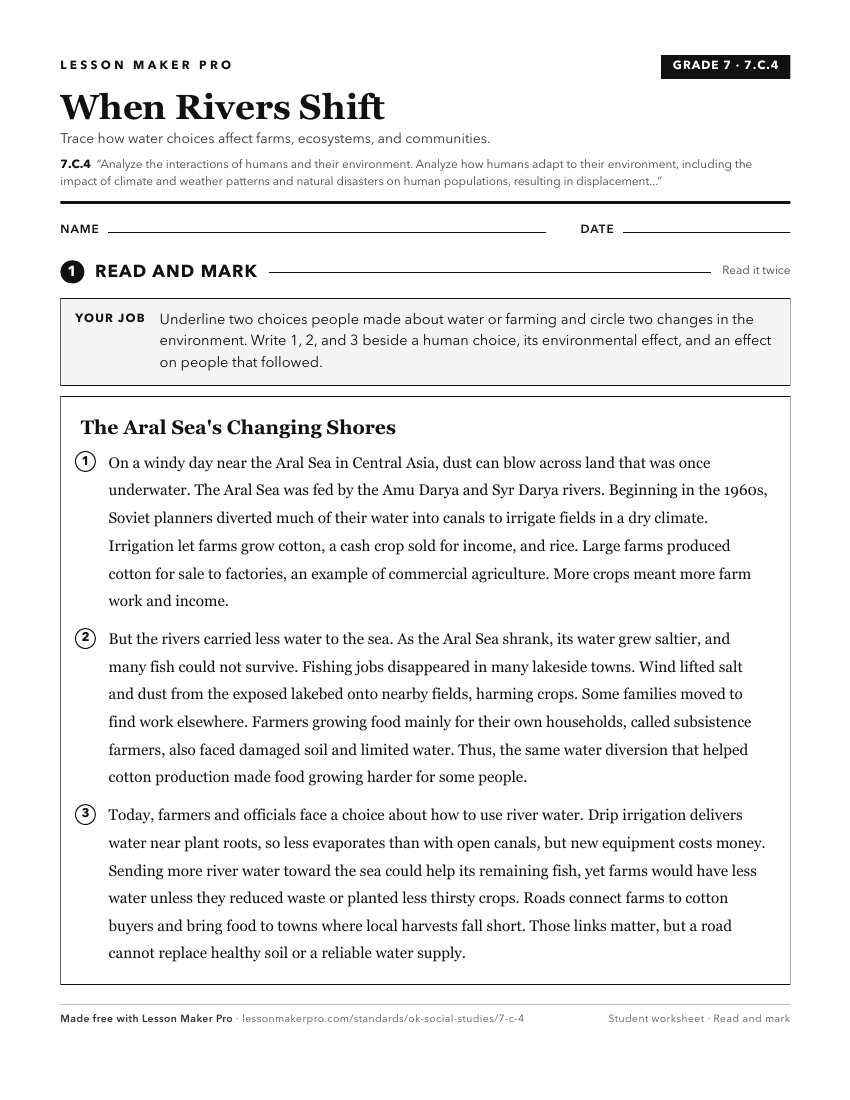
A ready-to-print activity worksheet aligned to 7.C.4, with an answer key for the teacher on its own page. No account needed.
PDF, US Letter, prints cleanly in black and white.
Download the worksheetKeep exploring
Related Standards
- K.P.2.3.C
Identify how the physical environment impacts our daily lives and affects human activities.
- 6.C.4
Analyze the interactions of humans and their environment in the Western Hemisphere.
- 4.C.2.5
Analyze how humans interact with their environments in order to meet their needs and wants.
- 1.P.2.3.C
Identify how the physical environment impacts our daily lives and affects human activities.
Turn this cluster into a lesson
Grade, subject, topic, and the complete cluster are prefilled. Create one free, no account needed.
Also for this cluster:Make a WorksheetMake a QuizMake a Sub Lesson