Oklahoma Social Studies 7.C.4.2
Standard Cluster
- 7.C.4
- Analyze the interactions of humans and their environment.
Describe how humans adapt to and modify their environment for the purpose of food production. Describe the differences among subsistence, cash crop, and commercial agriculture, including their impact on the economic development of a region. Explain how agricultural innovations, such as the Green Revolution and modern irrigation systems, increase food production in developing countries. Examine how agricultural practices in a region imprint the physical environment (e.g., desertification of the Aral Sea, terraced construction for rice farming, modern irrigation methods utilized in the Arabian Peninsula).
Oklahoma Academic Standards for Social Studies (2026) · 7.C.4
Cluster contents
Standards in This Cluster
7.C.4.2 is a cluster heading. These are the individual standards under it.
- 7.C.4.2.A
Describe the differences among subsistence, cash crop, and commercial agriculture, including their impact on the economic development of a region.
- 7.C.4.2.B
Explain how agricultural innovations, such as the Green Revolution and modern irrigation systems, increase food production in developing countries.
- 7.C.4.2.C
Examine how agricultural practices in a region imprint the physical environment (e.g., desertification of the Aral Sea, terraced construction for rice farming, ...
Teacher's field guide
What This Cluster Means
What Students Need to Do
- Students compare farms that grow food for the household with farms that grow crops for sale. They explain how irrigation, improved seeds, and terraces can increase harvests. They also describe how farming can change land and water and affect a region's income.
What Mastery Looks Like
- Students can identify a family bean plot as subsistence farming and coffee grown for sale as a cash crop. They know a large farm selling wheat is commercial farming, and that a cash crop can also be grown on a commercial farm. They can explain how irrigation raises harvests but can reduce water elsewhere, as it did near the Aral Sea.
Common Misconceptions
- Students may treat cash crops and commercial farming as opposites, though the categories can overlap. They may think irrigation creates new water or that larger harvests cannot harm nearby lakes and soil. Some mistake rice terraces for natural hillsides.
How to Assess It
- Exit ticket: A farm sells irrigated cotton grown near the Aral Sea. Explain one benefit for local income and one possible cost to the water supply.
Lesson moves
Ways to Teach It
Shape two slopes in trays of damp soil, cut steps into one, pour equal cups of water, and compare the runoff.
Show cards for family beans, coffee sold abroad, and mechanized wheat for sale; ask which farms feed households and which earn income.
Run a farm-card sort where students label subsistence, cash crop, or commercial farming and mark cards that fit two labels.
Show satellite images of the Aral Sea before and after river diversions; have students mark the changed shoreline and nearby farmland.
Free download
Printable 7.C.4.2 Worksheet
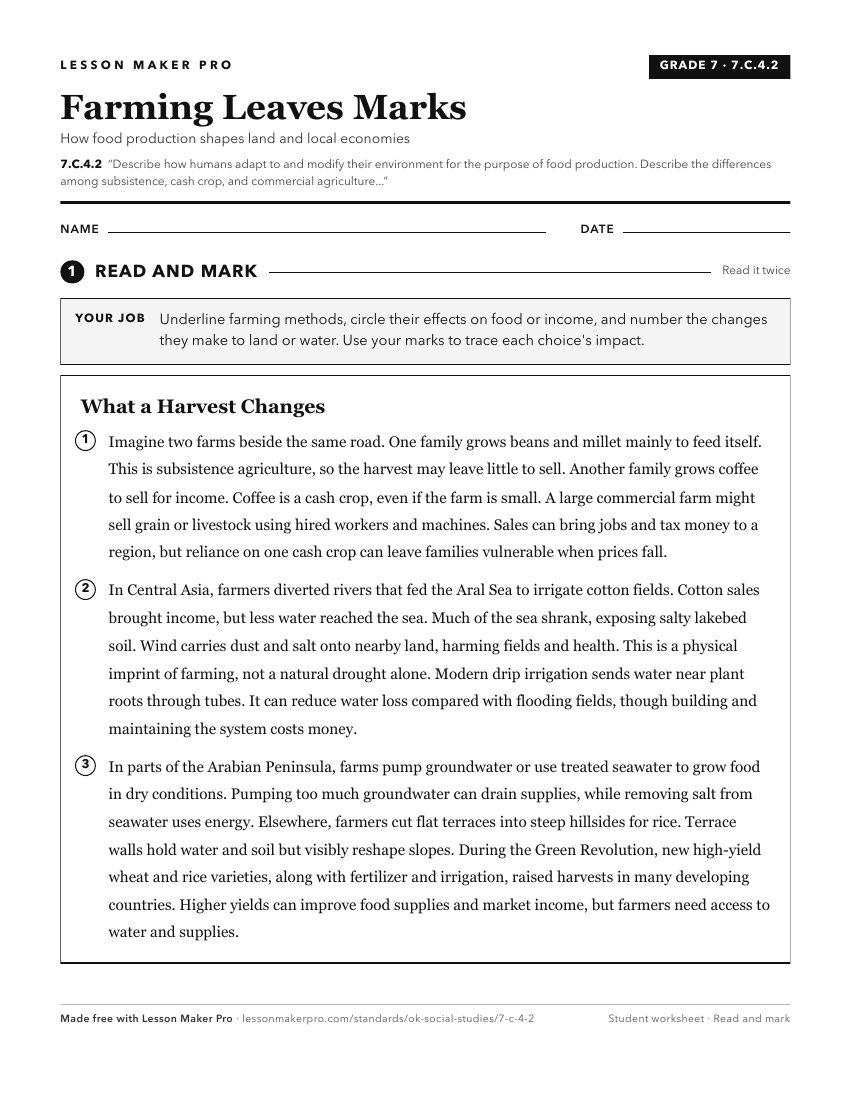
A ready-to-print activity worksheet aligned to 7.C.4.2, with an answer key for the teacher on its own page. No account needed.
PDF, US Letter, prints cleanly in black and white.
Download the worksheetKeep exploring
Related Standards
- 4.C.2.5.A
Explain how humans adapt to the physical environment (e.g., food, shelter, earning a living) by identifying historical and contemporary examples.
- 2.P.2.3.C
Identify and describe how humans modify and adapt to their physical environment, using its natural and human resources.
- 4.C.2.5.B
Describe how humans modify the environment to meet their needs (e.g., clearing of forests, crop rotation and irrigation, conservation, extraction of fossil fuel...
- 2.C.3.9
Explain and describe human interaction with the environment by describing how humans both adapt to (e.g., clothing, housing, food choices) and modify it (e.g., ...
Turn this cluster into a lesson
Grade, subject, topic, and the complete cluster are prefilled. Create one free, no account needed.
Also for this cluster:Make a WorksheetMake a QuizMake a Sub Lesson