Oklahoma Social Studies 7.C.3.4
The Standard
- 7.C.3
- Identify the distribution and demographic patterns of human populations of the Eastern Hemisphere.
Examine how nations address population changes through government policies (e.g., education, health care, immigration).
Oklahoma Academic Standards for Social Studies (2026) · 7.C.3
Teacher's field guide
What This Standard Means
What Students Need to Do
- Students identify how a changing population can put pressure on schools, health care, or jobs. They explain how a government policy responds to that change and who it affects.
What Mastery Looks Like
- A student can explain why a country with more children might build schools, while a country with more older adults might expand health care. They can name a cost or tradeoff of each choice.
Common Misconceptions
- Students may think population change only means a country is growing, not that its people are getting older or moving. They may assume a policy helps everyone equally or has no cost.
How to Assess It
- Exit ticket: A country has a growing number of older adults and too few care workers. Name one policy its government could try, explain how it would help, and give one possible cost.
Lesson moves
Ways to Teach It
Give groups age-group cards showing a changing population and ten budget tokens; have them fund schools, clinics, or worker training.
Ask: Country A has many new children, while Country B has more older adults. Which service should each expand first, and why?
Play Policy Match with cards showing population changes and cards showing school, health care, and immigration policies; have pairs defend each match.
Show a chart of Japan's aging population and a notice about its care worker visas; ask students to connect the policy to the chart.
Free download
Printable 7.C.3.4 Worksheet
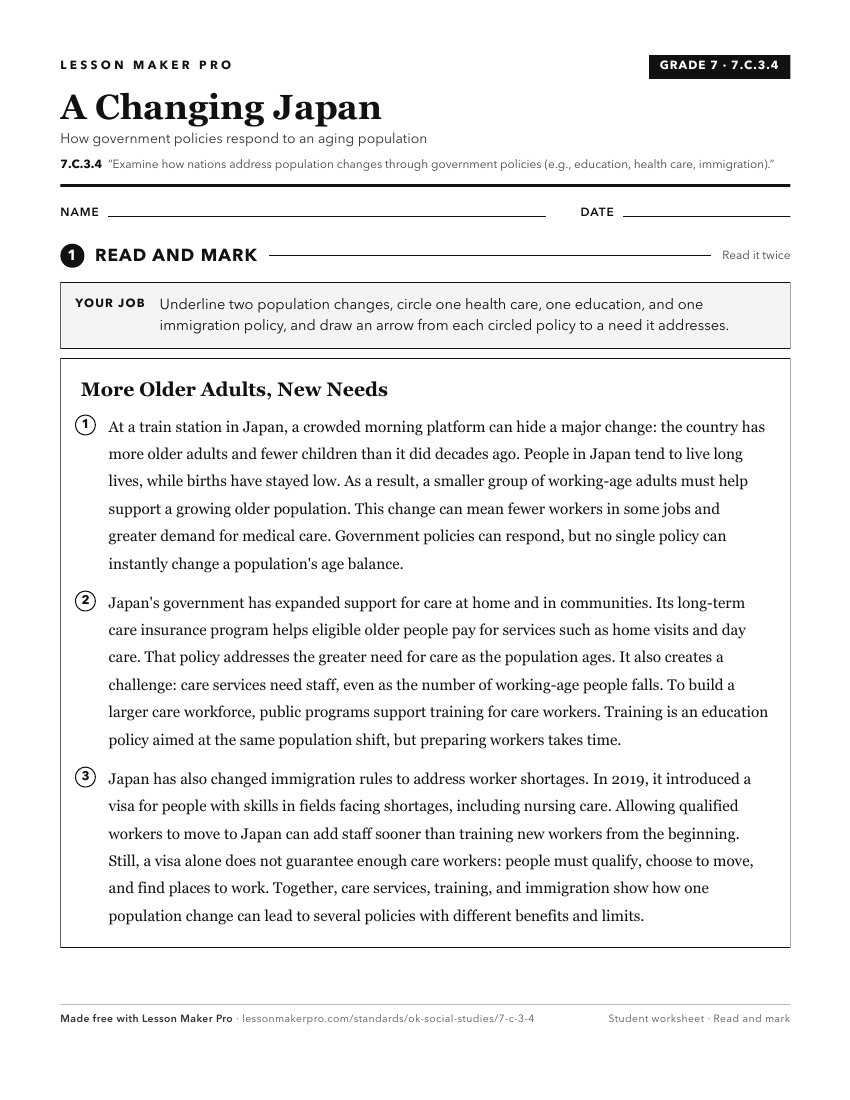
A ready-to-print activity worksheet aligned to 7.C.3.4, with an answer key for the teacher on its own page. No account needed.
PDF, US Letter, prints cleanly in black and white.
Download the worksheetKeep exploring
Related Standards
- WG.C.2.1
Interpret geographic data measuring population including density, distribution, patterns of composition, and population trends and projections to analyze issues...
- WG.C.2
Analyze how the human population is organized geographically in order to understand how change affects human systems.
- 6.C.3.4
Examine the impact of geography on migration and population distribution.
- E.P.2.4.C
Evaluate the impact, both intended and unintended, of government policies on market outcomes at national and global levels, past and present.
Turn this exact standard into a lesson
Grade, subject, topic, and the complete standard are prefilled. Create one free, no account needed.
Also for this standard:Make a WorksheetMake a QuizMake a Sub Lesson