Oklahoma Social Studies 6.C.3.4
Standard Cluster
- 6.C.3
- Identify the characteristics, distribution, and demographic patterns of human populations and systems of the Western Hemisphere.
Examine the impact of geography on migration and population distribution. Define push factors of migration (e.g., instability, conflict, natural disasters) using historic or contemporary examples (e.g., European colonization, political or religious asylum seekers). Identify and provide examples of pull factors of migration (e.g., economic opportunity, religious freedom, family ties, education).
Oklahoma Academic Standards for Social Studies (2026) · 6.C.3
Cluster contents
Standards in This Cluster
6.C.3.4 is a cluster heading. These are the individual standards under it.
- 6.C.3.4.A
Define push factors of migration (e.g., instability, conflict, natural disasters) using historic or contemporary examples (e.g., European colonization, politica...
- 6.C.3.4.B
Identify and provide examples of pull factors of migration (e.g., economic opportunity, religious freedom, family ties, education).
Teacher's field guide
What This Cluster Means
What Students Need to Do
- Students use maps to explain why people leave one place and choose another. They separate reasons for leaving, such as drought or conflict, from reasons for arriving, such as jobs or family. They explain how geography affects travel routes and where people settle.
What Mastery Looks Like
- Given a migration story and a map, a student correctly labels a push factor and a pull factor. They use a feature such as a river or mountain range to explain a travel route or settlement pattern. They can explain why one area gains people while another loses them.
Common Misconceptions
- Students may label a job opportunity as a push factor because it causes someone to move. They may assume all moves are voluntary or that people settle evenly across a map, regardless of flood risk or access to water.
How to Assess It
- Give students a map showing a flood-prone river town and an inland city with jobs. Ask them to draw a migration arrow and label a push factor, a pull factor, and one geographic reason for the move.
Lesson moves
Ways to Teach It
Give pairs a map, two town labels, and yarn; have them trace a route around mountains and explain their choice.
Ask students to write: A family leaves a drought-stricken farm for a city job. What pushed them out, and what pulled them in?
Make cards labeled conflict, family nearby, flood, and school; students sort them into push and pull piles, then defend one choice.
Use a local flood-risk map to mark one neighborhood people might leave and a nearby higher-ground area they might choose.
Free download
Printable 6.C.3.4 Worksheet
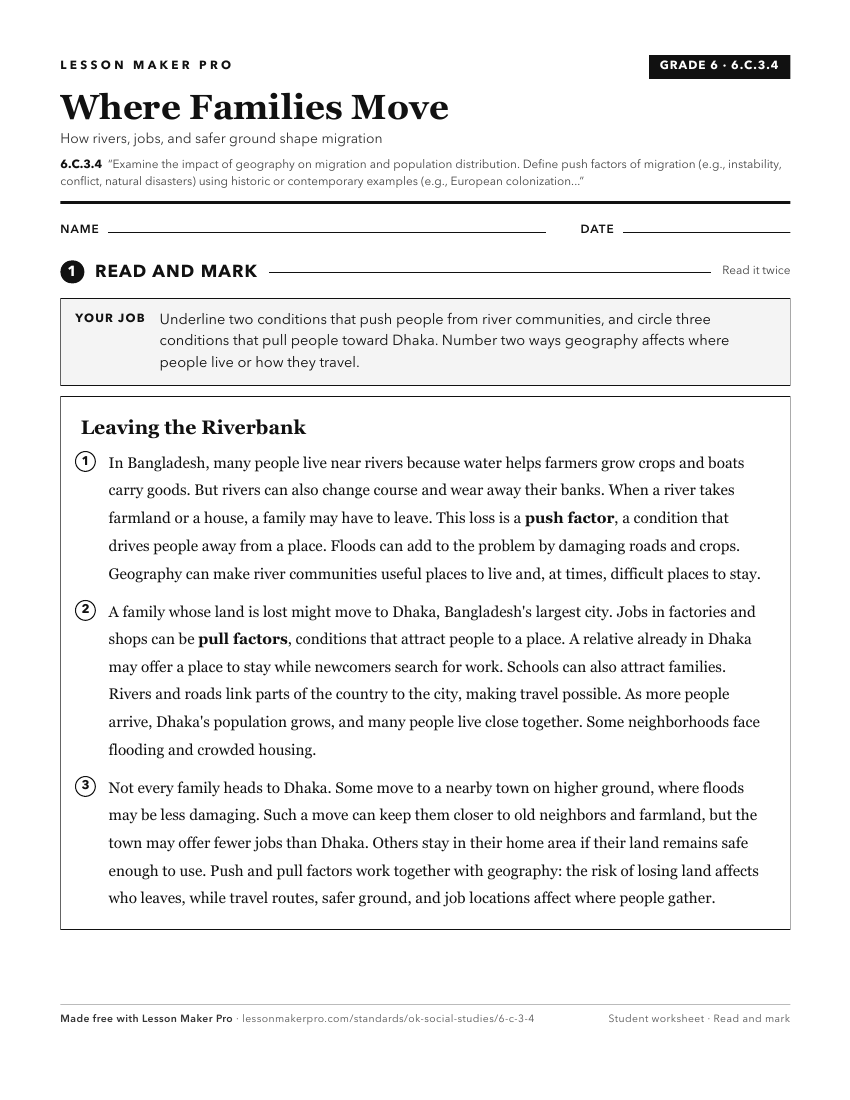
A ready-to-print activity worksheet aligned to 6.C.3.4, with an answer key for the teacher on its own page. No account needed.
PDF, US Letter, prints cleanly in black and white.
Download the worksheetKeep exploring
Related Standards
- WG.C.2
Analyze how the human population is organized geographically in order to understand how change affects human systems.
- 7.C.3.2
Explain the impact of geography on population distribution, density, growth, change, settlement patterns, the availability of resources, and migration.
- WG.C.2.2
Examine common characteristics of urban versus rural communities, including the patterns and impact of modern migration to urban centers and megacities.
- 7.C.2.2
Describe how the physical environment can influence human population distribution, population growth, settlement patterns, land use, and economic activities.
Turn this cluster into a lesson
Grade, subject, topic, and the complete cluster are prefilled. Create one free, no account needed.
Also for this cluster:Make a WorksheetMake a QuizMake a Sub Lesson