Oklahoma Social Studies 7.C.3.2
The Standard
- 7.C.3
- Identify the distribution and demographic patterns of human populations of the Eastern Hemisphere.
Explain the impact of geography on population distribution, density, growth, change, settlement patterns, the availability of resources, and migration.
Oklahoma Academic Standards for Social Studies (2026) · 7.C.3
Teacher's field guide
What This Standard Means
What Students Need to Do
- Students use maps to explain why people cluster in some places and spread out in others. They compare how crowded equal-size areas are. They explain how water, land, and climate can affect resources, growth, and migration.
What Mastery Looks Like
- A student can identify the denser of two equal-size map areas. They can explain why a river valley may attract settlers or why drought may cause families to leave. They recognize that jobs and other factors also shape where people live.
Common Misconceptions
- Students may call the place with the most people the densest without checking its size. They may assume mountains and deserts are empty, or that geography alone explains every move.
How to Assess It
- Give students a map with two equal-size areas: a river valley with eight homes and dry hills with two. Ask which area is denser, why the valley attracts homes, and where two families might move after a drought.
Lesson moves
Ways to Teach It
Give groups a grid map with a river, mountains, and farmland plus 20 counters; have them place settlements and explain their choices.
Ask students to write two sentences explaining how a drought could change a town's population even if its roads stay the same.
Play Move or Stay with drought, fertile soil, and flood cards; students choose whether to move their map markers and explain why.
Open a local map and mark homes near a river or highway; discuss how land and jobs might both shape those locations.
Free download
Printable 7.C.3.2 Worksheet
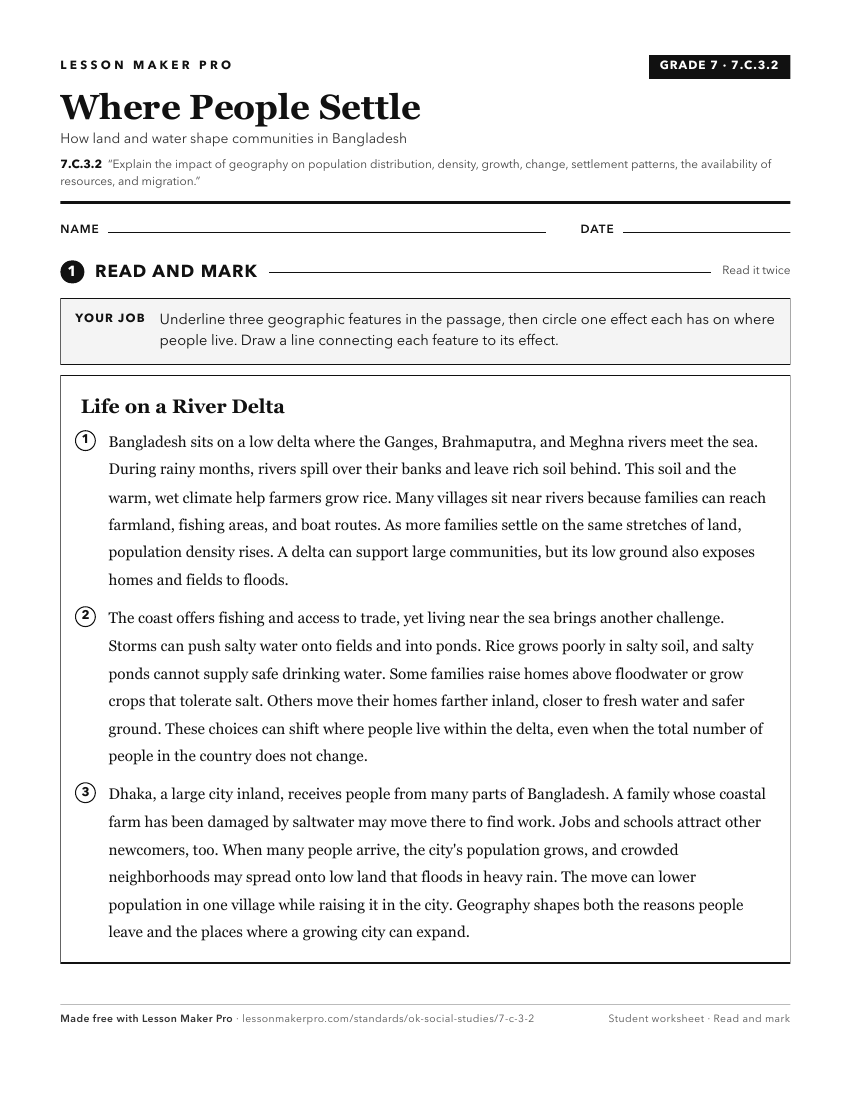
A ready-to-print activity worksheet aligned to 7.C.3.2, with an answer key for the teacher on its own page. No account needed.
PDF, US Letter, prints cleanly in black and white.
Download the worksheetKeep exploring
Related Standards
- MWH.C.1.2
Explain how geographical and environmental factors impacted settlement and cultural development.
- WG.C.2.1
Interpret geographic data measuring population including density, distribution, patterns of composition, and population trends and projections to analyze issues...
- 6.C.3.4
Examine the impact of geography on migration and population distribution.
- 7.C.2.2
Describe how the physical environment can influence human population distribution, population growth, settlement patterns, land use, and economic activities.
Turn this exact standard into a lesson
Grade, subject, topic, and the complete standard are prefilled. Create one free, no account needed.
Also for this standard:Make a WorksheetMake a QuizMake a Sub Lesson