Oklahoma Social Studies WG.C.2.2
The Standard
- WG.C.2
- Analyze how the human population is organized geographically in order to understand how change affects human systems.
Examine common characteristics of urban versus rural communities, including the patterns and impact of modern migration to urban centers and megacities.
Oklahoma Academic Standards for Social Studies (2026) · WG.C.2
Teacher's field guide
What This Standard Means
What Students Need to Do
- Students compare urban and rural places using population density, land use, jobs, and access to services. They explain why people move to cities and how that move affects both the city and the place they left.
What Mastery Looks Like
- Given a map and two community profiles, a student identifies the urban and rural places and points to evidence. They explain a reason people might move to a megacity and describe an effect on each place.
Common Misconceptions
- Students may assume all rural communities are poor or that everyone who moves to a city finds work. They may also treat city population growth as proof of migration, even though births can raise population too.
How to Assess It
- Exit ticket: A village loses 500 residents to a megacity. Name one likely reason for the move, one difference between the places, and one effect on each place.
Lesson moves
Ways to Teach It
On equal-size paper grids, place 18 home tokens on one and two on the other; mark a clinic and explain its location.
Ask: Why might a family leave a rural village for a megacity, and what might change for both places?
Sort cards reading 'farm jobs disappear,' 'city wages rise,' and 'rents climb' into push, pull, or effect piles.
Compare a printed city bus map with a rural road map; mark how a new resident could reach a clinic without a car.
Free download
Printable WG.C.2.2 Worksheet
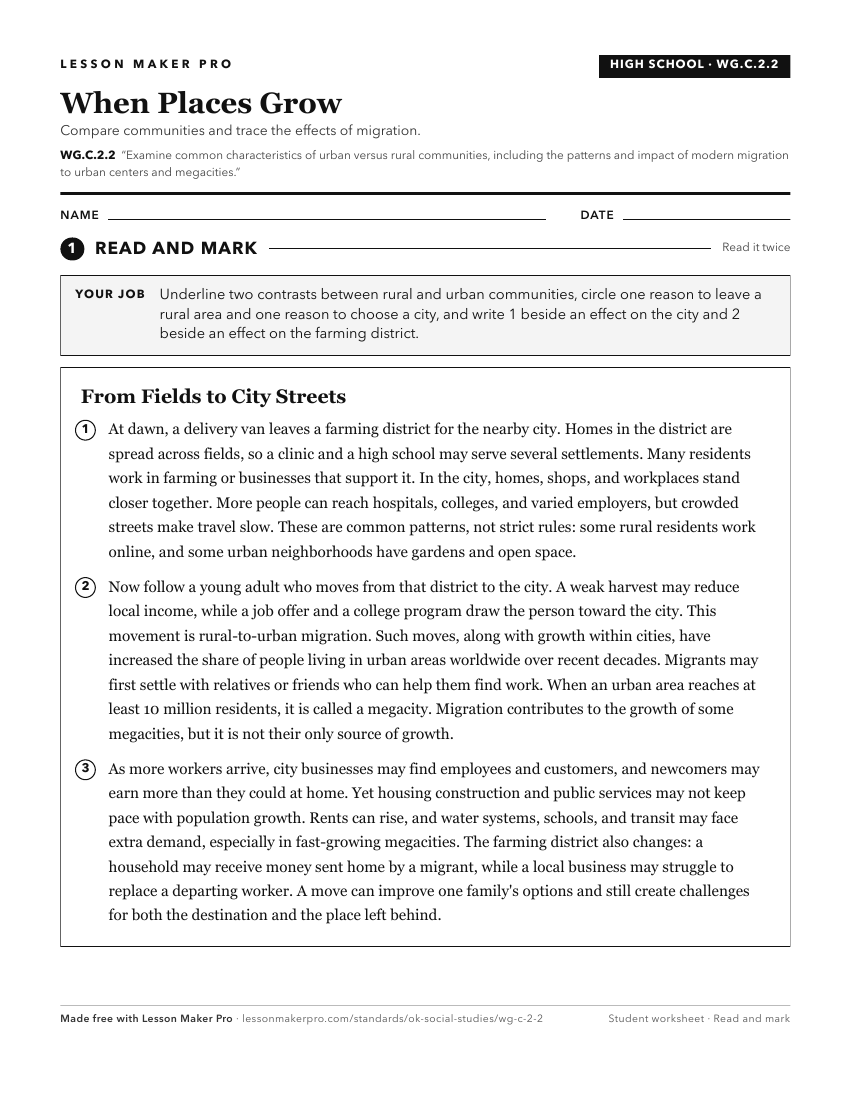
A ready-to-print activity worksheet aligned to WG.C.2.2, with an answer key for the teacher on its own page. No account needed.
PDF, US Letter, prints cleanly in black and white.
Download the worksheetKeep exploring
Related Standards
- 6.C.3.4
Examine the impact of geography on migration and population distribution.
- 2.C.3.8
Compare the characteristics of land use in urban and rural environments (e.g., agricultural and recreational purposes, manufacturing, shopping, community buildi...
- 7.C.3.5.B
Describe contemporary reasons and examples of migration (e.g., drought in agricultural eastern Africa resulting in urbanization, overpopulation of India’s citie...
- OKH.C.8.2.G
Identify the causes and consequences of rural to urban to suburban migration, as well as urban renewal efforts (e.g., Oklahoma City’s MAPS Project).
Turn this exact standard into a lesson
Grade, subject, topic, and the complete standard are prefilled. Create one free, no account needed.
Also for this standard:Make a WorksheetMake a QuizMake a Sub Lesson