Oklahoma Social Studies 5.C.3.3
Standard Cluster
- 5.C.3
- Analyze the series of events and policies which led colonists to seek and declare independence.
Explain efforts to mobilize support for the American Revolution. Compare the role of the Sons of Liberty, the Committees of Correspondence, and the Minutemen. Describe how the British raids and armed encounters at Lexington and Concord became catalysts for the revolution. Explain how Thomas Paine’s Common Sense shifted American sentiment toward independence. Describe the significance of the rallying cry, “no taxation without representation.”
Oklahoma Academic Standards for Social Studies (2026) · 5.C.3
Cluster contents
Standards in This Cluster
5.C.3.3 is a cluster heading. These are the individual standards under it.
- 5.C.3.3.A
Compare the role of the Sons of Liberty, the Committees of Correspondence, and the Minutemen.
- 5.C.3.3.B
Describe how the British raids and armed encounters at Lexington and Concord became catalysts for the revolution.
- 5.C.3.3.C
Explain how Thomas Paine’s Common Sense shifted American sentiment toward independence.
- 5.C.3.3.D
Describe the significance of the rallying cry, “no taxation without representation.”
Teacher's field guide
What This Cluster Means
What Students Need to Do
- Students explain how colonists used protests, shared letters, and local militias to build resistance to British rule. They describe how fighting at Lexington and Concord, Paine’s pamphlet, and anger over taxes without a vote in Parliament moved more colonists toward independence.
What Mastery Looks Like
- Students can say that the Sons of Liberty organized protests, the Committees of Correspondence shared news, and the Minutemen prepared to fight. They explain how British troops’ march to seize colonial supplies led to fighting at Lexington and Concord. They connect Paine’s case against monarchy and the tax complaint to growing support for independence.
Common Misconceptions
- Students may think all three groups were militias or that the Minutemen wrote the letters. Some think the fighting at Lexington and Concord happened after independence was declared. Others think colonists had no elected representatives anywhere, rather than no elected representatives in Parliament.
How to Assess It
- On an exit ticket, ask students to match each group to protest, news sharing, or militia response. Then have them write one short line each about how Lexington and Concord, Paine’s pamphlet, and the tax complaint built support.
Lesson moves
Ways to Teach It
Give pairs dated cards for tax protests, committee letters, Lexington and Concord, and Common Sense; have them build an annotated timeline.
Ask: “Why might a tax feel unfair if you cannot vote for anyone in Parliament?” Have students write a colonist’s reply.
Play a card sort matching protest, letter writing, and militia response to the Sons of Liberty, Committees of Correspondence, and Minutemen.
Show a school board meeting notice and a sample student petition about lunch; ask how each could build support for a change.
Free download
Printable 5.C.3.3 Worksheet
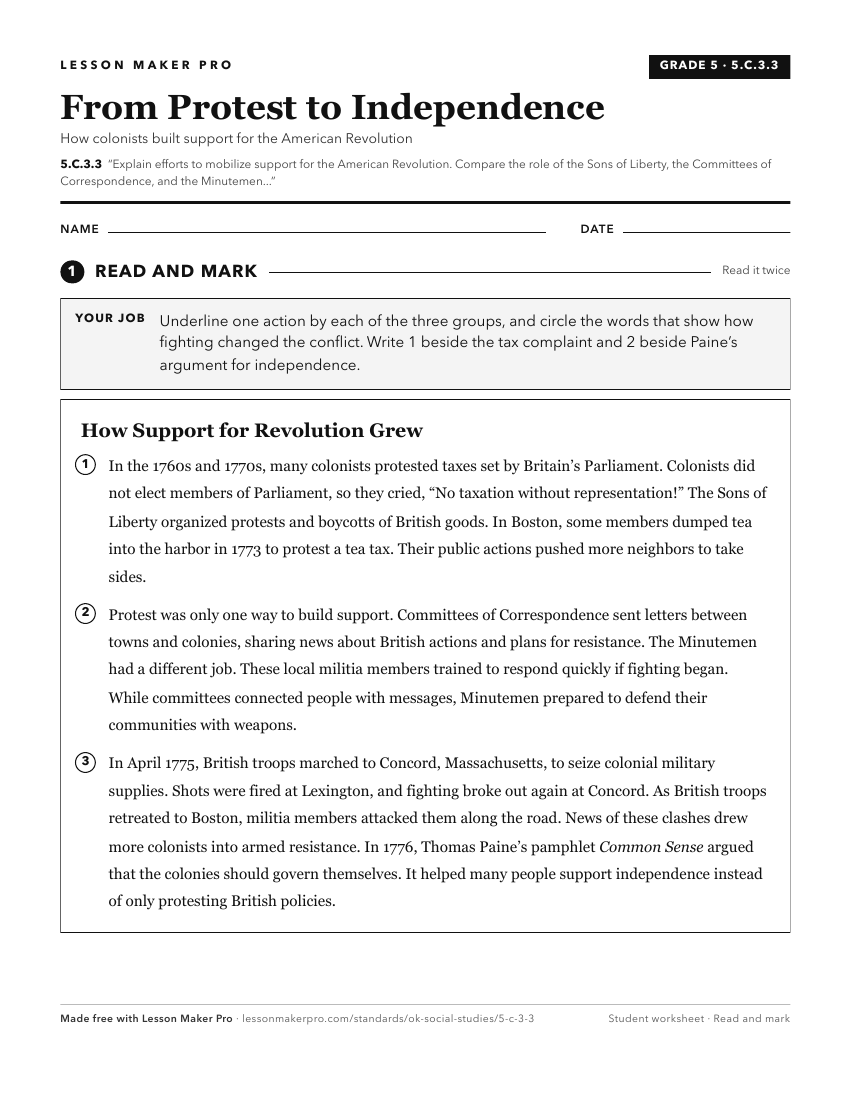
A ready-to-print activity worksheet aligned to 5.C.3.3, with an answer key for the teacher on its own page. No account needed.
PDF, US Letter, prints cleanly in black and white.
Download the worksheetKeep exploring
Related Standards
- 5.C.4.5
Identify the contributions of key individuals influential to the American Revolution in the fields of
- 5.C.4.1
Explain how the colonists were divided toward the growing call for independence by identifying various points of view and motivations, including patriots, loyal...
- 8.C.1.3.C
Explain the strategies utilized by colonists to oppose imperial policies, including the issuance of the Stamp Act Resolves and the use of propaganda, exemplifie...
- 5.C.4.4.E
Explain the significance of Thomas Paine’s The Crisis in bolstering patriot morale among the public and the military.
Turn this cluster into a lesson
Grade, subject, topic, and the complete cluster are prefilled. Create one free, no account needed.
Also for this cluster:Make a WorksheetMake a QuizMake a Sub Lesson