Oklahoma Social Studies 4.C.1.1
Standard Cluster
- 4.C.1
- Explain the principles of democratic government and the role of citizens.
Describe the principles of democratic governments, such as the United States of America. Identify the principles upon which our nation’s government is based, including the rule of law, compromise, equality, and individual rights of life, liberty and property. Examine the responsibility of the United States of America’s government as it relates to the promotion of the common good (e.g., security of the people, law and order, general welfare). Explain why the United States of America is considered a constitutional republic by identifying the people as the source of authority and describing how the people engage in the political process of fair elections at local, state, and national levels. Explain how the Constitution of the United States of America is a written plan for establishing the shared powers of government and organizing its institutions. Explain basic principles expressed in the Declaration of Independence.
Oklahoma Academic Standards for Social Studies (2026) · 4.C.1
Cluster contents
Standards in This Cluster
4.C.1.1 is a cluster heading. These are the individual standards under it.
- 4.C.1.1.A
Identify the principles upon which our nation’s government is based, including the rule of law, compromise, equality, and individual rights of life, liberty and...
- 4.C.1.1.B
Examine the responsibility of the United States of America’s government as it relates to the promotion of the common good (e.g., security of the people, law and...
- 4.C.1.1.C
Explain why the United States of America is considered a constitutional republic by identifying the people as the source of authority and describing how the peo...
- 4.C.1.1.D
Explain how the Constitution of the United States of America is a written plan for establishing the shared powers of government and organizing its institutions.
- 4.C.1.1.E
Explain basic principles expressed in the Declaration of Independence.
Teacher's field guide
What This Cluster Means
What Students Need to Do
- Students explain how laws, compromise, equality, and rights guide government decisions. They describe how people elect leaders at local, state, and national levels. They explain how the Declaration of Independence states basic rights and how the Constitution sets up and divides government power.
What Mastery Looks Like
- A student can explain that elected officials must follow laws and that government works to protect people's safety and well-being. They can name life, liberty, and property as rights, explain that government gets its authority from the people, and tell what each founding document does.
Common Misconceptions
- Students may think voters decide every law, rather than electing people to make many decisions. Some think officials are above the law or that individual rights mean they can ignore rules that protect others. Others mix up the documents and say the Declaration sets up the branches of government.
How to Assess It
- Exit ticket: “A town elects a mayor who ignores a safety law. Who gave the mayor authority, why must the mayor follow the law, and how does the law help the town?”
Lesson moves
Ways to Teach It
Give pairs mayor, governor, and president cards to place under local, state, or national, then have them cast a paper ballot.
Ask: “Should the town close a playground with broken equipment? How would safety, freedom, and the common good shape that decision?”
Play document match: read “people are created equal” and “Congress makes laws”; students raise Declaration or Constitution cards and explain each choice.
Show a photo of a park’s “No swimming” sign; ask who it protects and whether the mayor must obey it.
Free download
Printable 4.C.1.1 Worksheet
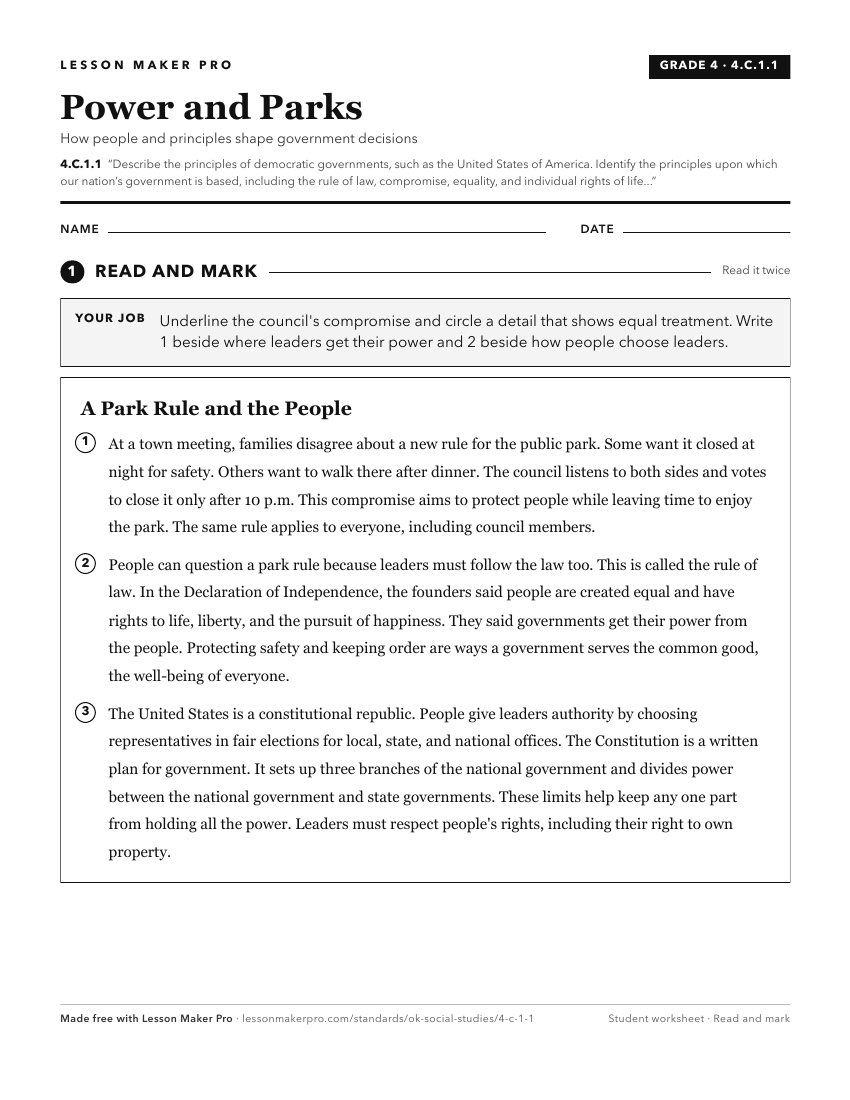
A ready-to-print activity worksheet aligned to 4.C.1.1, with an answer key for the teacher on its own page. No account needed.
PDF, US Letter, prints cleanly in black and white.
Download the worksheetKeep exploring
Related Standards
- 6.P.2.1
Demonstrate an understanding of the principles of government, the benefits of democratic systems, and their responsibilities as citizens.
- 5.P.2.1
Demonstrate an understanding of the principles of government, the benefits of democratic systems, and their responsibilities as citizens.
- 1.P.2.1
Demonstrate an understanding of the principles of government, the benefits of democratic systems, and their responsibilities as citizens.
- 4.C.1
Explain the principles of democratic government and the role of citizens.
Turn this cluster into a lesson
Grade, subject, topic, and the complete cluster are prefilled. Create one free, no account needed.
Also for this cluster:Make a WorksheetMake a QuizMake a Sub Lesson