Oklahoma Social Studies 4.C.1
Standard Cluster
Explain the principles of democratic government and the role of citizens. Describe the principles of democratic governments, such as the United States of America. Identify the principles upon which our nation’s government is based, including the rule of law, compromise, equality, and individual rights of life, liberty and property. Examine the responsibility of the United States of America’s government as it relates to the promotion of the common good (e.g., security of the people, law and order, general welfare). Explain why the United States of America is considered a constitutional republic by identifying the people as the source of authority and describing how the people engage in the political process of fair elections at local, state, and national levels. Explain how the Constitution of the United States of America is a written plan for establishing the shared powers of government and organizing its institutions. Explain basic principles expressed in the Declaration of Independence. Analyze the historical development of American Indian citizenship and constitutional rights in the United States of America. Examine how tribal sovereignty and United States of America citizenship function within the United States of America. Explain the concept of civic virtue and responsibilities of citizenship. Examine why citizens are expected to respect the law and institutions of authority. Analyze how fulfilling one’s civic responsibilities (e.g., voting, jury and military service, paying taxes) is necessary for the health and continuity of a constitutional republic. Describe how our nation’s constitutional republic relies on civil discourse, thoughtful decision-making, and compromise to make laws. Explain how citizens can contribute to the betterment of their communities through public service, charitable donations, and volunteerism. Summarize ways in which citizens are stewards of the nation’s environment by examining how natural resources can be managed wisely (e.g., recycling and anti-littering efforts, water conservation, development of renewable energy sources).
Oklahoma Academic Standards for Social Studies (2026)
Cluster contents
Standards in This Cluster
4.C.1 is a cluster heading. These are the individual standards under it.
- 4.C.1.1
Describe the principles of democratic governments, such as the United States of America.
- 4.C.1.1.A
Identify the principles upon which our nation’s government is based, including the rule of law, compromise, equality, and individual rights of life, liberty and...
- 4.C.1.1.B
Examine the responsibility of the United States of America’s government as it relates to the promotion of the common good (e.g., security of the people, law and...
- 4.C.1.1.C
Explain why the United States of America is considered a constitutional republic by identifying the people as the source of authority and describing how the peo...
- 4.C.1.1.D
Explain how the Constitution of the United States of America is a written plan for establishing the shared powers of government and organizing its institutions.
- 4.C.1.1.E
Explain basic principles expressed in the Declaration of Independence.
- 4.C.1.2
Analyze the historical development of American Indian citizenship and constitutional rights in the United States of America. Examine how tribal sovereignty and ...
- 4.C.1.3
Explain the concept of civic virtue and responsibilities of citizenship.
- 4.C.1.3.A
Examine why citizens are expected to respect the law and institutions of authority.
- 4.C.1.3.B
Analyze how fulfilling one’s civic responsibilities (e.g., voting, jury and military service, paying taxes) is necessary for the health and continuity of a cons...
- 4.C.1.3.C
Describe how our nation’s constitutional republic relies on civil discourse, thoughtful decision-making, and compromise to make laws.
- 4.C.1.3.D
Explain how citizens can contribute to the betterment of their communities through public service, charitable donations, and volunteerism.
- 4.C.1.3.E
Summarize ways in which citizens are stewards of the nation’s environment by examining how natural resources can be managed wisely (e.g., recycling and anti-lit...
Teacher's field guide
What This Cluster Means
What Students Need to Do
- Students explain how rights, rule of law, and compromise guide government. They connect elections, the Declaration of Independence, and the Constitution to government by the people. They describe civic duties, public services, care for natural resources, and how tribal and U.S. citizenship can coexist.
What Mastery Looks Like
- A student can explain that voters choose representatives and the Constitution divides government power. They can connect the Declaration's claims about equality, rights, and consent to a public decision. They can describe the 1924 citizenship law, later voting barriers for American Indians, and the continuing authority of tribal governments.
Common Misconceptions
- Students may think a majority vote can take away anyone's rights, or that the president makes all laws. Some assume U.S. citizenship in 1924 immediately gave every American Indian an equal chance to vote. Others think U.S. citizenship ends tribal citizenship or tribal self-government.
How to Assess It
- Exit ticket: Voters choose a town council that passes a water-saving rule. Who gave the council authority, what common good might the rule serve, and what rights should council members consider?
Lesson moves
Ways to Teach It
Give groups 12 counters to fund a crossing guard, water station, and park cleanup; have them agree on a budget and explain their compromise.
Ask, “Should a city limit lawn watering during a drought?” Have partners discuss rights, the common good, and one fair compromise.
Match cards showing a voter, Congress, the president, and courts to their roles in making, carrying out, and reviewing laws.
Compare a tribal nation's public service page with your city government's site; list one service each provides and who makes the decisions.
Free download
Printable 4.C.1 Worksheet
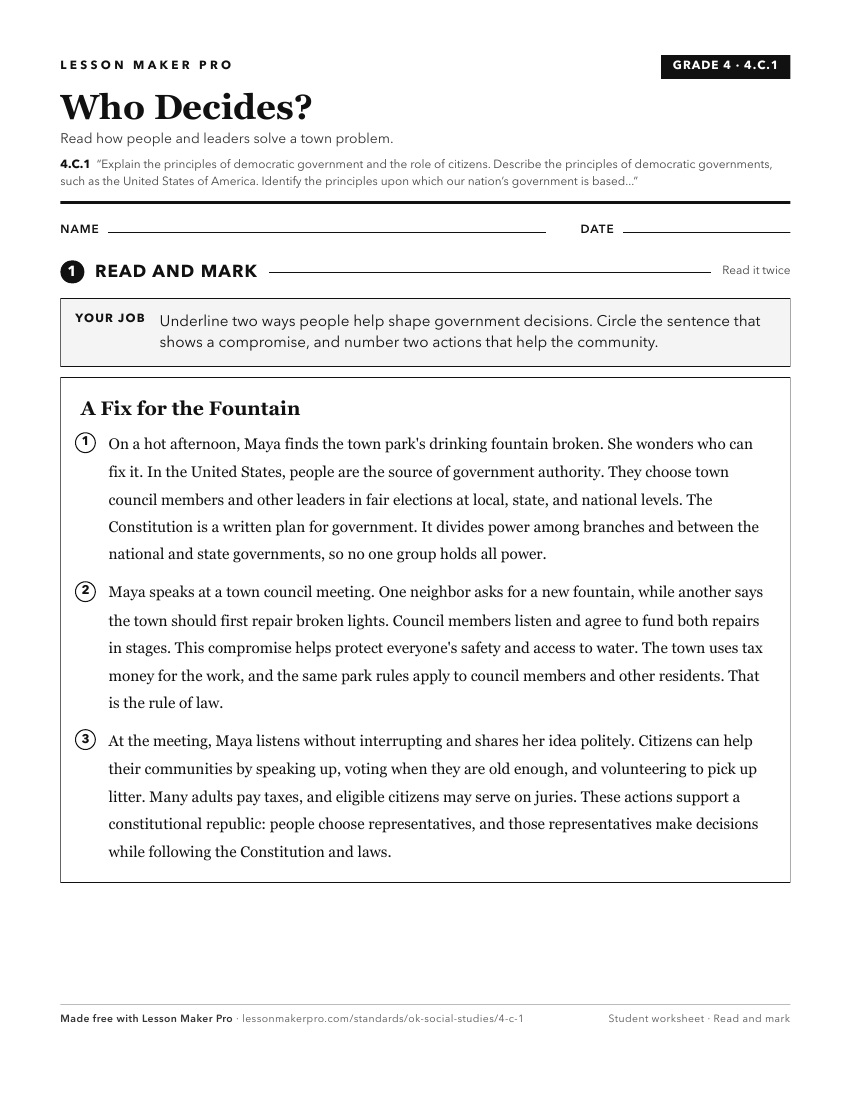
A ready-to-print activity worksheet aligned to 4.C.1, with an answer key for the teacher on its own page. No account needed.
PDF, US Letter, prints cleanly in black and white.
Download the worksheetKeep exploring
Related Standards
- 6.P.2.1
Demonstrate an understanding of the principles of government, the benefits of democratic systems, and their responsibilities as citizens.
- 5.P.2.1
Demonstrate an understanding of the principles of government, the benefits of democratic systems, and their responsibilities as citizens.
- 1.P.2.1
Demonstrate an understanding of the principles of government, the benefits of democratic systems, and their responsibilities as citizens.
Turn this cluster into a lesson
Grade, subject, topic, and the complete cluster are prefilled. Create one free, no account needed.
Also for this cluster:Make a WorksheetMake a QuizMake a Sub Lesson