Oklahoma Social Studies 3.C.2.3
Standard Cluster
- 3.C.2
- Examine Oklahoma’s geography and how people of Oklahoma interact with their environment.
Describe ways early inhabitants of present-day Oklahoma satisfied their basic needs and wants by interacting with the environment and using the natural resources of the region. Explain that people both adapt to and modify their environment in order to meet their basic needs and wants. Describe how the environment contains natural resources used by humans and identify the characteristics of renewable versus non-renewable resources by providing examples found in Oklahoma. Identify the ways in which physical geography influenced early American Indian cultures of the region (e.g., bison hunting, fur trading, farming). Describe how early settlers to the region adapted to and modified their environment (e.g., sod houses, windmills, irrigation of cash crops).
Oklahoma Academic Standards for Social Studies (2026) · 3.C.2
Cluster contents
Standards in This Cluster
3.C.2.3 is a cluster heading. These are the individual standards under it.
- 3.C.2.3.A
Explain that people both adapt to and modify their environment in order to meet their basic needs and wants.
- 3.C.2.3.B
Describe how the environment contains natural resources used by humans and identify the characteristics of renewable versus non-renewable resources by providing...
- 3.C.2.3.C
Identify the ways in which physical geography influenced early American Indian cultures of the region (e.g., bison hunting, fur trading, farming).
- 3.C.2.3.D
Describe how early settlers to the region adapted to and modified their environment (e.g., sod houses, windmills, irrigation of cash crops).
Teacher's field guide
What This Cluster Means
What Students Need to Do
- Students explain how the land and its resources shaped food and shelter for early American Indian communities in present-day Oklahoma. They describe how settlers used materials they found and changed the land to meet their needs. They tell which resources can be replaced within a human lifetime.
What Mastery Looks Like
- A student connects bison hunting to grasslands and farming to river water. They explain why settlers built sod houses where trees were scarce and how irrigation changed dry fields. They identify trees as renewable and oil as nonrenewable, and say why.
Common Misconceptions
- Students may think every early American Indian community hunted bison, even though some also farmed. They may call oil renewable because people can drill for more. They may confuse adapting to dry land with changing it by digging an irrigation ditch.
How to Assess It
- Hand out a sketch of a prairie, river, trees, and oil well. Ask students to label one early food source, one settler adaptation or change, and which resource, trees or oil, nature can replace within a human lifetime.
Lesson moves
Ways to Teach It
Give pairs cards showing prairie, river, trees, and oil; have them match bison hunting, farming, sod houses, and drilling to each setting.
Ask, “Why would a settler build with sod instead of wood on a prairie, and how would an irrigation ditch change that place?”
Play a two-pile card sort with trees, bison, oil, and natural gas; partners explain which resources nature can replace within a human lifetime.
Show photos of a local tree and an Oklahoma oil pumpjack; ask which resource could grow back after use.
Free download
Printable 3.C.2.3 Worksheet
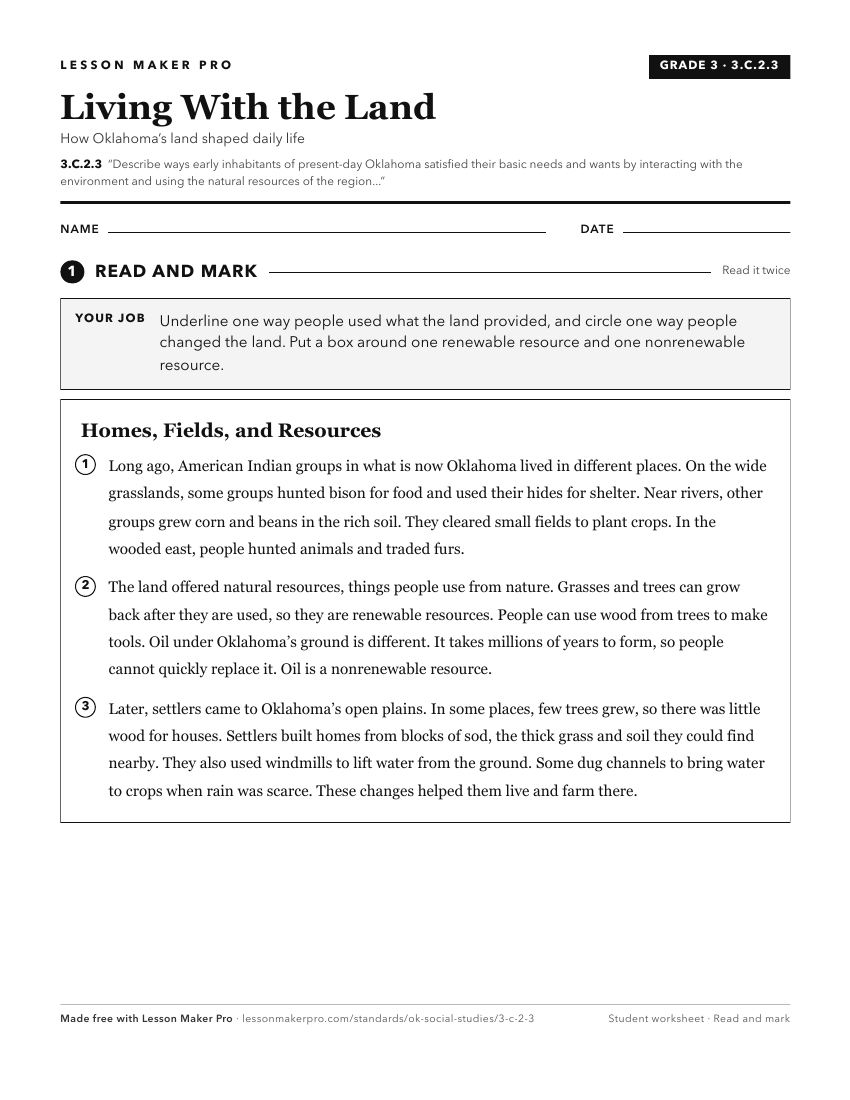
A ready-to-print activity worksheet aligned to 3.C.2.3, with an answer key for the teacher on its own page. No account needed.
PDF, US Letter, prints cleanly in black and white.
Download the worksheetKeep exploring
Related Standards
- OKH.C.1.1
Describe the diverse physical features of Oklahoma and how the environment, ecological regions, and natural resources can affect human activity, by comparing in...
- 3.C.2
Examine Oklahoma’s geography and how people of Oklahoma interact with their environment.
- 3.C.2.4
Examine how Oklahomans continue to adapt and modify their environments to meet their needs.
Turn this cluster into a lesson
Grade, subject, topic, and the complete cluster are prefilled. Create one free, no account needed.
Also for this cluster:Make a WorksheetMake a QuizMake a Sub Lesson