Oklahoma Social Studies 1.P.3
Standard Cluster
Engage in critical, active reading of primary and secondary sources related to social studies concepts. Comprehend, evaluate, and synthesize textual sources to acquire and refine knowledge in the social studies. Locate the topic or main idea and supporting details of a text. Use titles and graphic features, including photographs and illustrations, to understand a text. Apply critical reading and thinking skills to interpret, evaluate, and respond to a variety of complex texts and perspectives. Identify the author’s purpose, with guidance and support. Locate facts that are clearly stated in a text (e.g., who, what, where, when, why, how). Ask and answer basic questions and engage in collaborative discussions about appropriate topics in a text.
Oklahoma Academic Standards for Social Studies (2026)
Cluster contents
Standards in This Cluster
1.P.3 is a cluster heading. These are the individual standards under it.
- 1.P.3.1
Comprehend, evaluate, and synthesize textual sources to acquire and refine knowledge in the social studies.
- 1.P.3.1.A
Locate the topic or main idea and supporting details of a text.
- 1.P.3.1.B
Use titles and graphic features, including photographs and illustrations, to understand a text.
- 1.P.3.2
Apply critical reading and thinking skills to interpret, evaluate, and respond to a variety of complex texts and perspectives.
- 1.P.3.2.A
Identify the author’s purpose, with guidance and support.
- 1.P.3.2.B
Locate facts that are clearly stated in a text (e.g., who, what, where, when, why, how).
- 1.P.3.2.C
Ask and answer basic questions and engage in collaborative discussions about appropriate topics in a text.
Teacher's field guide
What This Cluster Means
What Students Need to Do
- Students use titles, pictures, and short texts about community life or the past to find the main idea and facts on the page. They compare what an old photo shows with what a later account says. They ask questions and talk about why someone wrote the text.
What Mastery Looks Like
- Given a photo of an old classroom and a short paragraph about it, a student tells what the paragraph is mostly about. They point to a detail in the words and a clue in the photo. With a prompt, they explain what the writer wants readers to know.
Common Misconceptions
- Students may pick the most noticeable object in a photo as the main idea, even when the words are about something else. They may guess an answer instead of finding it in the text. They may assume a photo tells the whole story.
How to Assess It
- Show a photo of children writing on slates and read: “School Long Ago. Children wrote on slates. One teacher taught many ages.” Ask, “What is this mostly about? Give one clue from the words and one from the photo.”
Lesson moves
Ways to Teach It
Give pairs a printed photo of an old classroom and a two-sentence museum label; have them underline one detail the photo supports.
Show an old classroom photo and read its museum caption; ask, “What does the caption tell us that the photo cannot?”
Play detail detective with a library flyer: pairs find where story time happens and point to the printed answer.
Bring in a school newsletter with a photo; students name the event, find one printed fact, and tell who might read it.
Free download
Printable 1.P.3 Worksheet
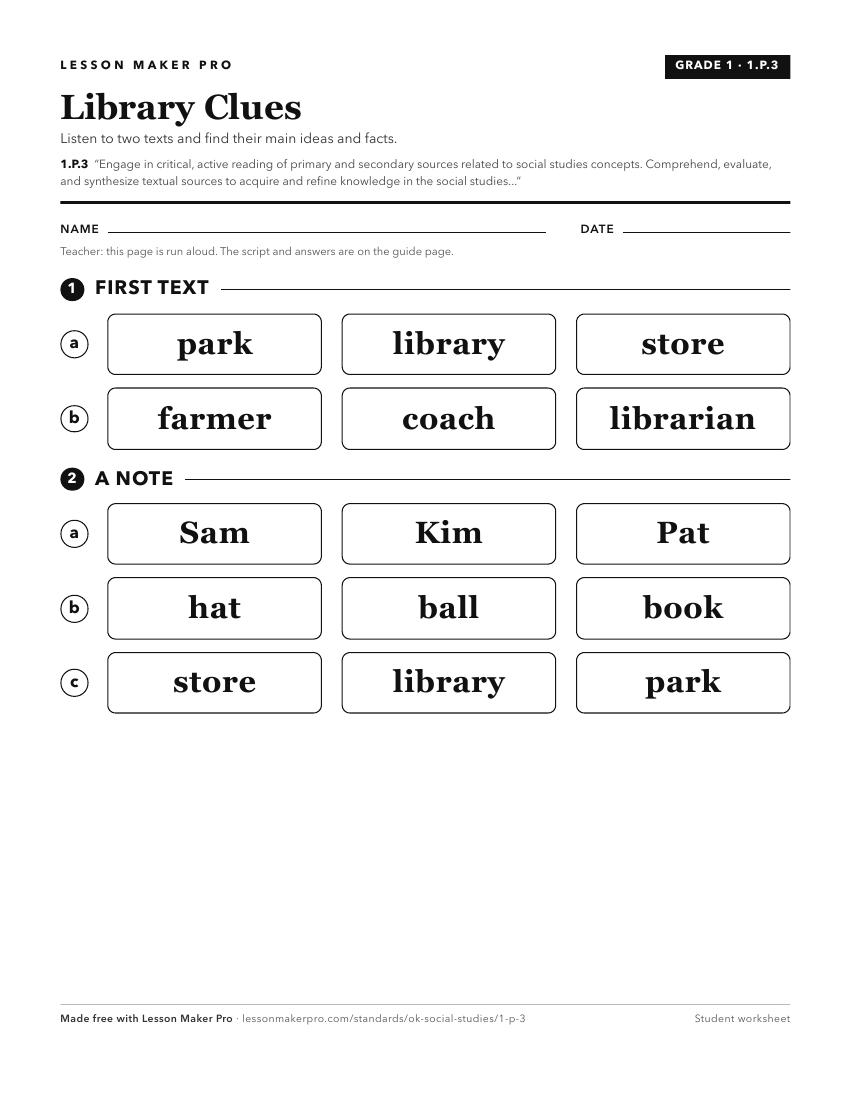
A ready-to-print activity worksheet aligned to 1.P.3, with an answer key for the teacher on its own page. No account needed.
PDF, US Letter, prints cleanly in black and white.
Download the worksheetKeep exploring
Related Standards
Turn this cluster into a lesson
Grade, subject, topic, and the complete cluster are prefilled. Create one free, no account needed.
Also for this cluster:Make a WorksheetMake a QuizMake a Sub Lesson