Oklahoma Math G.2D.1
Standard Cluster
Discover, evaluate, and analyze the relationships between lines, angles, and polygons to solve real-world and mathematical problems; express proofs in a form that clearly justifies the reasoning (e.g., two-column proofs, paragraph proofs, flowcharts). Use properties of parallel lines cut by a transversal to determine angle relationships and solve problems. Use the angle relationships formed by lines cut by a transversal to determine if the lines are parallel and verify, using algebraic and deductive proofs. Apply the properties of angles (corresponding, exterior, interior, vertical, complementary, supplementary) to solve problems using mathematical models, algebraic reasoning, and proofs. Apply theorems involving the interior and exterior angle sums of polygons to solve problems using mathematical models, algebraic reasoning, and proofs. Apply the properties of special quadrilaterals (square, rectangle, trapezoid, isosceles trapezoid, rhombus, kite, parallelogram) to solve problems involving angle measures and segment lengths using mathematical models, algebraic reasoning, and proofs. Use coordinate geometry and algebraic reasoning to represent and analyze line segments and polygons, including determining lengths, midpoints, and slopes of line segments. Apply the properties of polygons, and use them to represent and apply mathematical models involving perimeter and area (e.g., triangles, special quadrilaterals, regular polygons up to 12 sides, composite figures). Apply the properties of congruent or similar polygons to solve problems using mathematical models and algebraic and logical reasoning. Construct logical arguments to prove triangle congruence (SSS, SAS, ASA, AAS and HL). Construct logical arguments to prove triangle similarity (AA, SSS, SAS). Use numeric, graphic, and algebraic representations of transformations in two dimensions (e.g., reflections, translations, dilations, rotations about the origin by multiples of 90̊) to solve problems involving figures on a coordinate plane and identify types of symmetry.
Oklahoma Academic Standards for Mathematics (2022)
Cluster contents
Standards in This Cluster
G.2D.1 is a cluster heading. These are the individual standards under it.
- G.2D.1.1
Use properties of parallel lines cut by a transversal to determine angle relationships and solve problems.
- G.2D.1.2
Use the angle relationships formed by lines cut by a transversal to determine if the lines are parallel and verify, using algebraic and deductive proofs.
- G.2D.1.3
Apply the properties of angles (corresponding, exterior, interior, vertical, complementary, supplementary) to solve problems using mathematical models, algebrai...
- G.2D.1.4
Apply theorems involving the interior and exterior angle sums of polygons to solve problems using mathematical models, algebraic reasoning, and proofs.
- G.2D.1.5
Apply the properties of special quadrilaterals (square, rectangle, trapezoid, isosceles trapezoid, rhombus, kite, parallelogram) to solve problems involving ang...
- G.2D.1.6
Use coordinate geometry and algebraic reasoning to represent and analyze line segments and polygons, including determining lengths, midpoints, and slopes of lin...
- G.2D.1.7
Apply the properties of polygons, and use them to represent and apply mathematical models involving perimeter and area (e.g., triangles, special quadrilaterals,...
- G.2D.1.8
Apply the properties of congruent or similar polygons to solve problems using mathematical models and algebraic and logical reasoning.
- G.2D.1.9
Construct logical arguments to prove triangle congruence (SSS, SAS, ASA, AAS and HL).
- G.2D.1.10
Construct logical arguments to prove triangle similarity (AA, SSS, SAS).
- G.2D.1.11
Use numeric, graphic, and algebraic representations of transformations in two dimensions (e.g., reflections, translations, dilations, rotations about the origin...
Teacher's field guide
What This Cluster Means
What Students Need to Do
- Students use angle and polygon facts to find missing angles, lengths, perimeter, and area. They use coordinates and transformations to analyze figures. They justify when lines are parallel or triangles are congruent or similar.
What Mastery Looks Like
- Given a diagram, a student uses angle sums and quadrilateral properties to find unknown measures and justify each equation. They use slope, midpoint, and distance to check a figure, then describe its symmetry or a transformation. They prove lines parallel or triangles congruent or similar, naming the facts behind each step.
Common Misconceptions
- Students may assume lines are parallel because they look parallel, or treat corresponding angles as supplementary. They may use a length scale factor directly to find a new area. They may use AAA to claim triangles are congruent rather than similar.
How to Assess It
- Draw two lines cut by a transversal, with corresponding angles labeled (3x + 5)° and (5x − 25)°. Ask: What value of x makes the lines parallel, and why?
Lesson moves
Ways to Teach It
Lay two parallel strips of tape across a third, measure angle pairs with a protractor, and explain why corresponding angles match.
Ask pairs to explain why triangles with sides 3, 4, 5 and 6, 8, 10 are similar but not congruent.
Give pairs marked triangle diagrams and cards labeled SSS, SAS, ASA, AAS, HL, and AA; have them match each diagram to a rule.
On a 1:100 floor plan, a room measures 4 cm by 3 cm; calculate its actual floor area in square meters.
Free download
Printable G.2D.1 Worksheet
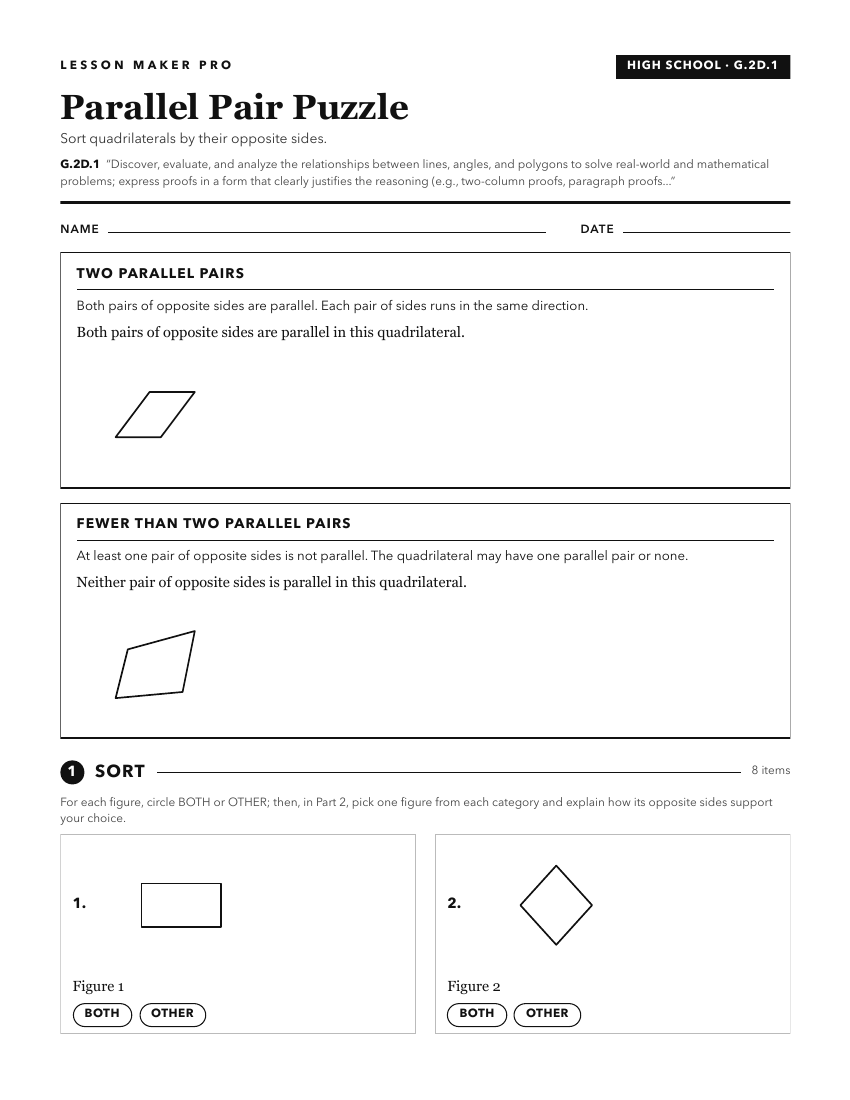
A ready-to-print activity worksheet aligned to G.2D.1, with an answer key for the teacher on its own page. No account needed.
PDF, US Letter, prints cleanly in black and white.
Download the worksheetTurn this cluster into a lesson
Grade, subject, topic, and the complete cluster are prefilled. Create one free, no account needed.
Also for this cluster:Make a WorksheetMake a QuizMake a Sub Lesson