Oklahoma Math G.2D.1.2
The Standard
- G.2D.1
- Discover, evaluate, and analyze the relationships between lines, angles, and polygons to solve real-world and mathematical problems; express proofs in a form that clearly justifies the reasoning (e.g., two-column proofs, paragraph proofs, flowcharts).
Use the angle relationships formed by lines cut by a transversal to determine if the lines are parallel and verify, using algebraic and deductive proofs.
Oklahoma Academic Standards for Mathematics (2022)
Teacher's field guide
What This Standard Means
What Students Need to Do
- Students identify corresponding, alternate interior, and same-side interior angles when a transversal crosses two lines. They use angle facts and algebra to show that a pair is equal or adds to 180°. They name the rule that proves the lines are parallel.
What Mastery Looks Like
- Given angle expressions and a value for x, a student calculates both angles and checks whether they match or add to 180°. They write a short proof that names the correct converse rule and concludes that the lines are parallel.
Common Misconceptions
- Students may use equal vertical angles to claim two lines are parallel, even though vertical angles are always equal. They may assume corresponding angles match before proving the lines are parallel, or treat same-side interior angles as equal instead of supplementary.
How to Assess It
- Exit ticket: Two corresponding angles measure (3x+15)° and (5x−25)°, and x=20. Calculate both angles, then state whether the lines are parallel and name the rule that proves it.
Lesson moves
Ways to Teach It
Draw two lines and a transversal, measure corresponding angles with a protractor, and explain what the measurements suggest about parallelism.
Ask: If alternate interior angles are equal, which rule proves the lines parallel, and why would vertical angles not work?
Give cards with marked corresponding angles 3x+15 and 5x−25, plus x=20; partners calculate angles and name the converse rule.
On an overhead photo of railroad tracks crossed by a road, students mark corresponding angles and explain what would prove the rails parallel.
Free download
Printable G.2D.1.2 Worksheet
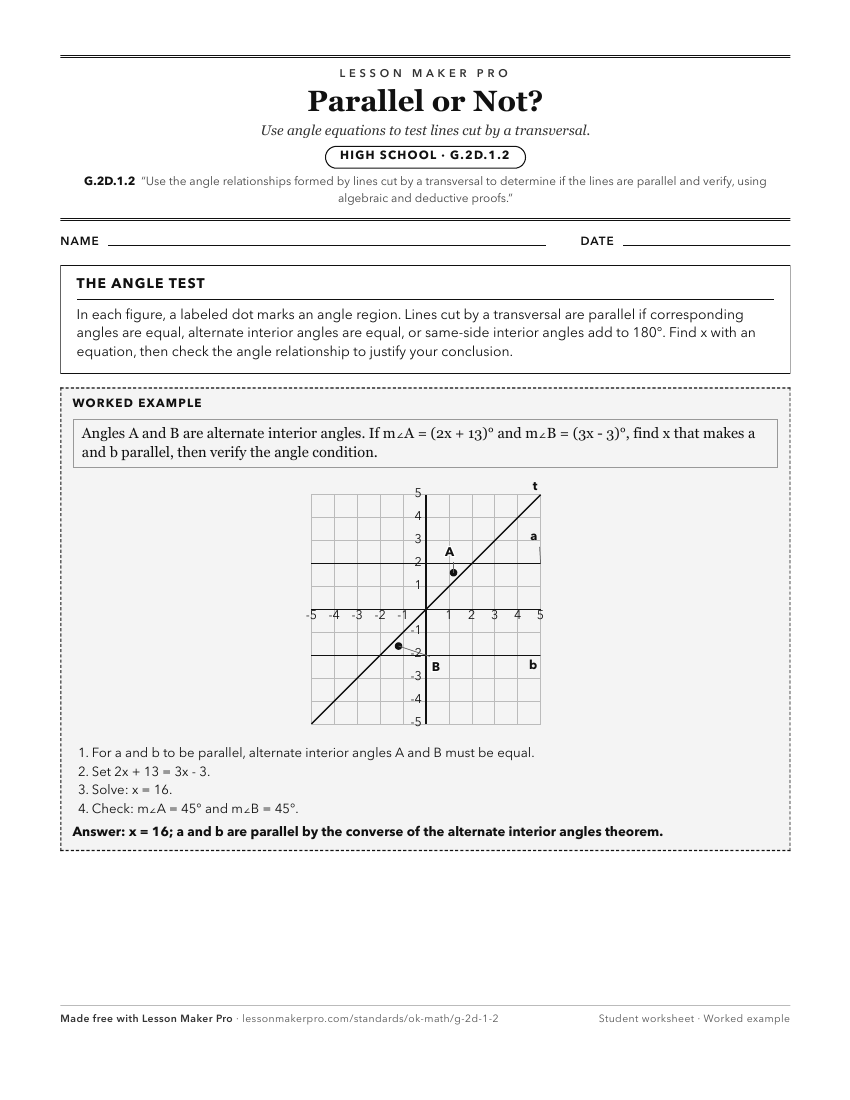
A ready-to-print activity worksheet aligned to G.2D.1.2, with an answer key for the teacher on its own page. No account needed.
PDF, US Letter, prints cleanly in black and white.
Download the worksheetKeep exploring
Related Standards
- G.2D.1.1
Use properties of parallel lines cut by a transversal to determine angle relationships and solve problems.
- 6.GM.3.1
Solve problems using the relationships between the angles (vertical, complementary, and supplementary) formed by intersecting lines.
- G.2D.1
Discover, evaluate, and analyze the relationships between lines, angles, and polygons to solve real-world and mathematical problems; express proofs in a form th...
- G.2D.1.3
Apply the properties of angles (corresponding, exterior, interior, vertical, complementary, supplementary) to solve problems using mathematical models, algebrai...
Turn this exact standard into a lesson
Grade, subject, topic, and the complete standard are prefilled. Create one free, no account needed.
Also for this standard:Make a WorksheetMake a QuizMake a Sub Lesson