Oklahoma Math G.2D.1.1
The Standard
- G.2D.1
- Discover, evaluate, and analyze the relationships between lines, angles, and polygons to solve real-world and mathematical problems; express proofs in a form that clearly justifies the reasoning (e.g., two-column proofs, paragraph proofs, flowcharts).
Use properties of parallel lines cut by a transversal to determine angle relationships and solve problems.
Oklahoma Academic Standards for Mathematics (2022)
Teacher's field guide
What This Standard Means
What Students Need to Do
- Students locate angle pairs formed when a line crosses two parallel lines. They use those pairs to find missing angles and solve for x.
What Mastery Looks Like
- Students identify corresponding and alternate interior angles as equal. They identify same-side interior angles as adding to 180°, then use the right relationship to solve for an unknown angle.
Common Misconceptions
- Students may treat every pair of interior angles as equal. They may add corresponding angles to 180° or use these rules when the lines are not marked parallel.
How to Assess It
- Draw two parallel horizontal lines crossed by a slanted line. Mark the interior angle on the right at the top intersection 65°, then ask students to find both lower interior angles and name the rule for each.
Lesson moves
Ways to Teach It
Lay two rulers parallel and cross them with a pencil; measure the angles with a protractor and record equal pairs.
Show a diagram with one interior angle marked 70°; ask, “Why is its alternate interior angle 70° but its same-side interior angle 110°?”
Give students angle cards on a parallel-line diagram; have them sort equal and supplementary pairs, then calculate the missing measures.
Draw two parallel streets crossed by a diagonal road; mark one intersection angle 60° and find the corresponding angle at the next intersection.
Free download
Printable G.2D.1.1 Worksheet
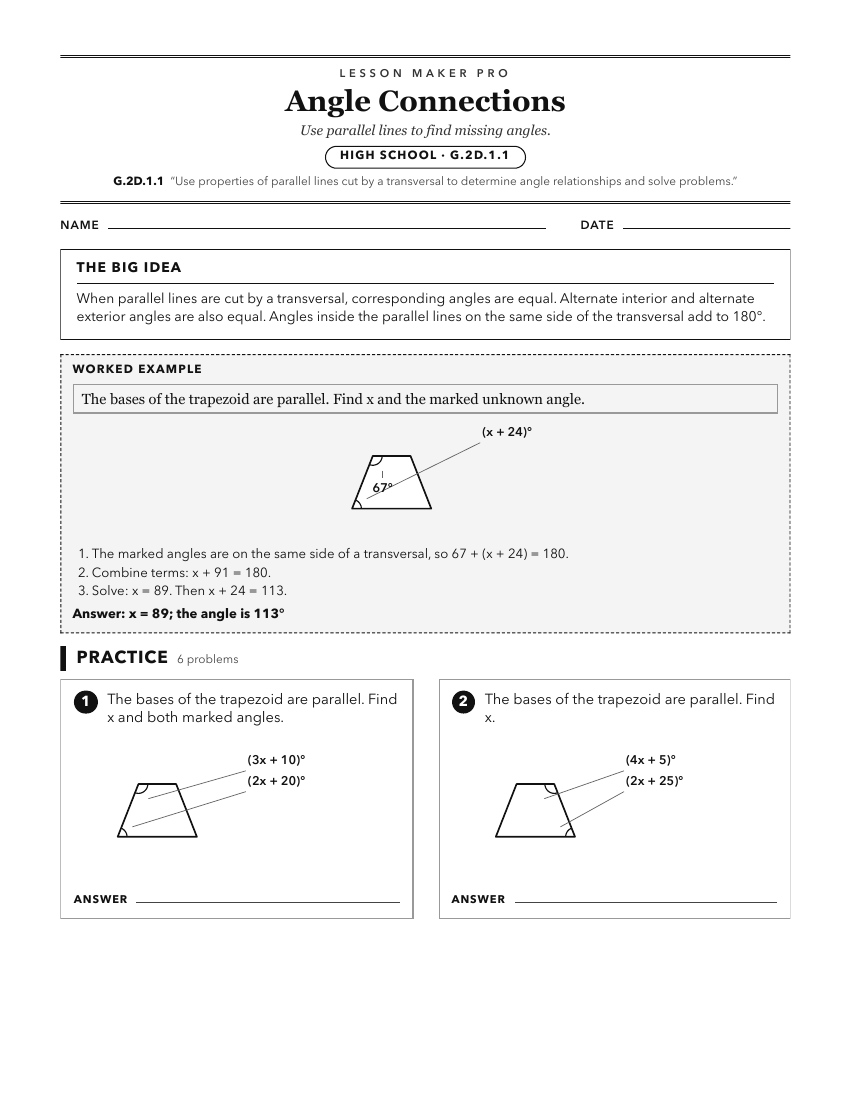
A ready-to-print activity worksheet aligned to G.2D.1.1, with an answer key for the teacher on its own page. No account needed.
PDF, US Letter, prints cleanly in black and white.
Download the worksheetKeep exploring
Related Standards
- G.2D.1.2
Use the angle relationships formed by lines cut by a transversal to determine if the lines are parallel and verify, using algebraic and deductive proofs.
- 6.GM.3.1
Solve problems using the relationships between the angles (vertical, complementary, and supplementary) formed by intersecting lines.
- G.2D.1.3
Apply the properties of angles (corresponding, exterior, interior, vertical, complementary, supplementary) to solve problems using mathematical models, algebrai...
- 6.GM.3
Understand and use relationships between angles in geometric figures.
Turn this exact standard into a lesson
Grade, subject, topic, and the complete standard are prefilled. Create one free, no account needed.
Also for this standard:Make a WorksheetMake a QuizMake a Sub Lesson