Oklahoma Math G.2D.1.5
The Standard
- G.2D.1
- Discover, evaluate, and analyze the relationships between lines, angles, and polygons to solve real-world and mathematical problems; express proofs in a form that clearly justifies the reasoning (e.g., two-column proofs, paragraph proofs, flowcharts).
Apply the properties of special quadrilaterals (square, rectangle, trapezoid, isosceles trapezoid, rhombus, kite, parallelogram) to solve problems involving angle measures and segment lengths using mathematical models, algebraic reasoning, and proofs.
Oklahoma Academic Standards for Mathematics (2022)
Teacher's field guide
What This Standard Means
What Students Need to Do
- Students choose the right property for a quadrilateral in a diagram or word problem. They use it to find missing angles or lengths, then explain their reasoning.
What Mastery Looks Like
- Given a parallelogram with opposite sides labeled x + 8 and 2x − 3, a student sets them equal and finds x = 11. They explain why the sides must have the same length.
Common Misconceptions
- Students may assume every rhombus has right angles or every trapezoid has equal legs. They may also think both diagonals of a kite bisect each other.
How to Assess It
- Draw a parallelogram with adjacent angles labeled 3x + 10° and 2x + 20°. Ask students to find x and both angles, then name the property they used.
Lesson moves
Ways to Teach It
Cut out a paper rhombus, draw its diagonals, and measure the four half-diagonals and the angles where they cross.
Draw a parallelogram with one 65° angle, then explain in writing how to find its other three angles.
Partners draw cards showing opposite parallelogram sides labeled x + 8 and 2x − 3; they solve for x and earn points for explaining why.
Show a rectangular window frame with one diagonal measuring 50 inches; ask students to predict the other diagonal and explain why.
Free download
Printable G.2D.1.5 Worksheet
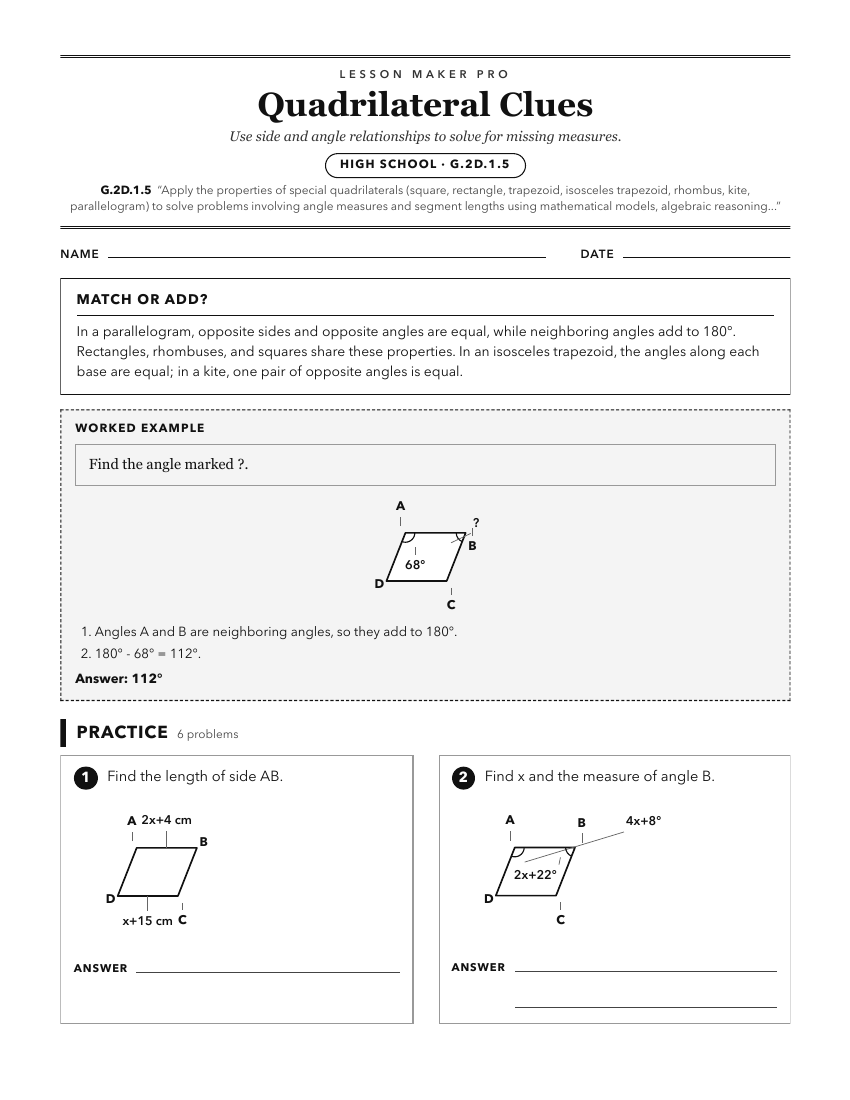
A ready-to-print activity worksheet aligned to G.2D.1.5, with an answer key for the teacher on its own page. No account needed.
PDF, US Letter, prints cleanly in black and white.
Download the worksheetKeep exploring
Related Standards
- G.2D.1.3
Apply the properties of angles (corresponding, exterior, interior, vertical, complementary, supplementary) to solve problems using mathematical models, algebrai...
- 4.GM.1.2
Describe, classify, and construct quadrilaterals, including squares, rectangles, trapezoids, rhombuses, parallelograms, and kites. Recognize quadrilaterals in v...
- G.2D.1.7
Apply the properties of polygons, and use them to represent and apply mathematical models involving perimeter and area (e.g., triangles, special quadrilaterals,...
- 6.GM.2
Use mathematical modeling to calculate the area of squares, parallelograms, and triangles to solve problems.
Turn this exact standard into a lesson
Grade, subject, topic, and the complete standard are prefilled. Create one free, no account needed.
Also for this standard:Make a WorksheetMake a QuizMake a Sub Lesson