Oklahoma Math 6.GM.2
Standard Cluster
Use mathematical modeling to calculate the area of squares, parallelograms, and triangles to solve problems. Develop and use formulas for the area of squares and parallelograms using a variety of methods including but not limited to the standard algorithms and finding unknown measures. Develop and use formulas to determine the area of triangles and find unknown measures. Find the area of right triangles, other triangles, special quadrilaterals, and polygons that can be decomposed into triangles and other shapes.
Oklahoma Academic Standards for Mathematics (2022)
Cluster contents
Standards in This Cluster
6.GM.2 is a cluster heading. These are the individual standards under it.
- 6.GM.2.1
Develop and use formulas for the area of squares and parallelograms using a variety of methods including but not limited to the standard algorithms and finding ...
- 6.GM.2.2
Develop and use formulas to determine the area of triangles and find unknown measures.
- 6.GM.2.3
Find the area of right triangles, other triangles, special quadrilaterals, and polygons that can be decomposed into triangles and other shapes.
Teacher's field guide
What This Cluster Means
What Students Need to Do
- Students find area by counting squares, cutting shapes apart, and rearranging pieces. They use formulas to find the area of squares, parallelograms, and triangles, or to find a missing side or height. They split larger polygons into familiar shapes and add the areas.
What Mastery Looks Like
- A student can explain why a cut-and-rearranged parallelogram has the same area as a rectangle, and why a triangle has half that area. They use side times side for a square, base times perpendicular height for a parallelogram, and half of base times height for a triangle. They split a trapezoid into smaller shapes and report its area in square units.
Common Misconceptions
- Students may use a slanted side instead of the perpendicular height. Some multiply a square’s side by four instead of finding its area, or forget to halve a triangle’s area. When splitting a polygon, they may count the same region twice.
How to Assess It
- Exit ticket: A parallelogram has an area of 36 cm² and a base of 9 cm. Find its perpendicular height and the area of either triangle made by a diagonal.
Lesson moves
Ways to Teach It
Cut a paper parallelogram along its height, slide the cut piece to make a rectangle, and write the area rule beside it.
Draw a triangle labeled base 7 cm, perpendicular height 4 cm, and slanted side 5 cm; ask which measurements find its area and why.
Give pairs shape cards and area-calculation cards for squares, triangles, parallelograms, and trapezoids; include one card with a missing height.
Draw a 10 m by 6 m rectangular garden with a 2 m by 3 m triangular corner removed; calculate its planting area.
Free download
Printable 6.GM.2 Worksheet
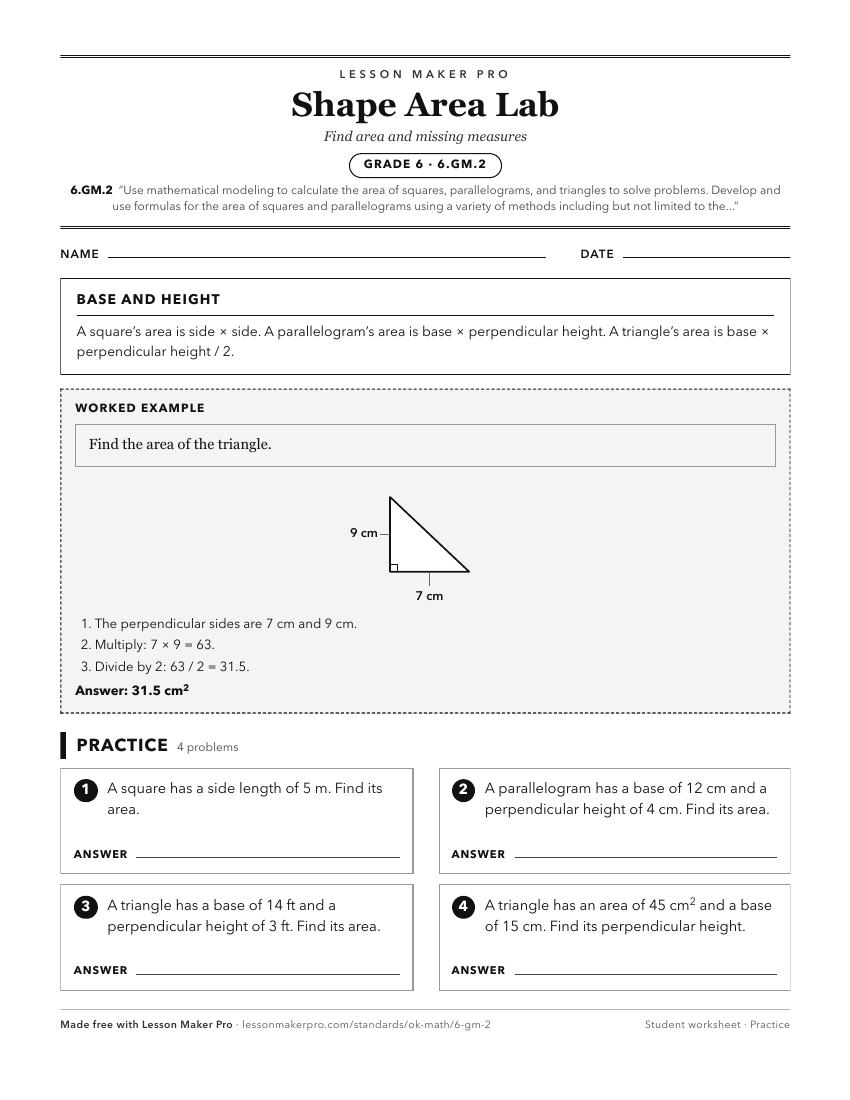
A ready-to-print activity worksheet aligned to 6.GM.2, with an answer key for the teacher on its own page. No account needed.
PDF, US Letter, prints cleanly in black and white.
Download the worksheetKeep exploring
Related Standards
- 7.GM.2
Use mathematical models and problems to calculate and justify the area of trapezoids and the area and perimeter of composite figures with rational measurements.
- G.2D.1.5
Apply the properties of special quadrilaterals (square, rectangle, trapezoid, isosceles trapezoid, rhombus, kite, parallelogram) to solve problems involving ang...
Turn this cluster into a lesson
Grade, subject, topic, and the complete cluster are prefilled. Create one free, no account needed.
Also for this cluster:Make a WorksheetMake a QuizMake a Sub Lesson