Oklahoma Math 7.GM.2
Standard Cluster
Use mathematical models and problems to calculate and justify the area of trapezoids and the area and perimeter of composite figures with rational measurements. Develop and use the formula to determine the area of a trapezoid. Find the area and perimeter of composite figures.
Oklahoma Academic Standards for Mathematics (2022)
Cluster contents
Standards in This Cluster
7.GM.2 is a cluster heading. These are the individual standards under it.
Teacher's field guide
What This Cluster Means
What Students Need to Do
- Students use two copies of a trapezoid to work out its area formula. They split composite figures into familiar shapes, then find area and outside perimeter using fractions or decimals.
What Mastery Looks Like
- A student uses the parallel bases and perpendicular height to find a trapezoid's area and explains why the result is divided by two. They find missing side lengths in a composite figure and use square units for area and linear units for perimeter.
Common Misconceptions
- Students use a slanted side as the trapezoid's height. They forget to divide by two when finding its area. They count inside edges as part of a composite figure's perimeter.
How to Assess It
- Exit ticket: Sketch a trapezoid with bases 4 cm and 10 cm, height 4 cm, and two 5 cm sides. Attach a 4 cm by 3 cm rectangle along the 4 cm base, then ask students to explain the trapezoid's area formula and find the combined area and perimeter.
Lesson moves
Ways to Teach It
Give pairs two identical paper trapezoids; have them fit the copies into a parallelogram and label its base and height.
Ask, 'Why does doubling a trapezoid make a parallelogram, and where does the division by two enter the area formula?'
Give groups four composite-figure cards; have them highlight outside edges before calculating each figure's area and perimeter.
Give students a patio plan made from a rectangle and trapezoid with decimal lengths; ask for paving area and edging length.
Free download
Printable 7.GM.2 Worksheet
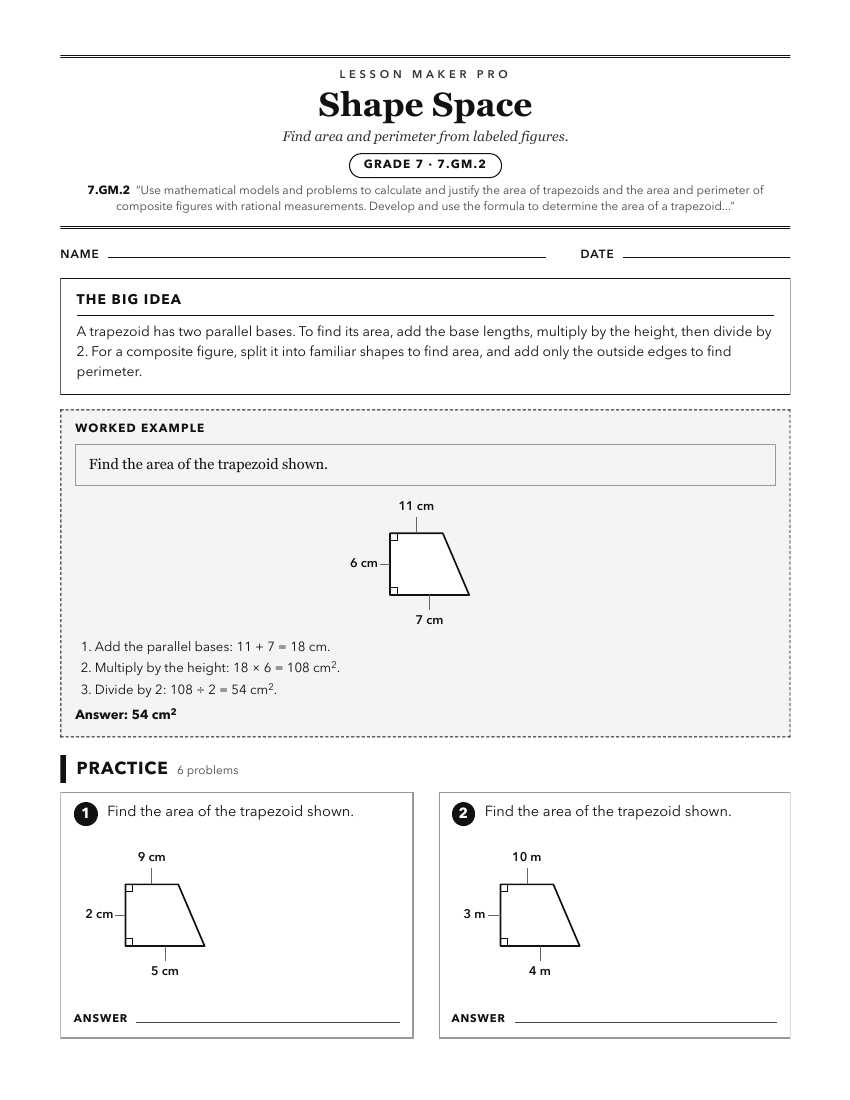
A ready-to-print activity worksheet aligned to 7.GM.2, with an answer key for the teacher on its own page. No account needed.
PDF, US Letter, prints cleanly in black and white.
Download the worksheetKeep exploring
Related Standards
- 6.GM.2
Use mathematical modeling to calculate the area of squares, parallelograms, and triangles to solve problems.
- G.2D.1.7
Apply the properties of polygons, and use them to represent and apply mathematical models involving perimeter and area (e.g., triangles, special quadrilaterals,...
- 7.GM.3
Use mathematical models and reasoning with proportions and ratios to determine measurements, justify formulas, and solve problems.
Turn this cluster into a lesson
Grade, subject, topic, and the complete cluster are prefilled. Create one free, no account needed.
Also for this cluster:Make a WorksheetMake a QuizMake a Sub Lesson