Oklahoma Math 7.GM.3
Standard Cluster
Use mathematical models and reasoning with proportions and ratios to determine measurements, justify formulas, and solve problems. Solve problems that require the conversion of weights and capacities within the same measurement systems using appropriate units. Demonstrate an understanding of the proportional relationship between the diameter and circumference of a circle and that the unit rate (constant of proportionality) is pi (π) and can be approximated by rational numbers such as 22/7 and 3.14. Calculate the circumference and area of circles to solve problems in various contexts, in terms of pi (π) and using approximations for pi (π).
Oklahoma Academic Standards for Mathematics (2022)
Cluster contents
Standards in This Cluster
7.GM.3 is a cluster heading. These are the individual standards under it.
- 7.GM.3.1
Solve problems that require the conversion of weights and capacities within the same measurement systems using appropriate units.
- 7.GM.3.2
Demonstrate an understanding of the proportional relationship between the diameter and circumference of a circle and that the unit rate (constant of proportiona...
- 7.GM.3.3
Calculate the circumference and area of circles to solve problems in various contexts, in terms of pi (π) and using approximations for pi (π).
Teacher's field guide
What This Cluster Means
What Students Need to Do
- Students use ratios to find missing measurements and explain why measurement formulas work. They convert weights and capacities within one measurement system. They find circle circumference and area in terms of π and using 3.14.
What Mastery Looks Like
- Given a circle's diameter, students find its circumference and area with correct units, in terms of π and as decimals. They explain that circumference is π times the diameter and show how circle slices can form an approximate rectangle with area πr². They use ratios to convert units, such as 3 gallons to 12 quarts.
Common Misconceptions
- Students use diameter instead of radius in the area formula, or forget to double the radius when finding circumference. They give square units for circumference or plain units for area. They multiply by 4 when converting quarts to gallons instead of dividing.
How to Assess It
- Exit ticket: A circular garden has a diameter of 6 ft. Find the edging length and planting area in terms of π and using 3.14, then explain your formulas and units.
Lesson moves
Ways to Teach It
Cut a paper circle into 12 sectors, alternate the pieces into a near rectangle, and label its height r and base about πr.
Ask, 'Why does doubling a circle's radius double its circumference but quadruple its area?' Have partners explain with labeled sketches.
Play conversion relay: teams draw cards such as 5 lb to oz or 3 L to mL, write a proportion, then check answers.
Use a pizza menu's diameters and prices to compare area per dollar, then calculate the crust length for each pizza.
Free download
Printable 7.GM.3 Worksheet
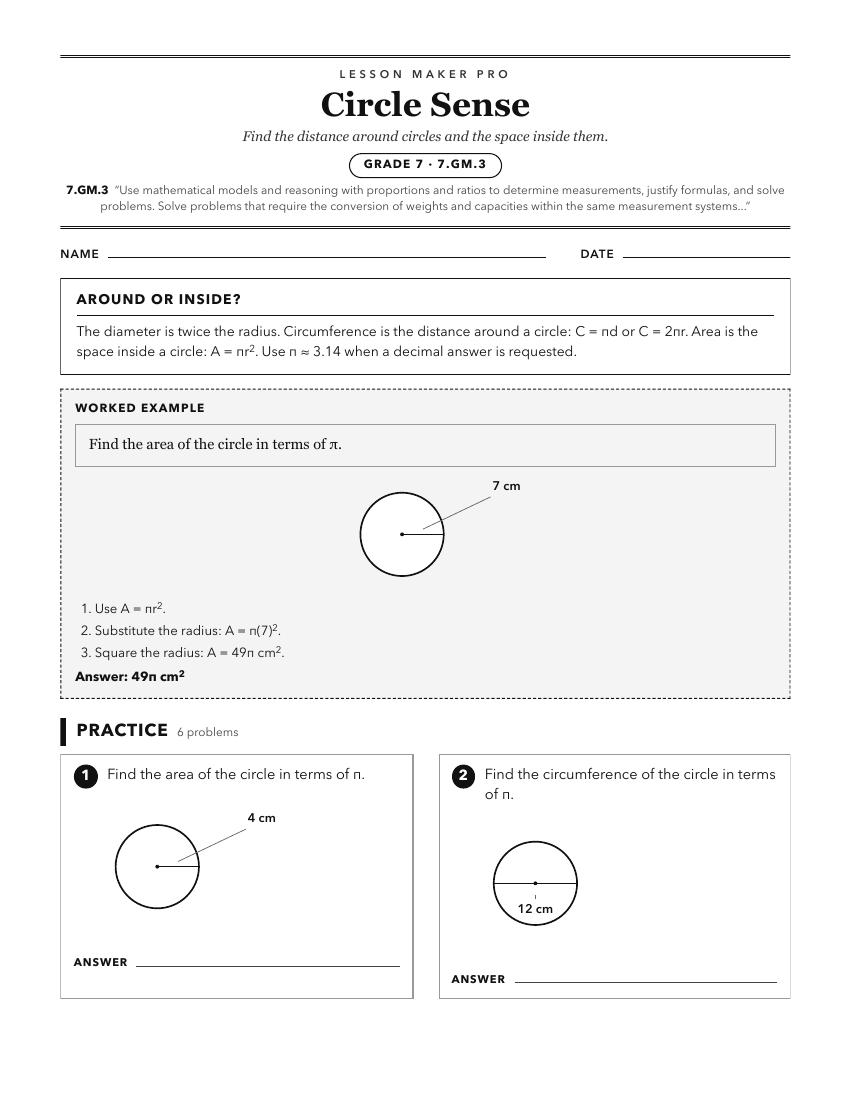
A ready-to-print activity worksheet aligned to 7.GM.3, with an answer key for the teacher on its own page. No account needed.
PDF, US Letter, prints cleanly in black and white.
Download the worksheetKeep exploring
Related Standards
- 7.D.2
Calculate and use proportional reasoning with probabilities to model and solve mathematical problems.
- A1.A.1.1
Use knowledge of solving equations with rational values to represent, use and apply mathematical models (e.g., angle measures, geometric formulas, dimensional a...
- 7.A.2
Identify and justify proportional relationships using mathematical models and situations; solve problems involving proportional relationships and interpret resu...
- 6.N.4.4
Use mathematical modeling to solve and interpret problems including money, measurement, geometry, and data requiring arithmetic with decimals, fractions and mix...
Turn this cluster into a lesson
Grade, subject, topic, and the complete cluster are prefilled. Create one free, no account needed.
Also for this cluster:Make a WorksheetMake a QuizMake a Sub Lesson