Oklahoma Math 6.GM.2.3
The Standard
- 6.GM.2
- Use mathematical modeling to calculate the area of squares, parallelograms, and triangles to solve problems.
Find the area of right triangles, other triangles, special quadrilaterals, and polygons that can be decomposed into triangles and other shapes.
Oklahoma Academic Standards for Mathematics (2022)
Teacher's field guide
What This Standard Means
What Students Need to Do
- Students use side lengths to find the area of a square. For parallelograms and triangles, they identify the base and perpendicular height. They split other polygons into familiar shapes and add or subtract the areas.
What Mastery Looks Like
- A student can mark the perpendicular height on a drawing, calculate the area, and label it in square units. For a house-shaped pentagon, they can find the rectangle and triangle areas, then add them.
Common Misconceptions
- Students may use a slanted side as the height, even when it is not perpendicular to the base. They may forget to halve a triangle’s area or add side lengths instead of areas.
How to Assess It
- On graph paper, draw a parallelogram with a base of 6 units and a perpendicular height of 4 units. Draw a diagonal and find the area of each triangle.
Lesson moves
Ways to Teach It
Cut a paper parallelogram along its height, move the end triangle to the other side, and measure the new rectangle.
Draw a house-shaped pentagon on grid paper and ask, “Which rectangle and triangle can you use to find its area?”
Give pairs six shape cards with dimensions; have them match each card to a formula and calculate its area.
Sketch a garden bed with a 4 m by 3 m rectangle and a triangular tip 3 m wide and 2 m high; find its area.
Free download
Printable 6.GM.2.3 Worksheet
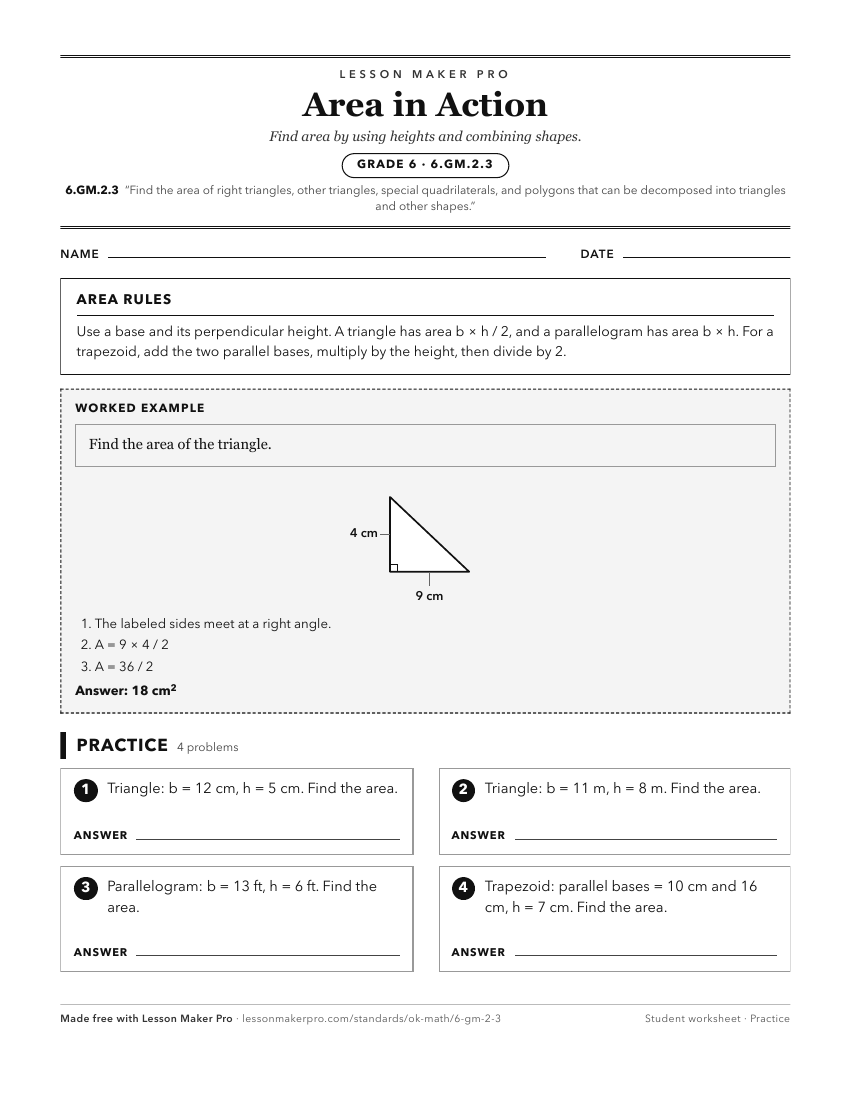
A ready-to-print activity worksheet aligned to 6.GM.2.3, with an answer key for the teacher on its own page. No account needed.
PDF, US Letter, prints cleanly in black and white.
Download the worksheetKeep exploring
Related Standards
- 2.GM.1.3
Compose and decompose two-dimensional shapes using triangles, squares, hexagons, trapezoids, and rhombi.
- 4.GM.2.2
Find the area of polygons by determining if they can be decomposed into rectangles.
- PC.T.2.3
Use trigonometry to find the area of triangles.
- 6.GM.2.2
Develop and use formulas to determine the area of triangles and find unknown measures.
Turn this exact standard into a lesson
Grade, subject, topic, and the complete standard are prefilled. Create one free, no account needed.
Also for this standard:Make a WorksheetMake a QuizMake a Sub Lesson