Oklahoma Math 4.GM.2.2
The Standard
- 4.GM.2
- Recognize and measure attributes in real-world and mathematical situations using various tools.
Find the area of polygons by determining if they can be decomposed into rectangles.
Oklahoma Academic Standards for Mathematics (2022)
Teacher's field guide
What This Standard Means
What Students Need to Do
- Students decide whether a polygon can be split into rectangles without gaps or overlaps. If it can, they find each rectangle’s area and add the parts.
What Mastery Looks Like
- Given an L-shaped figure with labeled sides, a student draws a split, finds any missing side lengths, and gives the total area in square units. They can explain why rectangles cannot cover a triangle exactly.
Common Misconceptions
- Students may multiply an L-shape’s overall width by its overall height, counting space outside the shape. They may add side lengths instead of areas. Some leave gaps when trying to cover a slanted edge with rectangles.
How to Assess It
- Draw an L-shape with a 6-by-2 top section and a 4-by-3 bottom section. Ask students to show the two rectangles and find the total area in square units.
Lesson moves
Ways to Teach It
Give students L-shaped paper mats and centimeter grid paper; have them cut each mat into two rectangles and find its area.
Show a stair-step polygon and a triangle; ask, “Which can you split into rectangles without gaps, and why?”
Play rectangle split relay: teams mark a split on an L-shaped grid figure, label side lengths, and calculate its area.
Sketch a patio with a 6-by-2-foot top section and a 4-by-3-foot bottom section; find how many square feet of pavers it needs.
Free download
Printable 4.GM.2.2 Worksheet
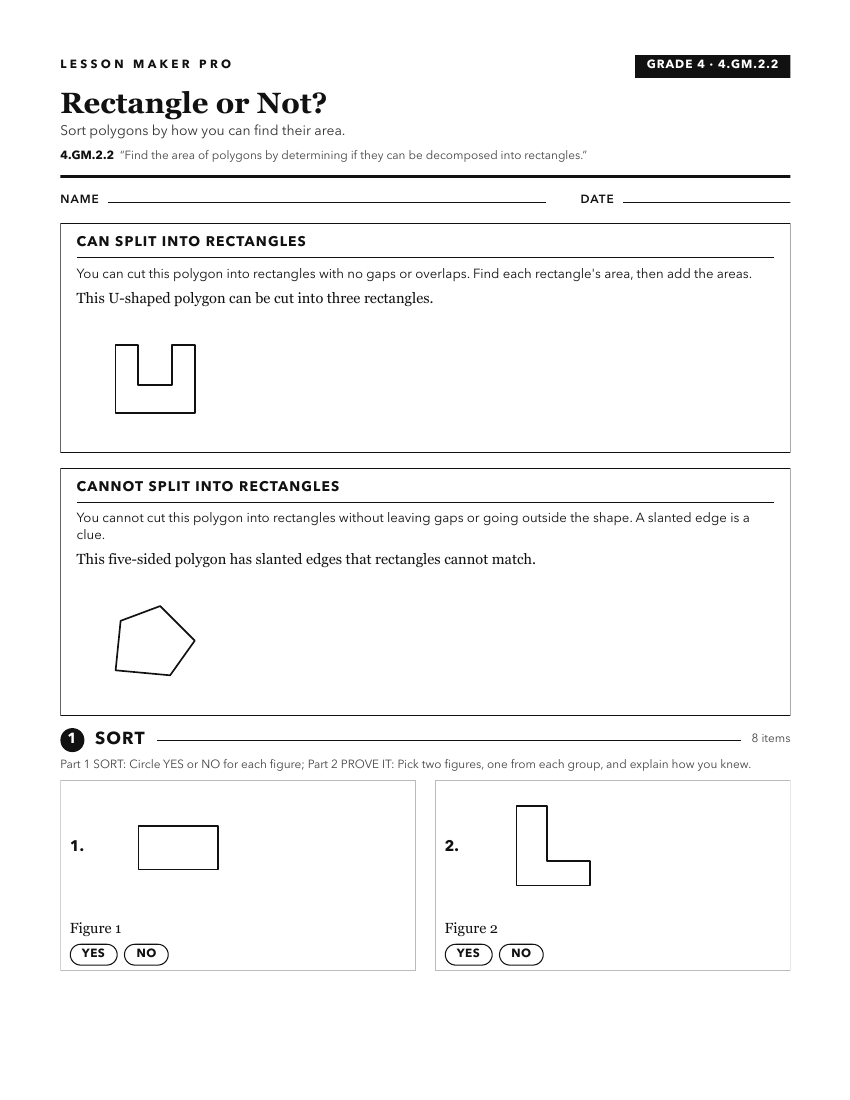
A ready-to-print activity worksheet aligned to 4.GM.2.2, with an answer key for the teacher on its own page. No account needed.
PDF, US Letter, prints cleanly in black and white.
Download the worksheetKeep exploring
Related Standards
- 6.GM.2.3
Find the area of right triangles, other triangles, special quadrilaterals, and polygons that can be decomposed into triangles and other shapes.
- 1.N.3.1
Partition a regular polygon using physical models and recognize when those parts are equal.
- 7.GM.2.2
Find the area and perimeter of composite figures.
Turn this exact standard into a lesson
Grade, subject, topic, and the complete standard are prefilled. Create one free, no account needed.
Also for this standard:Make a WorksheetMake a QuizMake a Sub Lesson