Oklahoma Math 1.N.3.1
The Standard
- 1.N.3
- Develop foundational ideas for fractions.
Partition a regular polygon using physical models and recognize when those parts are equal.
Oklahoma Academic Standards for Mathematics (2022)
Teacher's field guide
What This Standard Means
What Students Need to Do
- Students split paper squares and equilateral triangles into parts. They check whether the parts are equal by folding or placing one piece over another.
What Mastery Looks Like
- A student can fold a paper square into two equal parts and show that the parts match. They can spot an off-center cut and explain why it makes unequal parts.
Common Misconceptions
- Students may think any cut that makes two pieces makes equal parts. They may also think pieces are unequal because one has been turned around.
How to Assess It
- Ask students to draw a line that splits a square into two equal parts. Show them another square split near one edge, and ask whether its parts are equal and how they know.
Lesson moves
Ways to Teach It
Give students paper squares and equilateral triangles to fold into two equal parts, then have them cut and stack the pieces.
Show a square cut down the middle and one cut near an edge; ask, “Which gives two children equal shares? How can you check?”
Give pairs of students cut paper squares to sort into equal and unequal parts, then check their choices by stacking the pieces.
Use square paper sandwiches: students draw a cut for two equal snack portions and fold the paper to check their plan.
Free download
Printable 1.N.3.1 Worksheet
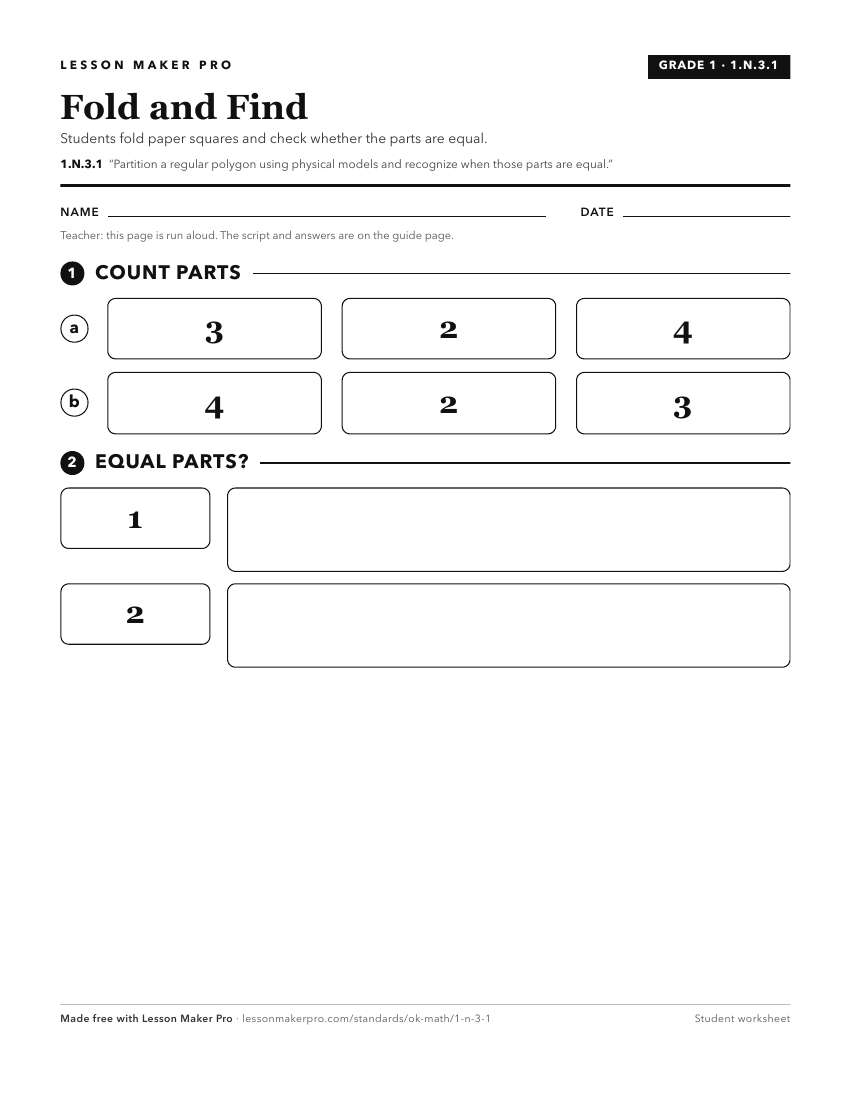
A ready-to-print activity worksheet aligned to 1.N.3.1, with an answer key for the teacher on its own page. No account needed.
PDF, US Letter, prints cleanly in black and white.
Download the worksheetKeep exploring
Related Standards
- 3.GM.2.1
Find the perimeter of a polygon, given whole number lengths of the sides, using a variety of models.
- G.2D.1.7
Apply the properties of polygons, and use them to represent and apply mathematical models involving perimeter and area (e.g., triangles, special quadrilaterals,...
- 4.GM.2.2
Find the area of polygons by determining if they can be decomposed into rectangles.
- 2.GM.1.1
Recognize regular and irregular trapezoids and hexagons.
Turn this exact standard into a lesson
Grade, subject, topic, and the complete standard are prefilled. Create one free, no account needed.
Also for this standard:Make a WorksheetMake a QuizMake a Sub Lesson