Oklahoma Math 3.GM.2.1
The Standard
- 3.GM.2
- Understand measurable attributes of real-world and mathematical objects using various tools.
Find the perimeter of a polygon, given whole number lengths of the sides, using a variety of models.
Oklahoma Academic Standards for Mathematics (2022)
Teacher's field guide
What This Standard Means
What Students Need to Do
- Students find the distance around a polygon by adding every side length. They use a drawing, unit marks, or an addition sentence to keep track.
What Mastery Looks Like
- A student traces each side once, adds the lengths, and gives the answer in length units. They can show how their drawing matches their addition sentence.
Common Misconceptions
- Some students count squares inside the shape instead of units around its edge. Others skip a side, add one side twice, or leave off the length unit.
How to Assess It
- Give students a rectangle with sides labeled 5, 3, 5, and 3 centimeters. Ask them to mark each side as they count it and write an addition sentence for the perimeter.
Lesson moves
Ways to Teach It
Tape 3 cm, 4 cm, and 5 cm paper strips into a triangle, then add their lengths to find the perimeter.
Show a 4-by-2 rectangle on grid paper and ask, 'Why is counting the 8 squares not its perimeter?'
Give pairs polygon cards with labeled sides; have them write addition sentences and check each other's perimeter totals.
Show a garden plan with sides labeled 6, 4, 6, and 4 feet; ask how much edging the garden needs.
Free download
Printable 3.GM.2.1 Worksheet
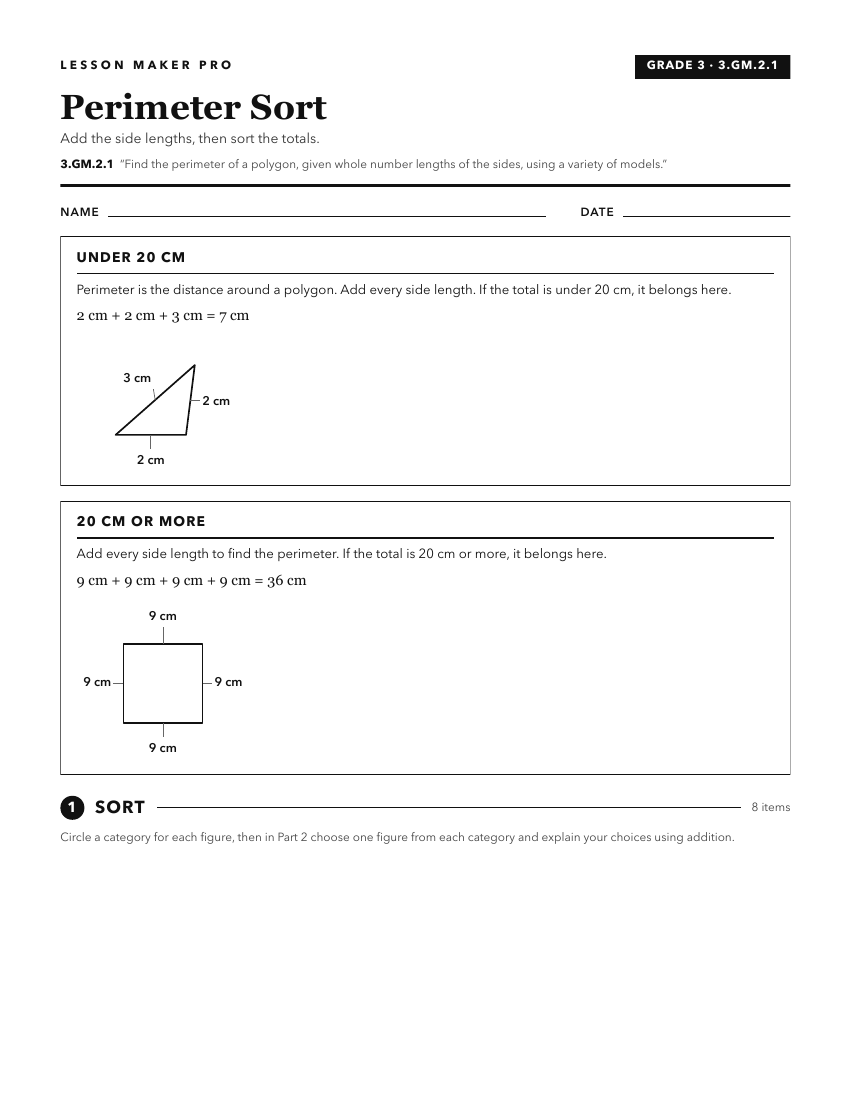
A ready-to-print activity worksheet aligned to 3.GM.2.1, with an answer key for the teacher on its own page. No account needed.
PDF, US Letter, prints cleanly in black and white.
Download the worksheetKeep exploring
Related Standards
- 5.GM.2.2
Estimate the perimeter of polygons and create arguments for reasonable perimeter values of shapes that may include curves.
- G.2D.1.7
Apply the properties of polygons, and use them to represent and apply mathematical models involving perimeter and area (e.g., triangles, special quadrilaterals,...
- 1.N.3.1
Partition a regular polygon using physical models and recognize when those parts are equal.
- G.2D.1.4
Apply theorems involving the interior and exterior angle sums of polygons to solve problems using mathematical models, algebraic reasoning, and proofs.
Turn this exact standard into a lesson
Grade, subject, topic, and the complete standard are prefilled. Create one free, no account needed.
Also for this standard:Make a WorksheetMake a QuizMake a Sub Lesson