Oklahoma Math 5.GM.2.2
The Standard
- 5.GM.2
- Determine volume using the object's dimensions. Compare and analyze rectangular prisms with equivalent volume to recognize their different dimensions.
Estimate the perimeter of polygons and create arguments for reasonable perimeter values of shapes that may include curves.
Oklahoma Academic Standards for Mathematics (2022)
Teacher's field guide
What This Standard Means
What Students Need to Do
- Students estimate the distance around polygons and shapes with curved edges. They use side lengths, rulers, or string to explain why an estimate makes sense.
What Mastery Looks Like
- A student counts each outside edge once and gives an estimate with units. For a curved edge, they can measure it with string or compare it with known lengths, then explain their estimate.
Common Misconceptions
- Students may find area instead of the distance around a shape. They may treat a curved edge as a straight line between its endpoints or count an inside line as part of the perimeter.
How to Assess It
- Exit ticket: An 8 cm by 4 cm rectangle has one 4 cm side replaced by a semicircle. Estimate its perimeter and explain how you estimated the curve.
Lesson moves
Ways to Teach It
Give pairs string, rulers, and paper shapes with straight and curved edges; have them trace, measure, and estimate each perimeter.
Show a 6 cm by 4 cm rectangle with one short side replaced by a semicircle; ask whether 20 cm is a reasonable perimeter.
Play Closest Estimate: post four shapes on a 1 cm grid, have teams estimate each perimeter, then check with string.
Sketch a garden with two 12 m straight sides and two semicircular ends, each 6 m across; estimate the edging needed.
Free download
Printable 5.GM.2.2 Worksheet
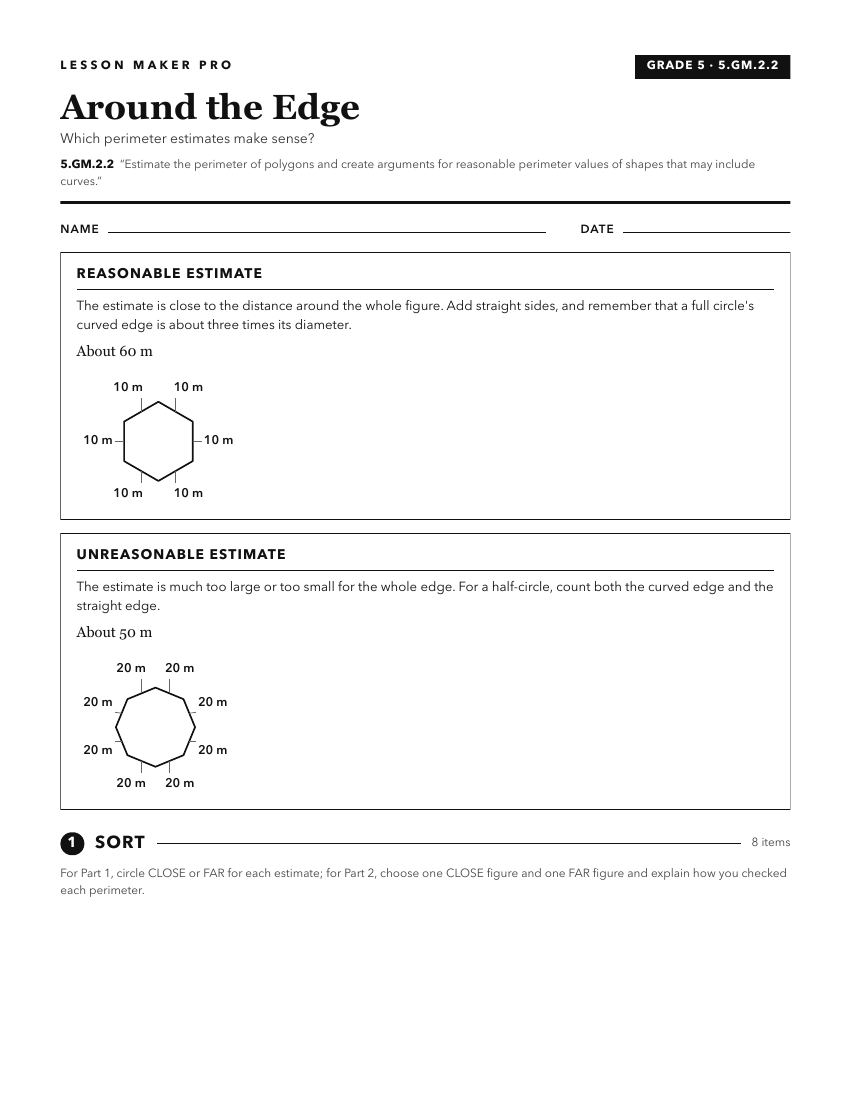
A ready-to-print activity worksheet aligned to 5.GM.2.2, with an answer key for the teacher on its own page. No account needed.
PDF, US Letter, prints cleanly in black and white.
Download the worksheetKeep exploring
Related Standards
- 3.GM.2.1
Find the perimeter of a polygon, given whole number lengths of the sides, using a variety of models.
- G.2D.1.7
Apply the properties of polygons, and use them to represent and apply mathematical models involving perimeter and area (e.g., triangles, special quadrilaterals,...
- 3.GM.1
Analyze and use geometric attributes to describe and create polygons and three-dimensional figures in various contexts.
- G.2D.1.4
Apply theorems involving the interior and exterior angle sums of polygons to solve problems using mathematical models, algebraic reasoning, and proofs.
Turn this exact standard into a lesson
Grade, subject, topic, and the complete standard are prefilled. Create one free, no account needed.
Also for this standard:Make a WorksheetMake a QuizMake a Sub Lesson