Oklahoma Math G.2D.1.4
The Standard
- G.2D.1
- Discover, evaluate, and analyze the relationships between lines, angles, and polygons to solve real-world and mathematical problems; express proofs in a form that clearly justifies the reasoning (e.g., two-column proofs, paragraph proofs, flowcharts).
Apply theorems involving the interior and exterior angle sums of polygons to solve problems using mathematical models, algebraic reasoning, and proofs.
Oklahoma Academic Standards for Mathematics (2022)
Teacher's field guide
What This Standard Means
What Students Need to Do
- Students find missing interior and exterior angles in polygons. They draw shapes, write equations for angles labeled with variables, and explain why the angle sums work.
What Mastery Looks Like
- Given a seven-sided polygon with one unknown interior angle, a student uses the 900° sum to find it. They can explain the interior sum with triangles and the exterior sum with one full turn.
Common Misconceptions
- Students may use 180° as the angle sum for every polygon or multiply the number of sides by 180°. They may assume all angles in an irregular polygon are equal or count more than one exterior angle at each vertex.
How to Assess It
- Exit ticket: A regular eight-sided polygon has exterior angles of (2x + 5)°. Find x and each interior angle, then explain why the exterior angles total 360°.
Lesson moves
Ways to Teach It
Cut a paper hexagon into triangles from one vertex, then use the pieces to explain its interior angle sum.
Ask students to explain in writing why one exterior turn at each vertex adds to 360°, even for an uneven hexagon.
Give pairs pentagon cards labeled 90°, 100°, 110°, 120°, and x°; have them solve for x and check each other's equations.
Show a pentagonal garden plan with corners of 100°, 110°, 115°, and 130°; students find the fifth corner for a fence layout.
Free download
Printable G.2D.1.4 Worksheet
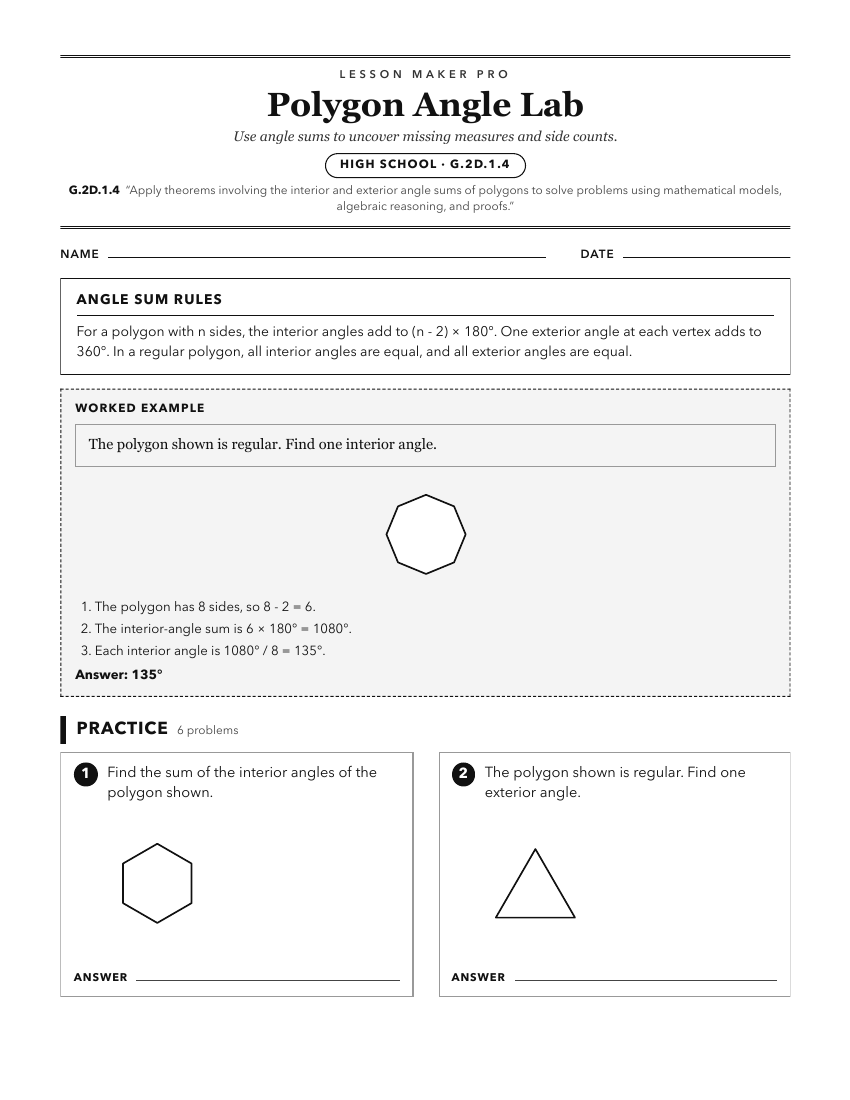
A ready-to-print activity worksheet aligned to G.2D.1.4, with an answer key for the teacher on its own page. No account needed.
PDF, US Letter, prints cleanly in black and white.
Download the worksheetKeep exploring
Related Standards
- G.2D.1.3
Apply the properties of angles (corresponding, exterior, interior, vertical, complementary, supplementary) to solve problems using mathematical models, algebrai...
- G.2D.1.8
Apply the properties of congruent or similar polygons to solve problems using mathematical models and algebraic and logical reasoning.
- G.2D.1
Discover, evaluate, and analyze the relationships between lines, angles, and polygons to solve real-world and mathematical problems; express proofs in a form th...
- G.2D.1.7
Apply the properties of polygons, and use them to represent and apply mathematical models involving perimeter and area (e.g., triangles, special quadrilaterals,...
Turn this exact standard into a lesson
Grade, subject, topic, and the complete standard are prefilled. Create one free, no account needed.
Also for this standard:Make a WorksheetMake a QuizMake a Sub Lesson