Oklahoma Math 6.N.2
Standard Cluster
Read, write, and model whole-number and integer operations to solve problems. Estimate solutions for integer addition and subtraction of problems in order to assess the reasonableness of results. Illustrate addition and subtraction of integers using a variety of representations. Add and subtract integers in a variety of situations; use efficient and generalizable procedures including but not limited to standard algorithms. Identify and represent patterns with whole-number exponents and perfect squares. Evaluate powers with whole-number bases and exponents. Factor whole numbers and express prime and composite numbers as a product of prime factors with exponents. Determine the greatest common factors and least common multiples. Use common factors and multiples to calculate with fractions, find equivalent fractions, and express the sum of two-digit numbers with a common factor using the distributive property.
Oklahoma Academic Standards for Mathematics (2022)
Cluster contents
Standards in This Cluster
6.N.2 is a cluster heading. These are the individual standards under it.
- 6.N.2.1
Estimate solutions for integer addition and subtraction of problems in order to assess the reasonableness of results.
- 6.N.2.2
Illustrate addition and subtraction of integers using a variety of representations.
- 6.N.2.3
Add and subtract integers in a variety of situations; use efficient and generalizable procedures including but not limited to standard algorithms.
- 6.N.2.4
Identify and represent patterns with whole-number exponents and perfect squares. Evaluate powers with whole-number bases and exponents.
- 6.N.2.5
Factor whole numbers and express prime and composite numbers as a product of prime factors with exponents.
- 6.N.2.6
Determine the greatest common factors and least common multiples. Use common factors and multiples to calculate with fractions, find equivalent fractions, and e...
Teacher's field guide
What This Cluster Means
What Students Need to Do
- Students model and solve integer addition and subtraction, then estimate to check their answers. They evaluate powers, spot perfect squares, and write prime factorizations with exponents. They use common factors and multiples to work with fractions and rewrite sums using the distributive property.
What Mastery Looks Like
- A student shows -3 - 5 on a number line, gets -8, and explains why the answer makes sense. They identify 36 as both 6² and 2² × 3², then find the greatest common factor and least common multiple of 12 and 18. They rewrite 1/3 + 1/4 as 4/12 + 3/12 and 24 + 36 as 12(2 + 3).
Common Misconceptions
- Students may move left when subtracting a negative number. They may read 3² as 3 × 2 or call 2 × 6 a prime factorization of 12. They may add denominators when adding fractions or confuse factors with multiples.
How to Assess It
- Exit ticket: Model -4 - (-3) on a number line, predict its sign, and solve. Then write 36 as a product of prime powers and use the least common multiple of 4 and 6 to add 1/4 + 1/6.
Lesson moves
Ways to Teach It
Use two-color counters and a paper number line to model -4 + 7 and 3 - 5, then compare the answers.
Have pairs explain 24 + 36 = 12(2 + 3) with a sketch of equal groups.
Give students number-pair cards such as 12 and 18; race to write prime factorizations, their greatest common factor, and their least common multiple.
Give a recipe calling for 1/6 cup and 1/4 cup of sugar; students find a common denominator to calculate the total.
Free download
Printable 6.N.2 Worksheet
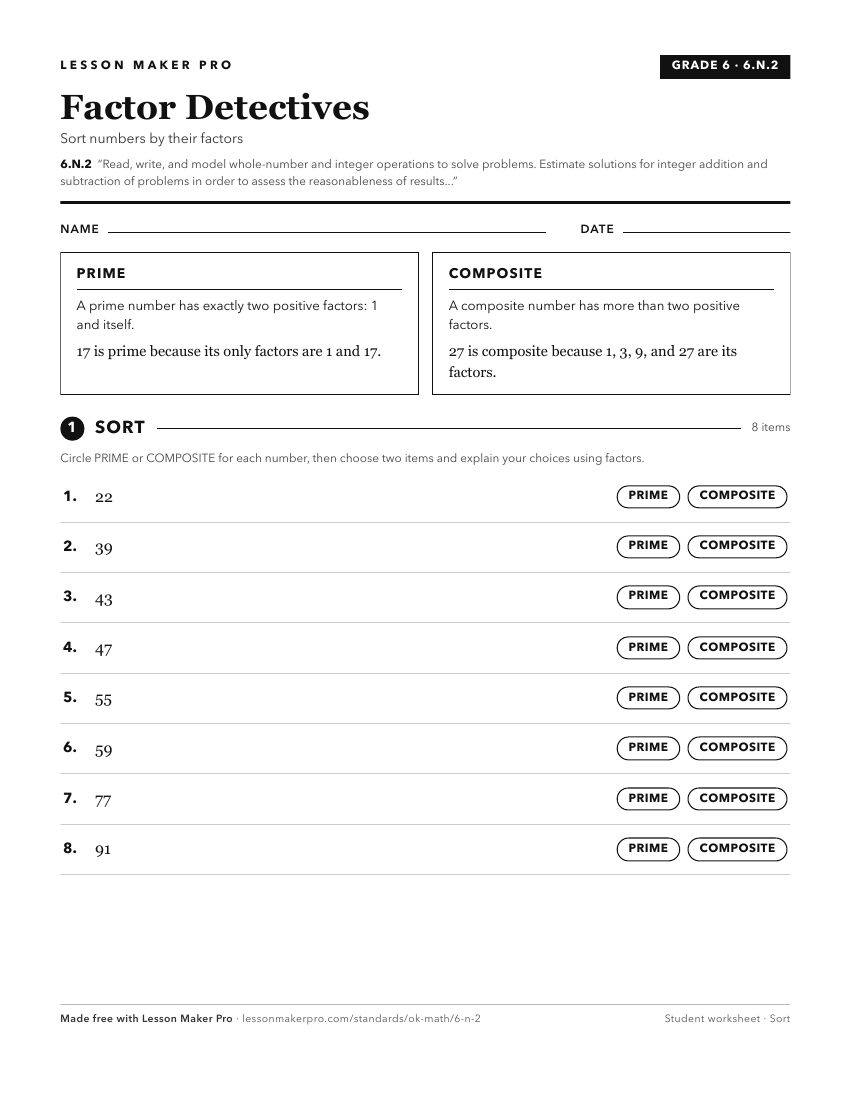
A ready-to-print activity worksheet aligned to 6.N.2, with an answer key for the teacher on its own page. No account needed.
PDF, US Letter, prints cleanly in black and white.
Download the worksheetKeep exploring
Related Standards
- PA.N.1
Read, write, compare, classify, and represent real numbers, and use them to solve problems in various contexts.
- 6.N.1
Read, write, and represent rational numbers expressed as integers, fractions, decimals, percents, and ratios; use these representations in real-world and mathem...
- 1.N.1.3
Read, write, discuss, and represent whole numbers up to 100. Representations may include numerals, words, addition and subtraction, pictures, tally marks, numbe...
- 5.N.2.4
Construct models to solve multi-digit whole number problems requiring addition, subtraction, multiplication, and division using various representations, includi...
Turn this cluster into a lesson
Grade, subject, topic, and the complete cluster are prefilled. Create one free, no account needed.
Also for this cluster:Make a WorksheetMake a QuizMake a Sub Lesson