Oklahoma Math PA.N.1
Standard Cluster
Read, write, compare, classify, and represent real numbers, and use them to solve problems in various contexts. Develop and apply the properties of integer exponents, including a⁰= 1 (with a ≠ 0), to generate equivalent numerical and algebraic expressions. Express and compare approximations of very large and very small numbers using scientific notation. Multiply and divide numbers expressed in scientific notation and express the answer in scientific notation. Compare and order real numbers; locate real numbers on a number line. Identify the square roots of perfect squares to 400 or, if it is not a perfect square root, locate it as an irrational number between two consecutive positive integers.
Oklahoma Academic Standards for Mathematics (2022)
Cluster contents
Standards in This Cluster
PA.N.1 is a cluster heading. These are the individual standards under it.
- PA.N.1.1
Develop and apply the properties of integer exponents, including a0= 1 (with a ≠ 0), to generate equivalent numerical and algebraic expressions.
- PA.N.1.2
Express and compare approximations of very large and very small numbers using scientific notation.
- PA.N.1.3
Multiply and divide numbers expressed in scientific notation and express the answer in scientific notation.
- PA.N.1.4
Compare and order real numbers; locate real numbers on a number line. Identify the square roots of perfect squares to 400 or, if it is not a perfect square root...
Teacher's field guide
What This Cluster Means
What Students Need to Do
- Students classify, compare, and place rational and irrational numbers on a number line. They find square roots of perfect squares through 400 and place other square roots between consecutive integers. They use exponent rules and scientific notation to rewrite, estimate, compare, multiply, and divide numbers.
What Mastery Looks Like
- A student knows √400 = 20 and places √18 between 4 and 5 as an irrational number. They simplify 5⁰ = 1 and x³ · x² = x⁵. They compare numbers in scientific notation and give products and quotients in proper scientific notation.
Common Misconceptions
- Students may treat 5⁰ as 0 or subtract exponents in the wrong order when dividing powers. They may call √18 rational because 4.24 is a decimal approximation. They may compare scientific notation using coefficients alone or leave an answer like 12 × 10⁵ unconverted.
How to Assess It
- Ask on an exit ticket: Between which two consecutive integers is √35, and is it rational or irrational? Explain using nearby perfect squares.
Lesson moves
Ways to Teach It
Give pairs cards labeled √16, √18, 4.3, and 9/2; have them place each on a taped number line and sort rational from irrational.
Ask, 'Why does 3⁰ equal 1 rather than 0?' Have students use 3³ ÷ 3³ to explain their answer.
Deal scientific notation cards; partners match (2 × 10⁴)(3 × 10⁻²) and (6 × 10⁵) ÷ (2 × 10²) with their answers.
Compare two bacteria lengths, 2 × 10⁻⁶ m and 5 × 10⁻⁷ m, then calculate how many times longer the first is.
Free download
Printable PA.N.1 Worksheet
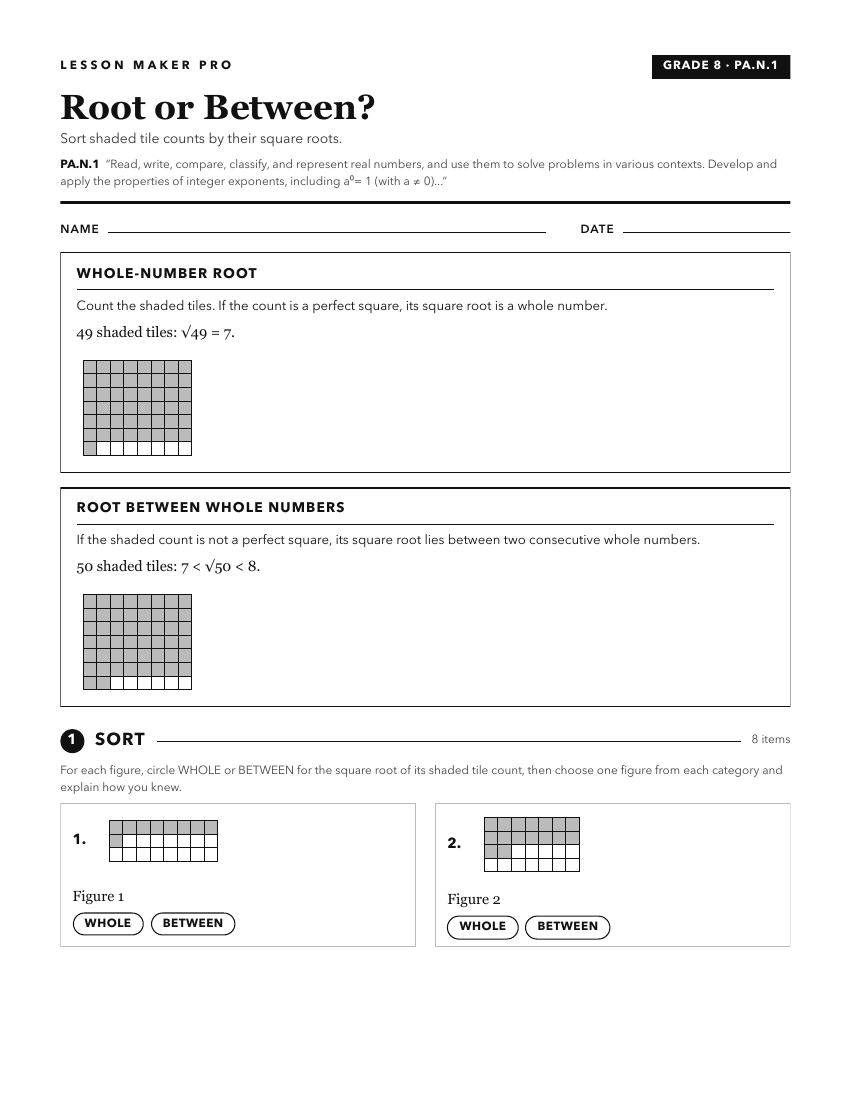
A ready-to-print activity worksheet aligned to PA.N.1, with an answer key for the teacher on its own page. No account needed.
PDF, US Letter, prints cleanly in black and white.
Download the worksheetKeep exploring
Related Standards
- 6.N.1
Read, write, and represent rational numbers expressed as integers, fractions, decimals, percents, and ratios; use these representations in real-world and mathem...
- 6.N.2
Read, write, and model whole number and integer operations to solve problems.
- 7.N.1
Read, write, represent, and compare rational numbers, expressed as integers, fractions, and decimals. Explain and apply the concept of absolute value.
- 5.N.1
Read, write, represent, and compare fractions and decimals; recognize and write equivalent fractions; convert between fractions and decimals; use fractions and ...
Turn this cluster into a lesson
Grade, subject, topic, and the complete cluster are prefilled. Create one free, no account needed.
Also for this cluster:Make a WorksheetMake a QuizMake a Sub Lesson