Oklahoma Math 6.N.1
Standard Cluster
Read, write, and represent rational numbers expressed as integers, fractions, decimals, percents, and ratios; use these representations in real-world and mathematical situations. Use manipulatives and models (e.g., number lines) to determine positive and negative numbers and their contexts, identify opposites, and explain the meaning of 0 (zero) in a variety of situations. Compare and order positive rational numbers, represented in various forms, or integers using the symbols "<", ">", and "=". Explain that a percent represents parts “out of 100” and ratios “to 100.” Determine equivalencies among fractions, mixed numbers, decimals, and percents.
Oklahoma Academic Standards for Mathematics (2022)
Cluster contents
Standards in This Cluster
6.N.1 is a cluster heading. These are the individual standards under it.
- 6.N.1.1
Use manipulatives and models (e.g., number lines) to determine positive and negative numbers and their contexts, identify opposites, and explain the meaning of ...
- 6.N.1.2
Compare and order positive rational numbers, represented in various forms, or integers using the symbols "<", ">", and "=".
- 6.N.1.3
Explain that a percent represents parts "out of 100" and ratios "to 100."
- 6.N.1.4
Determine equivalencies among fractions, mixed numbers, decimals, and percents.
Teacher's field guide
What This Cluster Means
What Students Need to Do
- Students read, write, and show numbers as integers, fractions, decimals, percents, and ratios. They place positive and negative numbers on a number line, name opposites, and explain what zero means in context. They match equivalent forms and compare positive numbers or integers using <, >, and =.
What Mastery Looks Like
- A student can place -3, 0, and 3 on a number line and explain them as account balances. They can match 1 1/4, 1.25, 125%, and 125:100. They can also show that 0.75 > 2/3.
Common Misconceptions
- Students may think -4 is greater than -2 because 4 is greater than 2. Some think zero always means nothing, even when it marks sea level. Others read 25% as 25 out of 10 or think 1/2 and 0.5 are different amounts.
How to Assess It
- Exit ticket: Mark -2, 0, and 2 as temperatures on a number line, name the opposites, and explain what zero means. Then write 1 1/4 as a decimal, percent, and ratio to 100, and fill in 1 1/4 __ 1.2.
Lesson moves
Ways to Teach It
Give pairs paper number lines and counters; have them place -3, 0, and 3 as account balances and point to opposites.
Ask, 'At sea level, what does zero mean, and why are -5 and 5 opposites?' Have students write two sentences.
Deal cards marked 1 1/4, 1.25, 125%, 125:100, and 1.2; partners sort them with < and =.
Show a store sign reading '25% off'; ask students to shade 25 squares on a hundred grid and write 25:100.
Free download
Printable 6.N.1 Worksheet
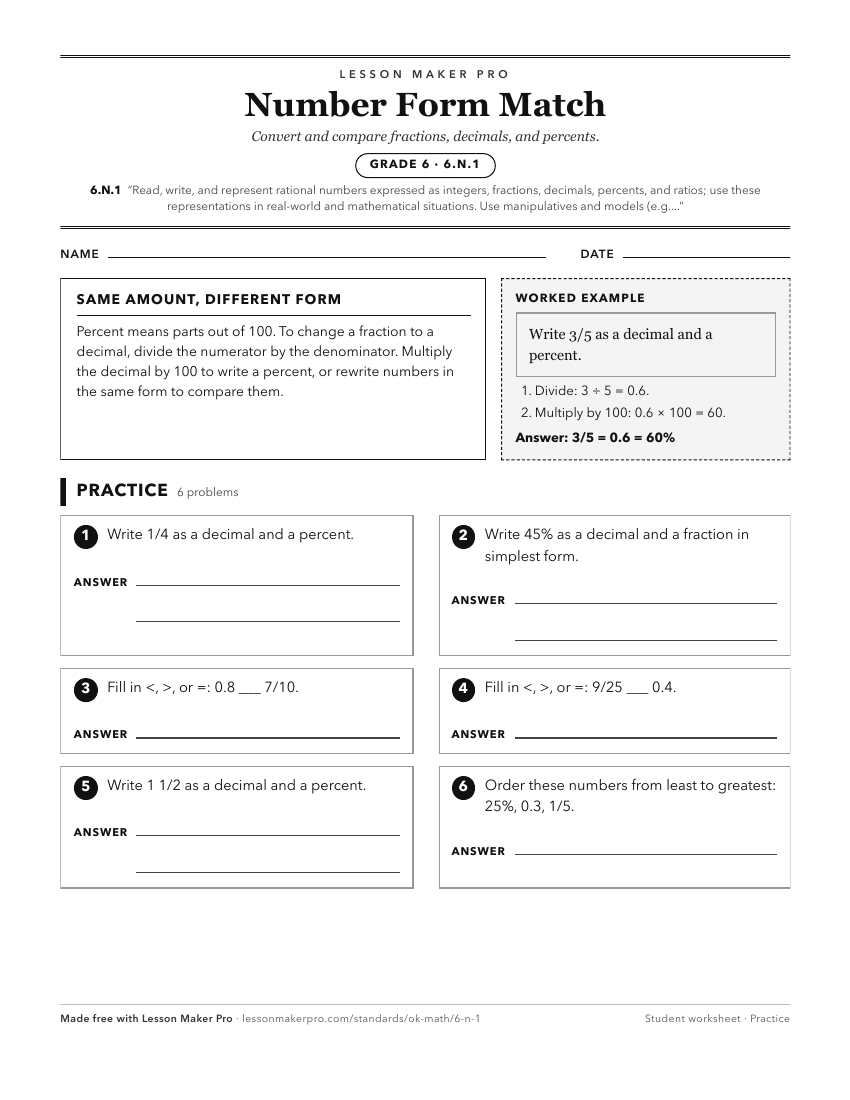
A ready-to-print activity worksheet aligned to 6.N.1, with an answer key for the teacher on its own page. No account needed.
PDF, US Letter, prints cleanly in black and white.
Download the worksheetKeep exploring
Related Standards
- 7.N.1
Read, write, represent, and compare rational numbers, expressed as integers, fractions, and decimals. Explain and apply the concept of absolute value.
- 5.N.1
Read, write, represent, and compare fractions and decimals; recognize and write equivalent fractions; convert between fractions and decimals; use fractions and ...
- PA.N.1
Read, write, compare, classify, and represent real numbers, and use them to solve problems in various contexts.
- 6.N.4
Multiply and divide decimals, fractions, and mixed numbers; solve real-world and mathematical problems with rational numbers.
Turn this cluster into a lesson
Grade, subject, topic, and the complete cluster are prefilled. Create one free, no account needed.
Also for this cluster:Make a WorksheetMake a QuizMake a Sub Lesson